SaaS Product Management and PLG: Best Practices for 2026
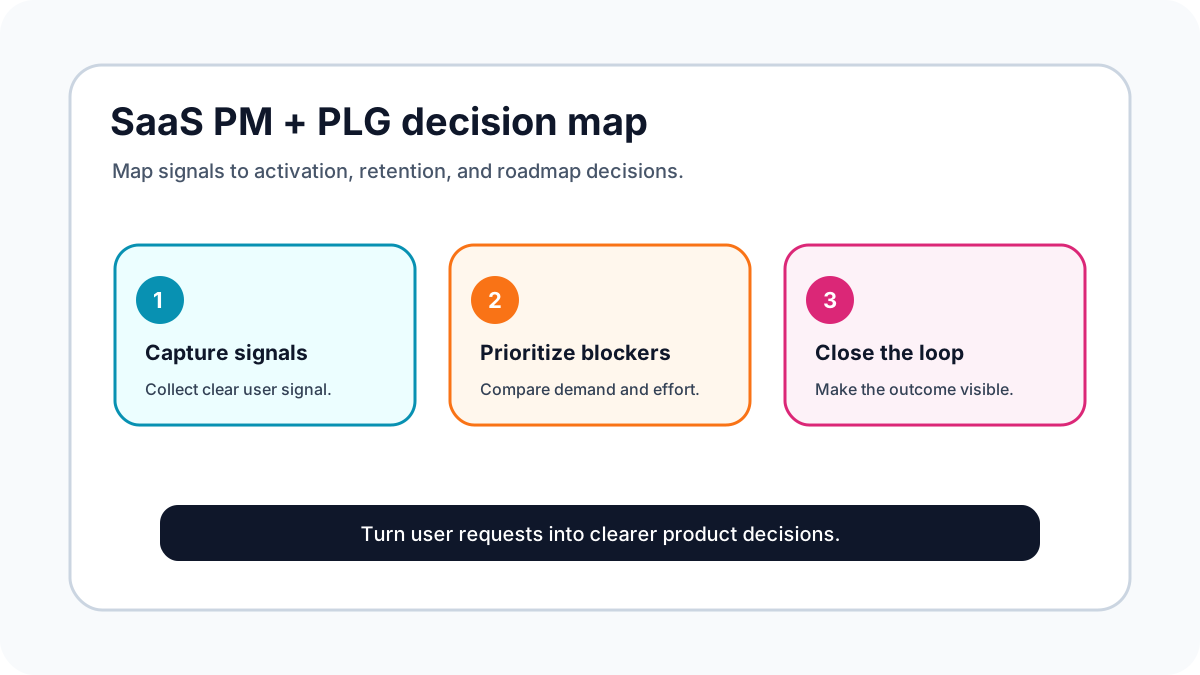
SaaS product management and PLG in 2026 are not about adding more dashboards, ceremonies, or AI summaries. They are about making the product itself easier to discover, adopt, evaluate, expand, and improve. A product-led growth motion only works when the product team can connect usage signals, customer feedback, onboarding friction, pricing questions, support patterns, and roadmap decisions into one operating loop.
The practical challenge is focus. Small SaaS teams now have more data than ever, but not always better decisions. Feature requests arrive through support, sales calls, communities, in-app messages, cancellation notes, onboarding sessions, and analytics tools. Product-led teams need a simple way to decide which signals matter, which requests deserve discovery, and which improvements will make users successful faster.
This guide gives a grounded 2026 playbook for SaaS product managers, founders, and growth teams. It avoids fake benchmark claims and vague “AI will change everything” advice. Instead, it focuses on habits you can run every week: define the activation path, collect feedback close to the moment of need, prioritize by customer outcome, communicate decisions, and keep the loop affordable enough that the team actually uses it.
Quick answer: what should SaaS teams do differently in 2026?
SaaS teams should treat product-led growth as an operating system, not a marketing slogan. The core loop is simple: help users reach value quickly, watch where they struggle, collect their requests in context, prioritize improvements by business and customer impact, ship smaller changes, then explain what changed.
That means product managers should spend less time defending a static roadmap and more time improving the system that produces roadmap decisions. Strong PLG teams tend to focus less on the number of feature ideas and more on identifying improvements that increase activation, reduce confusion, expand usage, or make the product easier to recommend.
A good minimum setup includes one activation metric, one feedback intake channel, one weekly triage habit, one prioritization model, and one public or semi-public way to close the loop with customers. If the process requires a full operations team before it works, it is too heavy for an early or lean SaaS business.
What PLG means for SaaS product management
Product-led growth means the product plays a central role in acquisition, activation, conversion, retention, and expansion. That does not mean sales, marketing, or customer success disappear. It means those teams need the product experience to carry more of the customer journey.
The <a href="https://www.pendo.io/glossary/product-led-growth/" rel="nofollow">Pendo glossary definition of product-led growth</a> describes PLG as a go-to-market approach where the product is central to acquisition, conversion, retention, and expansion. For product managers, that shifts the job from “manage features” to “manage the customer path to value.” A PLG product manager needs to understand signup intent, onboarding friction, empty states, upgrade moments, account collaboration, support pain, and repeated requests from users who are trying to do real work.
The mistake is treating PLG as a pricing page change or a free-trial checkbox. A free trial can create traffic, but it will not create growth if users cannot find the first useful action, understand the product’s promise, invite teammates, or trust that the product will keep improving. Product management owns much of that system.
If you need a lightweight way to collect product requests while users are already on your site, FeaturAsk gives you a feature request widget, voting, moderation, and request management for $29.95/year after a 30-day free trial with no credit card required. It is built for teams that need signal before they need an enterprise feedback suite.
Best practice 1: define the activation path before prioritizing features
A PLG roadmap starts with activation, not a backlog. Activation is the moment when a new user experiences enough value to continue. For a writing tool, it might be publishing a first draft. For an analytics tool, it might be connecting a data source and viewing a useful report. For a feature request platform, it might be installing the widget, receiving the first request, and seeing votes collect around an idea.
Product managers should define the activation path in plain language before ranking new features. What does the user need to believe? What action proves they reached value? What setup step creates the most friction? What missing context causes support tickets? What request keeps appearing from users who tried to activate but could not?
This prevents a common SaaS problem: building advanced features while the first-use experience still leaks users. In 2026, AI-assisted development makes it easier to ship more surface area, but it also makes it easier to overbuild around an unclear activation path. The product manager’s job is to keep the team honest about the path to value.
A practical weekly habit is to review new signups that did not activate. Compare analytics with feedback. If users stop at setup, the next product decision may be documentation, templates, defaults, sample data, or onboarding copy rather than a new feature. If activated users keep asking for the same workflow improvement, that request deserves stronger priority than a speculative idea from an internal brainstorming session.
Best practice 2: collect feedback where product intent is highest
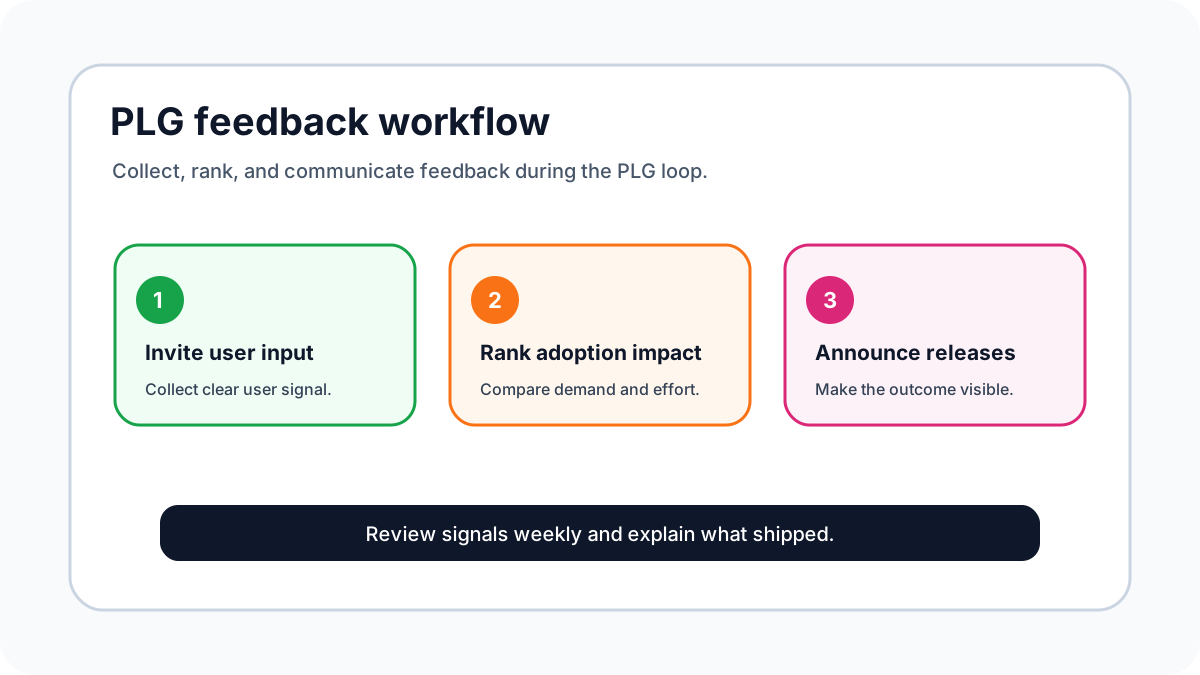
Feedback quality depends on timing. A generic quarterly survey can be useful, but the best product feedback often appears when a user is trying to complete a task and hits friction. That is why PLG teams should collect feedback near important product moments: onboarding, upgrade prompts, dashboards, integrations, exports, reports, collaboration flows, and cancellation pages.
The goal is not to interrupt every user. The goal is to make it easy for motivated users to explain what they wanted, what blocked them, and what outcome would have made the product more useful. A feedback board, in-app prompt, or website widget can capture this context before it disappears into a private support thread.
For more detail on designing an intake system, read FeaturAsk’s guide to customer feedback strategy. The same principle applies to SaaS PLG: ask for context, let other users validate demand, and keep the evidence visible enough that the team can act on it.
Best practice 3: separate demand, evidence, and commitment
A feature request is not a roadmap commitment. A vote is not a strategy. A sales objection is not automatically a product priority. Product-led teams need a shared language that separates demand, evidence, and commitment.
Demand means someone wants an outcome. Evidence means the team has enough context to understand whether the request is common, valuable, urgent, and aligned with the business. Commitment means the team has decided to invest time and communicate a planned direction. Mixing these stages creates confusion. Users think every accepted request will ship. Sales thinks every prospect objection belongs on the roadmap. Engineering sees a backlog full of half-understood ideas.
A healthier workflow uses statuses. “Under review” means the team is learning. “Planned” means the team has chosen a direction. “Shipped” means the improvement is live. “Not planned” means the request was considered and declined for a reason. Public or customer-visible statuses are powerful because they build trust without promising everything.
This is also where product managers should combine qualitative and quantitative signals. The <a href="https://www.nngroup.com/articles/analytics-user-experience/" rel="nofollow">Nielsen Norman Group notes that analytics can show what users do, while qualitative research helps explain why</a>. A PLG product team needs both. Usage data can show that users abandon a setup step. Comments and requests can explain what confused them.
Best practice 4: prioritize customer outcomes, not feature volume
A SaaS roadmap can look busy while the product barely improves. Product-led teams should prioritize outcomes: faster activation, higher completion of a core workflow, fewer support contacts for a repeated issue, more invited teammates, better retention for a target segment, or clearer upgrade value.
Frameworks such as RICE, impact-effort, MoSCoW, and opportunity scoring can help, but only if the inputs are honest. A feature with many votes from poor-fit users may matter less than a smaller request from ideal customers who are blocked from adopting the product. A retention fix may matter more than a flashy acquisition feature. A documentation or onboarding change may outperform a complex build.
Use a simple prioritization question: which decision would we make differently because of this signal? If the answer is unclear, the request needs more discovery. If the signal clearly affects activation, retention, expansion, or product quality for the right segment, it deserves attention.
Small teams should avoid turning prioritization into theater. Pick a few criteria and apply them consistently: customer fit, repeated demand, business impact, effort, confidence, and strategic alignment. Then publish the reasoning internally, and when appropriate, externally. A visible explanation reduces the “why did you build that?” problem that often appears in SaaS communities.
Best practice 5: make onboarding a product management responsibility
In PLG, onboarding is not a one-time growth experiment. It is part of the product. If users cannot understand the product’s promise, reach a useful first action, and recover from confusion, the rest of the roadmap has less leverage.
Product managers should review onboarding with the same seriousness as core features. Look at signup intent, empty states, sample content, default settings, first-run checklists, emails, help docs, and upgrade prompts. Ask whether each step helps the user reach value or merely explains the product’s internal structure.
Onboarding feedback is especially useful because it reveals language mismatches. Users may not describe the product the way the team does. They may ask for “approval flow” when they mean “I need my manager to see this before it goes live.” They may ask for “integration” when they mean “I do not want to copy data manually.” Preserving that language helps positioning, documentation, and roadmap decisions.
For SaaS teams that collect repeated onboarding requests, FeaturAsk’s guide to collecting in-app feedback is a useful companion. The product experience and the feedback experience should work together, not live in separate systems.
If your team is still collecting onboarding requests through scattered DMs, emails, and calls, try FeaturAsk free for 30 days. A simple request board can turn repeated onboarding friction into visible priorities without forcing a heavy product-ops rollout.
Best practice 6: use AI carefully inside the product loop
AI can help SaaS product managers summarize feedback, cluster themes, draft release notes, generate interview questions, and review support patterns. It should not substitute for judgment. The risk in 2026 is not that teams ignore AI. The risk is that they use AI to make weak evidence look organized.
A useful AI workflow starts with clean inputs. Capture the raw request, customer segment, user goal, related votes, support links, usage data, and status. Then use AI to summarize themes or suggest questions. Keep the original evidence available so the team can audit the summary. If the summary hides disagreement, removes customer language, or overstates certainty, it can mislead the roadmap.
The safest rule is this: use AI to speed up preparation, not to skip validation. Let AI draft a synthesis, but have a product owner check the source requests. Let AI propose categories, but let the team decide which categories match the product strategy. Let AI summarize release feedback, but verify it against actual adoption and support signals.
Best practice 7: close the loop after every meaningful decision
PLG depends on trust. Users are more likely to keep giving feedback when they see that the product team listens, clarifies, decides, and communicates. Closing the loop does not require long release notes for every small change. It requires enough visibility that users understand what happened.
When a request ships, link the update to the original problem. When a request is declined, explain the tradeoff if it is safe to do so. When the team needs more research, ask a follow-up question. When duplicates appear, merge them without deleting useful customer language. These small habits make the product feel alive.
Closing the loop also improves internal alignment. Support can point customers to a status instead of improvising. Sales can see whether a prospect request is planned or out of scope. Product can compare promised work with actual shipped work. Engineering can understand the customer problem behind a ticket.
This is why a lightweight board can outperform a private spreadsheet. The board keeps requests, votes, comments, statuses, and decisions connected. It becomes a shared memory for the product-led organization.
Best practice 8: keep the PLG stack simple until the process proves itself
Many SaaS teams buy complex tooling before they have a consistent habit. They add analytics, session replay, survey tools, roadmapping software, customer success platforms, and AI summarizers, but still lack a weekly decision rhythm. Tools cannot fix an unclear operating model.
A lean PLG stack starts with essentials: product analytics for behavior, a feedback board for requests, support data for pain, interviews for depth, and a regular review meeting. Add more tooling only when the team can explain what decision the tool improves.
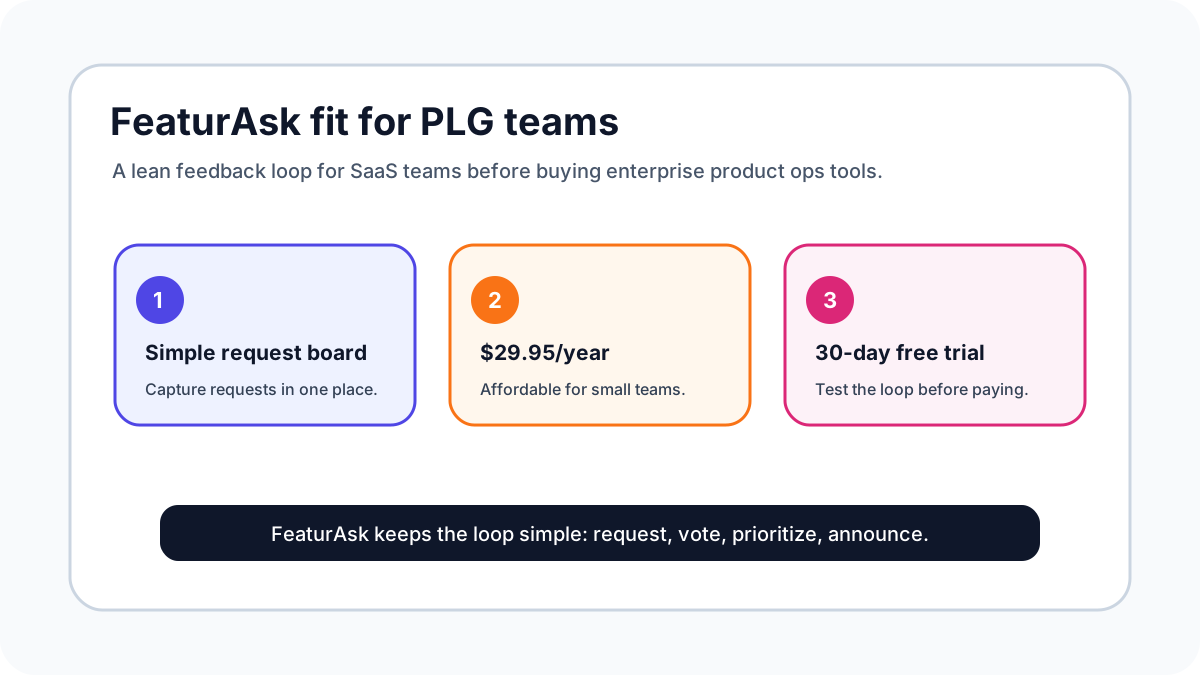
FeaturAsk fits the early and lean version of this stack. It is not trying to become every product operations platform. It gives small teams a focused way to collect feature requests, let users vote, manage ideas, and understand demand. At $29.95/year after a 30-day free trial with no credit card required, FeaturAsk makes the feedback loop affordable enough to test before committing to heavier systems.
A simple weekly PLG operating rhythm
Use this rhythm if your SaaS team needs a practical starting point:
- Review activation drop-off and support patterns from the past week.
- Read new feature requests and merge duplicates.
- Tag each request by segment, workflow, urgency, and likely business impact.
- Pick one unclear request and ask for more context.
- Pick one high-signal request and decide the next step: research, shape, ship, document, or decline.
- Update statuses so users and internal teams know what changed.
- Record one learning that should affect onboarding, positioning, pricing, or the roadmap.
This process can take 30 to 45 minutes for a small team. The point is not to create a perfect product council. The point is to keep product management connected to real user progress.
Common PLG mistakes to avoid
The first mistake is optimizing signup volume before activation. More users do not help if the product cannot deliver value quickly.
The second mistake is treating votes as commands. Votes reveal demand, but the team still needs strategy, customer fit, feasibility, and business judgment.
The third mistake is hiding decisions. If customers never see statuses or updates, they learn that feedback disappears.
The fourth mistake is copying enterprise PLG playbooks too early. A small SaaS team does not need every process used by a public company. It needs a clear loop it can maintain.
The fifth mistake is letting AI summaries erase customer language. Summaries are useful, but raw words often reveal positioning, onboarding, and trust problems that categories miss.
Bottom line
SaaS product management and PLG best practices for 2026 come down to one discipline: build a product loop that helps users reach value, captures friction at the right moment, turns repeated demand into decisions, and communicates what changed. Teams with a clear path from customer signal to product improvement are usually better positioned than teams that only maintain a large backlog.
Start small. Define activation. Collect feedback where intent is highest. Prioritize outcomes. Close the loop. Keep the process visible and affordable. If you want a simple place to begin, add FeaturAsk to your site and start collecting feature requests with voting, moderation, analytics, and a 30-day free trial. No credit card is required, and the annual plan is $29.95/year.
For related reading, see FeaturAsk’s guides to feature voting, customer feedback software, and feature request tools. Together, they give small SaaS teams a practical way to listen, prioritize, and build with more confidence.