Why User Feedback Is Crucial for SaaS Businesses
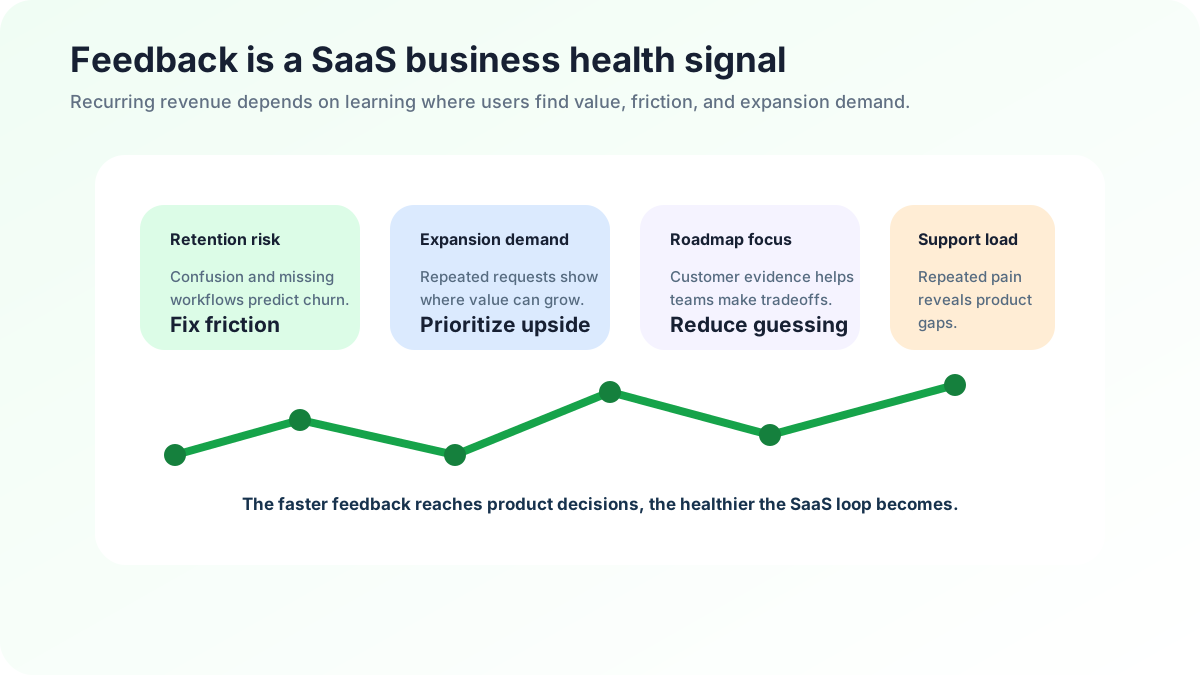
User feedback is crucial for SaaS businesses because subscription products are judged continuously. A customer does not make one purchase decision and disappear. They evaluate the product during trial, onboarding, daily use, support conversations, renewal reviews, expansion discussions, and budget cuts. Feedback shows where that recurring decision is becoming easier or harder.
Usage analytics can show what people did, but feedback explains what they expected, what confused them, and what they were trying to accomplish. Intercom’s customer feedback guidance makes the same distinction: feedback gives companies direct insight into customer needs and pain points (Intercom). Qualtrics frames customer feedback as a structured way to understand experiences and improve decisions across the customer journey (Qualtrics). For SaaS teams, that insight is operating infrastructure, not a nice-to-have survey project.
Related FeaturAsk reading: user feedback analysis, user feedback for SaaS, types of customer feedback, and customer feedback tools.
Feedback is the SaaS reality check
SaaS teams live inside their own product more than customers do. That creates blind spots. The team knows the intended workflow, the internal roadmap, and the reasons a feature behaves a certain way. Customers know whether the product helps them finish a job under real constraints. Feedback connects those worlds.
A customer who says onboarding felt confusing may be pointing to missing guidance, unclear terminology, a weak activation path, or a feature that does not match the promise made during sales. A customer who asks for an integration may be revealing where the product sits in a larger workflow. A churned account that says “we did not use it enough” may be describing an adoption problem long before renewal.
For SaaS teams that need a simple way to capture product requests and votes, FeaturAsk provides a focused feedback board for $29.95/year.
Retention starts before the cancellation reason
When a customer cancels, the most useful intervention may have passed. Feedback helps teams detect retention risk earlier. Repeated support questions, low-confidence onboarding comments, neutral satisfaction responses, and recurring feature requests from an important segment can all signal that value is not landing.
Retention feedback should be tied to lifecycle stage. Trial users reveal activation problems. New accounts reveal onboarding gaps. Mature customers reveal workflow depth and collaboration needs. Admins reveal reporting, permission, and procurement concerns. Churned customers reveal broken expectations. Blending all of that into one average score hides the differences that matter.
A practical retention loop asks three questions during review: Which feedback themes appeared before churn or nonrenewal? Which themes appear among healthy, expanding accounts? Which fixes could reduce support volume or increase adoption for the segment we care about most? The answers connect feedback to business outcomes.
Feedback improves roadmap focus
A SaaS roadmap is always crowded. Teams must choose between new features, reliability, onboarding, integrations, technical debt, pricing changes, and customer-specific requests. User feedback gives the team evidence about which work will change customer outcomes.
The best roadmap discussions connect each candidate to a customer problem. Who experienced it? How often does it appear? Which segment is affected? What happens if the team does nothing? What metric or behavior should improve if the work succeeds? These questions prevent the roadmap from becoming a list of internal preferences.
Feedback also reveals when the roadmap should not add a feature. Sometimes the fix is clearer copy, better defaults, a help article, an onboarding checklist, or a support macro. A disciplined feedback system classifies the problem before assigning the solution.
Segmentation makes feedback usable
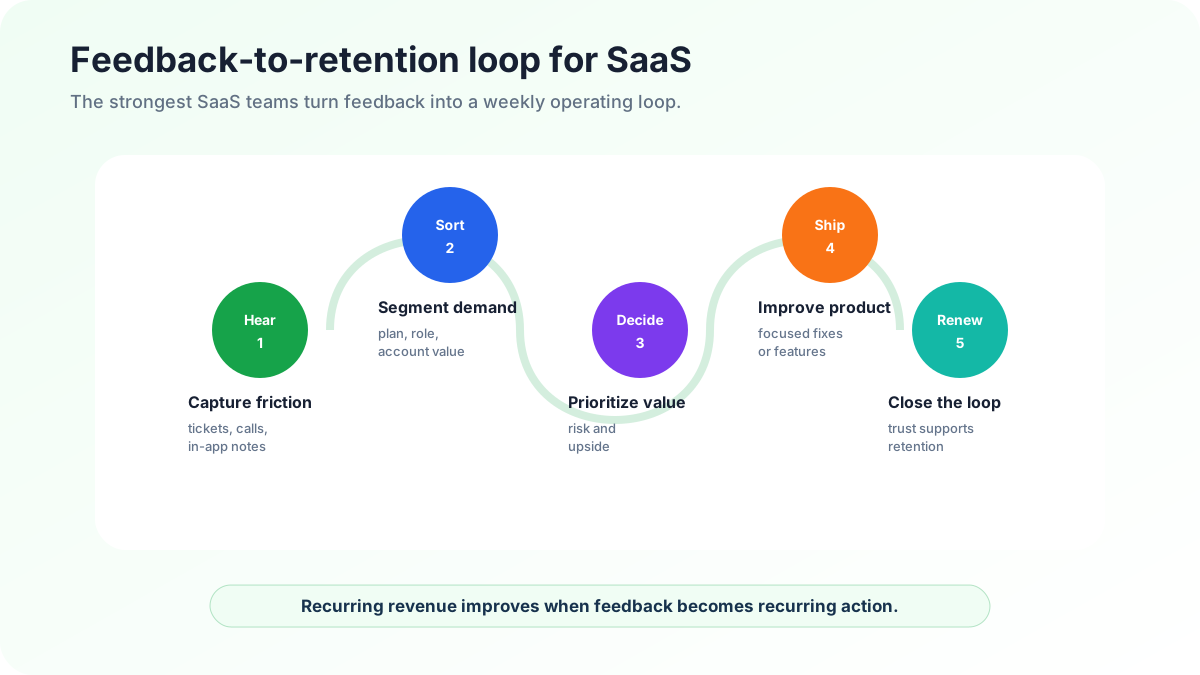
Not all feedback should carry the same weight. A request from a best-fit customer who uses the product daily may be more important than a request from a casual trial user outside the target market. A complaint from a new admin may indicate onboarding confusion, while the same complaint from a mature power user may indicate missing functionality.
Useful segmentation includes lifecycle stage, plan, role, company size, industry, use case, health score, and revenue impact. You do not need all of those fields on day one. Start with the attributes that influence your current decisions. If activation is the problem, lifecycle stage matters. If enterprise expansion is the problem, role, company size, and permission needs may matter more.
Segmentation also protects teams from the “average customer” trap. The average of a trial user, an admin, a power user, and a churned account is not a real person. Product decisions improve when the team knows which customer it is optimizing for.
Negative and neutral feedback are especially valuable
Positive feedback is useful because it identifies what to preserve and amplify. But negative and neutral feedback often identify the next improvement. A complaint shows friction. A confused question exposes unclear language. A neutral “it is fine” can reveal that the product works but does not create enough value to become habit.
The key is to respond without defensiveness. Thank the customer, clarify the use case, tag the theme, and decide whether the issue belongs in support, documentation, onboarding, roadmap review, or product discovery. If the team argues with feedback instead of investigating it, customers will stop sharing.
Salesforce’s research on connected customer expectations highlights that customers increasingly expect companies to understand their needs and personalize interactions (Salesforce). A SaaS feedback loop supports that expectation when the company can remember prior comments and respond with context.
Combine feedback with product metrics
Feedback becomes more powerful when paired with behavior. Activation data shows where users drop. Feedback explains why. Feature adoption data shows what people use. Feedback explains what they value or avoid. Support volume shows recurring questions. Feedback explains whether the issue is a bug, missing training, or a confusing workflow.
A good SaaS review might combine new feedback themes, churn reasons, support tags, activation funnels, expansion signals, and roadmap items. The team should look for alignment. If users request a feature and analytics show a drop-off in the related workflow, the theme deserves attention. If a heavily requested feature comes from a segment the company is not pursuing, the team may still decline it.
Build a feedback loop customers can see
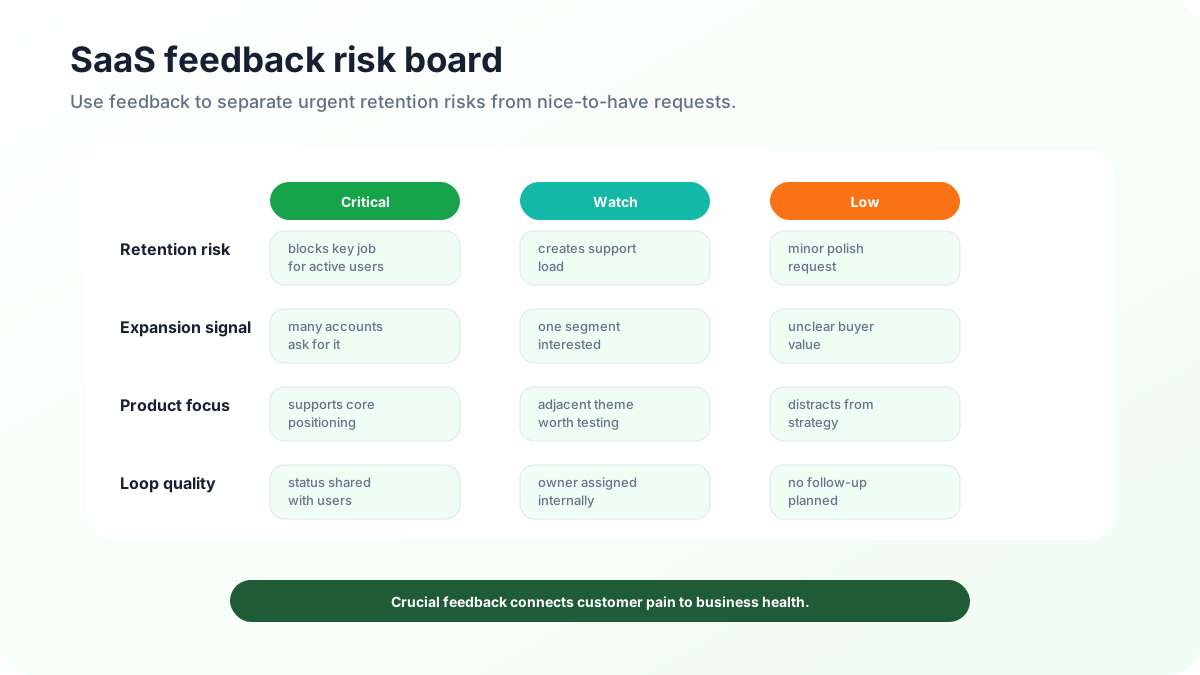
Collecting feedback privately is better than ignoring it, but visible loops build more trust. A public or semi-public board lets customers see existing requests, add votes, contribute use cases, and follow status. That reduces duplicate support conversations and makes the team’s listening habit observable.
Visible does not mean chaotic. The team can moderate submissions, merge duplicates, edit titles for clarity, and write short status notes. The board should explain how requests are evaluated: customer fit, severity, frequency, strategic alignment, and effort. Customers do not need full internal debates; they need confidence that decisions are not arbitrary.
To test that loop without a long procurement process, FeaturAsk offers a one month free trial with no credit card required and does not require a credit card.
Feedback supports product-market fit
Product-market fit is not a permanent badge. Markets change, competitors reset expectations, and customers mature. Feedback helps teams notice when the product’s value proposition is strengthening or drifting. If ideal customers keep asking for the same adjacent capability, the market may be pointing toward a larger job. If new users misunderstand a core feature, the product or positioning may need adjustment.
Feedback also reveals language. Customers describe outcomes in their own words. Those words can improve homepage copy, onboarding prompts, sales discovery, help articles, and release notes. A SaaS company that listens well does not only build better features; it explains the product in ways customers recognize.
A practical operating model
Start by choosing the business question. Are you trying to improve activation, reduce churn, prioritize roadmap work, increase expansion, or reduce support load? Then choose the feedback channels that match: onboarding prompts, cancellation surveys, support tags, customer interviews, in-app feedback, public request boards, or account reviews.
Next, create a review rhythm. Weekly is ideal for small teams with active feedback. Biweekly or monthly can work if volume is lower. During review, merge duplicates, tag themes, identify affected segments, assign owners, and write decision notes. Do not leave the meeting with “someone should look at this.” A feedback loop without ownership becomes a backlog of guilt.
Finally, close the loop. Tell customers when a request is shipped, when a workaround exists, when an idea needs more information, or when it is not aligned. The response does not have to be long. It has to be real.
Feedback across the SaaS lifecycle
During acquisition, feedback explains why prospects hesitate. They may not understand pricing, integrations, security, migration effort, or the difference between your product and an alternative. Those comments should inform website copy, sales enablement, and product packaging. They may also reveal features that are table stakes in a segment you want to enter.
During activation, feedback exposes the gap between signup and first value. New users may be unsure what to do first, which data to import, how to invite teammates, or how to evaluate success. A short in-app prompt or onboarding survey can reveal which step feels risky or unclear. Fixing that step may improve activation more than adding a new feature.
During retention, feedback helps teams understand daily usefulness. Mature accounts can identify slow workflows, missing collaboration features, reporting needs, and integration gaps. Churn-risk accounts can explain what value failed to become habit. Expansion-ready accounts can reveal which capabilities would help more teams adopt the product.
How feedback improves customer success
Customer success teams need more than health scores. They need the story behind the score. Feedback gives account managers concrete topics for business reviews: requests under consideration, recurring blockers, adoption wins, and issues already resolved. That context makes conversations more specific and reduces the chance that a client hears a generic script.
A shared feedback record also helps when account ownership changes. New teammates can see prior requests, decisions, workarounds, and shipped improvements. The customer does not have to rebuild the history from scratch. That continuity is part of the product experience, even though it happens outside the interface.
What to do with conflicting feedback
SaaS teams often receive contradictory requests. One customer wants more configuration; another wants fewer settings. One segment wants enterprise controls; another wants consumer-like simplicity. The answer is not to average the requests. The answer is to segment them and decide which product promise matters most.
Conflicting feedback can reveal that the product serves multiple jobs. It can also reveal that the team is attracting customers outside its intended market. In either case, the conflict is useful. It forces the company to clarify who the product is for, which workflows deserve depth, and where the product should intentionally remain simple.
Making feedback part of operating rhythm
Feedback should appear in regular business rituals. Product reviews should include top themes and evidence quality. Support reviews should include repeated issues and deflection opportunities. Customer-success meetings should include account-level requests and risk signals. Marketing reviews should include language from prospects and customers. When feedback lives only in a tool, it is easy to ignore; when it appears in operating meetings, it shapes decisions.
Feedback quality matters more than volume
A SaaS company does not need thousands of comments to make better decisions. It needs feedback with context. Ten specific comments from ideal customers about the same activation blocker may be more valuable than hundreds of generic survey responses. Quality improves when prompts are placed near the experience, when account context is attached, and when the team asks follow-up questions before jumping to solutions.
That is why the feedback process should reward clarity. Ask users what they were trying to accomplish, what they expected, what happened instead, and how important the issue is to their work. Those answers help the team separate curiosity from pain, preferences from blockers, and isolated opinions from recurring business impact.
Closing the loop after a decision
The last step is telling users what happened. If a request ships, notify the people who asked and explain the outcome in customer language. If the team chooses a workaround or documentation fix, share that too. If the request is declined, say why without blaming the customer. Closing the loop turns feedback from extraction into relationship building, and that relationship is central to SaaS renewal.
That message should be logged beside the original theme so future teammates can see the full path from signal to decision.
FAQ
Why is user feedback crucial for SaaS businesses?
Because SaaS depends on recurring value. Feedback reveals adoption friction, renewal risk, roadmap opportunities, and customer expectations before those signals become churn.
What feedback should SaaS teams collect first?
Start with onboarding friction, repeated support questions, churn reasons, feature requests from best-fit customers, and comments tied to activation or retention metrics.
How should SaaS teams combine feedback with metrics?
Use metrics to identify what happened and feedback to explain why. Together they show which product decisions may improve activation, retention, expansion, or support load.
Should SaaS teams build every highly requested feature?
No. Evaluate requests by customer fit, severity, frequency, strategy, effort, and confidence. Votes are useful evidence, not automatic roadmap instructions.
When feedback needs to become a visible product habit, FeaturAsk gives teams a focused place to collect, review, and update requests.