Why Ideas Matter: A Practical Guide to Customer-Led Product Momentum
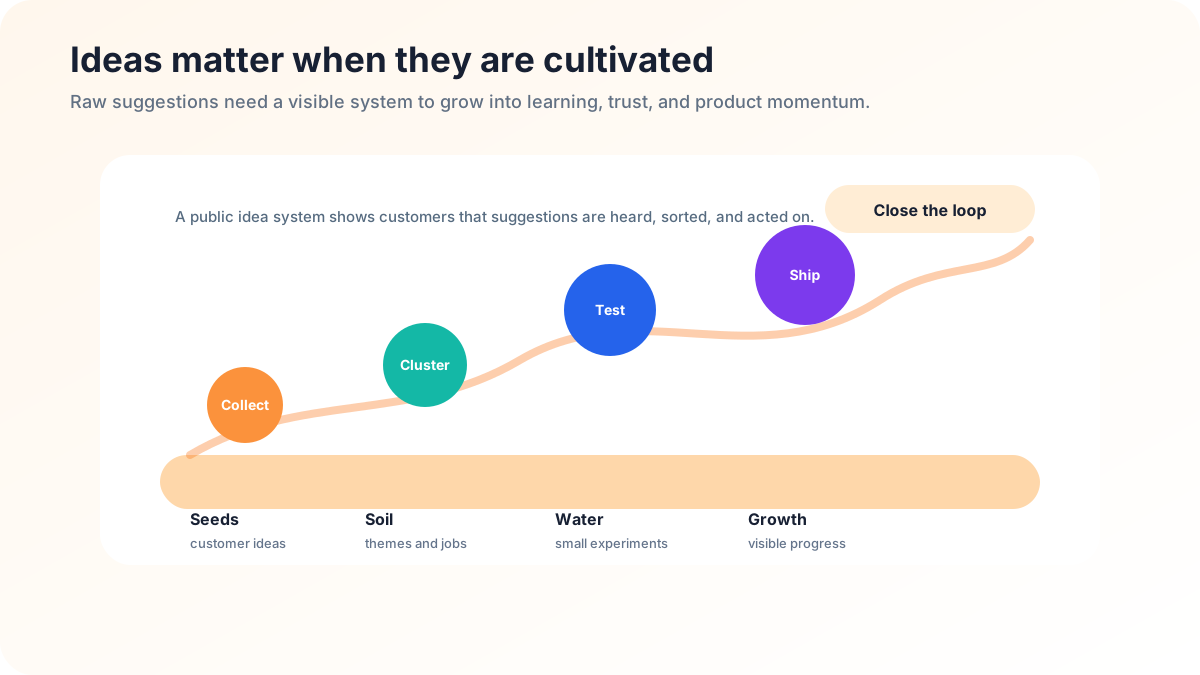
Ideas matter because they reveal how customers imagine the product helping them next. A suggestion is rarely a perfect roadmap instruction, but it is often a useful clue about a job, a workflow gap, a frustration, or a segment that sees the product differently than the team does. When ideas are captured and compared, they become product evidence. When they are ignored or scattered across private conversations, the team loses a source of market learning.
Product management guidance from Atlassian describes roadmaps as communication tools that connect direction, priorities, and outcomes (Atlassian). ProductPlan similarly frames roadmaps as strategic documents rather than feature lists (ProductPlan). Customer ideas fit that view when teams treat them as input to strategy, not as a queue of orders. The value is not “build everything customers ask for.” The value is learning which problems keep appearing and explaining what the team will do with that evidence.
Related FeaturAsk reading: user feedback for SaaS, using positive user feedback to validate product direction, feature request tracking, and feedback board software.
Ideas are signals, not commands
The fastest way to misuse customer ideas is to treat each request as a promise. A customer may ask for a particular integration, button, setting, report, or workflow. The exact proposal might be right, but it might also be a workaround for a deeper problem. The team’s job is to understand the problem before accepting the solution.
For example, “export to spreadsheet” may mean the customer needs offline reporting, finance approval, a backup workflow, or a way to combine product data with another system. “Add Slack alerts” may mean the team misses critical events, wants accountability, or needs visibility for stakeholders who never log in. The idea matters because it points to a job. Building the literal request without studying the job can create a feature that satisfies the words but misses the need.
This is why ideas need a place to land. FeaturAsk gives teams a public idea board for $29.95/year, helping customers submit requests, vote on existing ones, and see status updates instead of repeating the same suggestion in support threads.
Ideas reduce internal guessing
Every product team has internal pressure. Sales wants deals unblocked. Support wants repeated pain reduced. Engineering wants reliability work respected. Leadership wants strategic bets. Marketing wants a clearer story. Those perspectives are legitimate, but without customer evidence the loudest internal voice can dominate.
Customer ideas do not eliminate judgment; they improve it. They give the team examples, language, and patterns from the market. They reveal what customers expected the product to do, where the positioning created confusion, which workflows feel incomplete, and which segments are stretching the product into new use cases. Even a declined idea can teach the team that an expectation needs to be reset in onboarding or documentation.
Ideas also protect small teams from overbuilding in isolation. A founder may have a strong vision, but the market has details the founder cannot invent. A lightweight idea loop lets the team test whether the same needs appear across multiple accounts before committing scarce development time.
The difference between collecting and learning
Collecting ideas is easy. Learning from them requires structure. A messy inbox of suggestions becomes useful only when similar ideas are merged, customer segments are attached, problem statements are written, and decisions are recorded. Otherwise the team is just storing comments.
A good idea record should include the customer’s words, the suspected problem, affected segment, number of supporting accounts, links to related support conversations, current status, and a short decision note. That sounds more formal than it has to be. The key is consistency: future teammates should understand why an idea was considered, paused, planned, shipped, or declined.
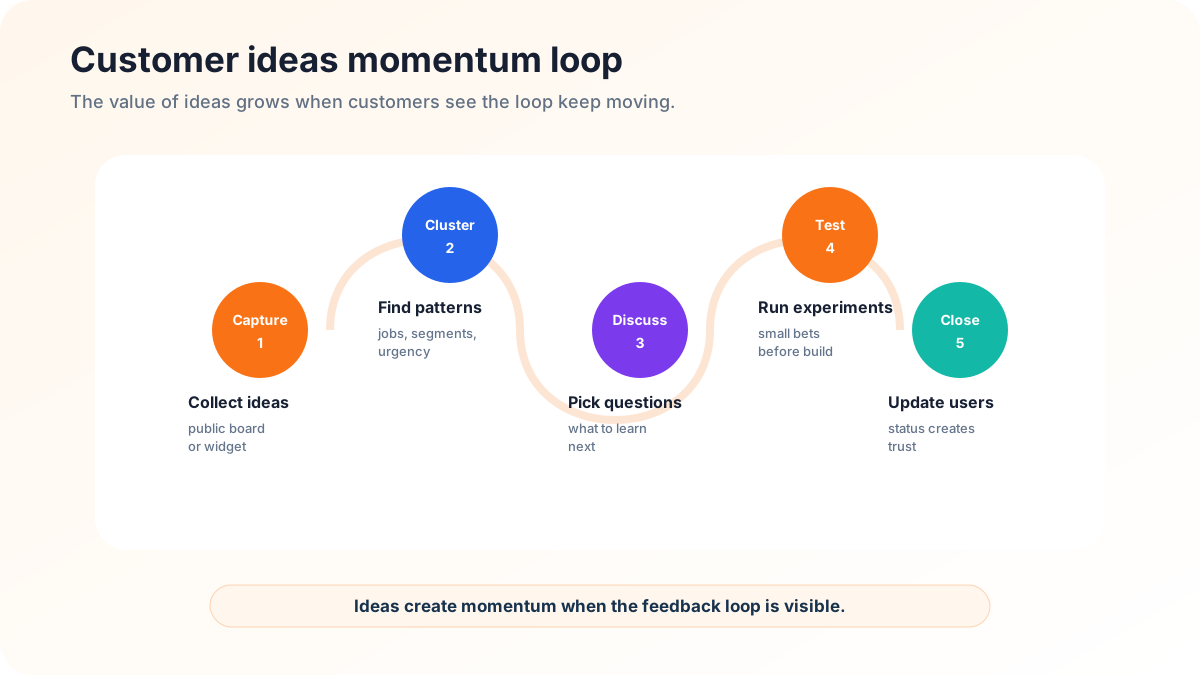
Learning also requires communicating back to customers. A visible status tells contributors the idea was received. A merge tells them their request is part of a broader pattern. A shipped update tells them the loop worked. A respectful decline tells them the team considered the request and made a product decision. Silence teaches the opposite lesson.
Why ideas matter for trust
When customers share ideas, they are investing attention in your product. They are saying, in effect, “I can imagine using this longer if it solved this problem.” That makes the response important. If the company asks for ideas and never acknowledges them, the request channel becomes a disappointment machine.
Trust does not require saying yes to everything. In fact, saying yes too easily can reduce trust if the team cannot deliver. Trust comes from an observable pattern: capture, clarify, merge, evaluate, update, and close the loop. Customers respect a clear “not now” more than an abandoned “planned” label. They respect a shipped status that mentions the original problem more than a generic release note.
This is especially important for SaaS because customers keep renewing their decision to use the product. Salesforce’s customer research notes that expectations for connected, responsive experiences continue to rise across business relationships (Salesforce). An idea loop is one visible way to show that the company listens across that relationship.
Evaluating ideas without becoming reactive
The fear of idea collection is real: teams worry that a public board will turn the roadmap into a popularity contest. That happens only when the team fails to publish decision criteria. Votes and comments should inform prioritization, but they should not replace product strategy.
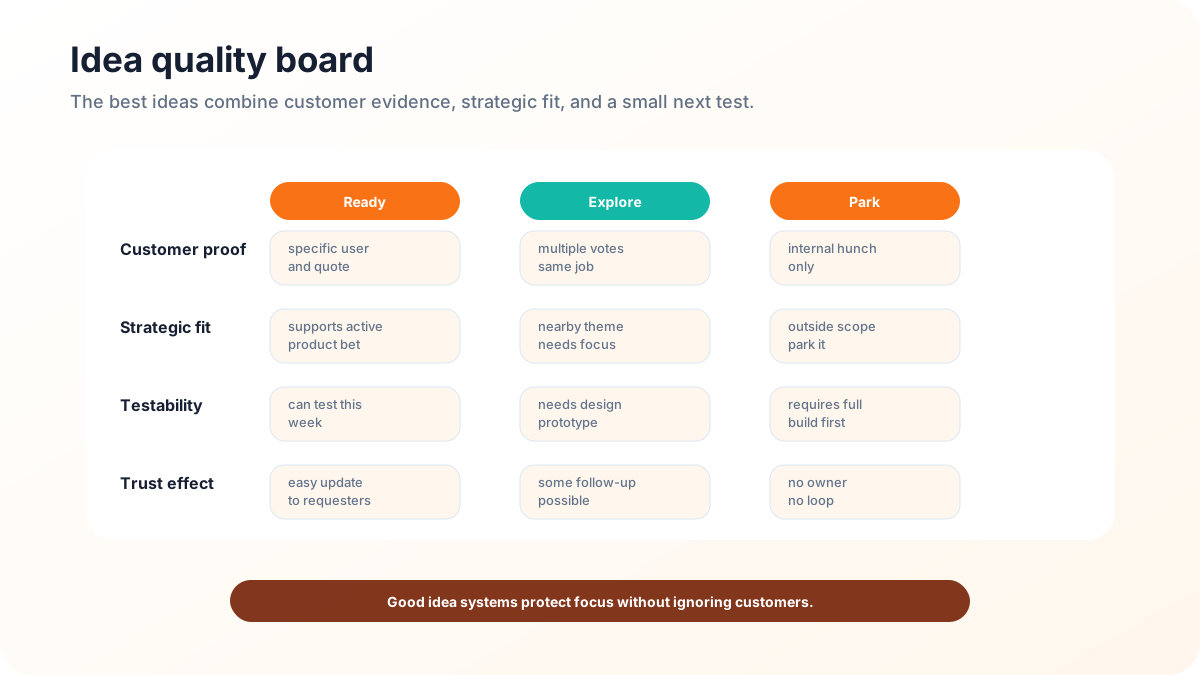
Evaluate each idea across five lenses. First, customer fit: who wants it, and are they the customers you are trying to serve? Second, problem severity: what breaks or slows down without it? Third, frequency: how many customers or opportunities show the same need? Fourth, strategic fit: does the idea strengthen the product’s direction or pull it sideways? Fifth, effort and confidence: how hard is it, and how sure are you that the proposed solution addresses the real problem?
This framework turns ideas into a discussion rather than a tally. A high-vote idea from the wrong segment may be declined. A low-vote idea from several high-fit customers may deserve discovery. A small copy change that resolves a repeated misunderstanding may beat a larger feature request. The point is to make the reasoning explicit.
Turning ideas into discovery
Many ideas should become questions before they become roadmap items. If customers ask for “advanced permissions,” interview a few of them about roles, risk, approval flows, and what they cannot safely do today. If they ask for “better reporting,” ask what decision the report supports. If they ask for “automation,” ask which manual step consumes time or creates errors.
Discovery does not need to be heavy. A few short interviews, comment threads on the idea, or follow-up emails can reveal whether the team understands the job. The public idea can remain open while discovery happens. That transparency keeps the conversation grounded and may attract more examples from customers with the same need.
Building an idea loop that survives
Start with a simple operating model. Create one public place for product ideas, one owner for weekly review, one status vocabulary, and one short explanation of how ideas are evaluated. Do not build a complicated taxonomy before customers submit real suggestions. Let the first month teach the categories.
During review, merge duplicates, clarify titles, tag themes, and write problem statements. Move obvious support questions out of the idea board. Move true product requests into review. If an idea is not aligned, explain why. If it needs more evidence, ask for examples. If it is planned, describe the problem the team intends to solve rather than promising every detail of the suggested solution.
The loop survives when expectations match capacity. If the team can review ideas every Friday, say that. If monthly review is realistic, say that instead. Customers do not need constant movement; they need honest movement. FeaturAsk supports that lightweight habit with a one month free trial and no credit card required, so teams can test the loop before committing.
The hidden value of customer language
Customer ideas also improve messaging. People often describe their needs in simpler words than the team uses internally. Save those words. They can sharpen onboarding checklists, pricing-page copy, help-center titles, release notes, and sales responses. Even if the idea is not built, the language may reveal how customers understand the product.
This matters because product-market fit is partly a language problem. A team may have the right feature but explain it in the wrong way. Repeated ideas can expose that gap. If many customers ask for something the product already does, the issue may be discoverability, naming, or education rather than functionality.
Ideas help teams say no with evidence
One underrated reason ideas matter is that they make refusal more principled. Without a record, saying no can sound arbitrary: the team simply did not feel like building something. With a record, the team can explain that an idea was reviewed, compared with related requests, evaluated against strategy, and declined for now. That explanation may not delight every customer, but it shows respect.
Evidence-based refusal also protects the roadmap. If a request keeps returning, the team can reopen the decision with new context instead of restarting from memory. If a different segment begins asking for the same outcome, the idea may become more important. If the product direction changes, previously declined ideas can be reconsidered. The record keeps the conversation from becoming personal.
How ideas connect to positioning
Customer ideas often reveal how people categorize the product. A team may think it sells a workflow tool, while customers request reporting because they see it as a system of record. A team may position around speed, while customers ask for approvals because they care about control. Those ideas are product feedback, but they are also positioning feedback.
This does not mean the team should chase every adjacent category. It means ideas should be read for market interpretation. What do customers believe the product is responsible for? What alternatives do they compare it with? Which words do they repeat when describing value? A strong product team shares those insights with marketing, sales, and customer success.
The role of votes and comments
Votes are useful because they reduce duplicate submissions and reveal visible demand. Comments are often more valuable because they explain the situation behind the vote. A vote says “me too.” A comment says “here is the workflow, risk, or outcome that matters.” Teams should encourage both, but should not treat all votes as equal.
Ask voters to add context when the idea is broad. “What would this help you do?” or “Which tool would this replace?” can turn a vague request into discovery evidence. If an idea has many votes but few comments, the team may need to investigate before committing. If an idea has fewer votes but rich comments from ideal customers, it may deserve more attention than the count suggests.
Keeping ideas from overwhelming the team
Idea systems fail when teams promise too much. Keep the intake broad enough that customers can share, but keep review rules narrow enough that the team can maintain the board. Archive stale items, merge aggressively, and decline ideas that do not fit. A smaller board with current statuses creates more trust than a giant board full of abandoned requests.
It also helps to define what belongs elsewhere. Support questions should become support tickets. Bugs should follow the bug process. Sales commitments should not be hidden as public ideas. A clean idea board is not a dumping ground; it is a decision space for product improvement.
Choosing the first ideas to act on
When several promising ideas compete, choose one that can teach the team quickly. A small improvement for a repeated workflow may be better than a large feature with uncertain adoption. Look for requests where the affected customers can explain the problem clearly, success can be measured, and the solution can be released in a contained way. That combination creates learning without consuming the entire roadmap.
After shipping, connect the release back to the idea. Tell voters what changed, what problem it solves, and where to try it. Then watch whether the original pain declines. An idea loop becomes more credible when customers see not only that something shipped, but that the team learned from the request and measured the result.
FAQ
Why do customer ideas matter if we cannot build all of them?
They reveal jobs, expectations, pain, customer language, and demand patterns. The team can learn from the evidence even when it declines the exact request.
How should teams avoid becoming reactive?
Publish decision criteria, segment ideas by customer fit, study the underlying problem, and treat votes as one signal among severity, strategy, effort, and confidence.
What makes an idea loop trustworthy?
A trustworthy loop captures ideas visibly, merges duplicates, uses clear statuses, explains decisions, and tells customers when a shipped improvement relates to their request.
What is the simplest next step?
Take ten recent ideas, rewrite each as a customer problem, merge duplicates, and decide which need clarification, which deserve review, and which should be declined with an explanation.
If your team is tired of losing ideas in chat threads and private notes, FeaturAsk keeps suggestions visible until someone makes a decision.