The 13 Best SaaS Product Management Books for Unlocking Success
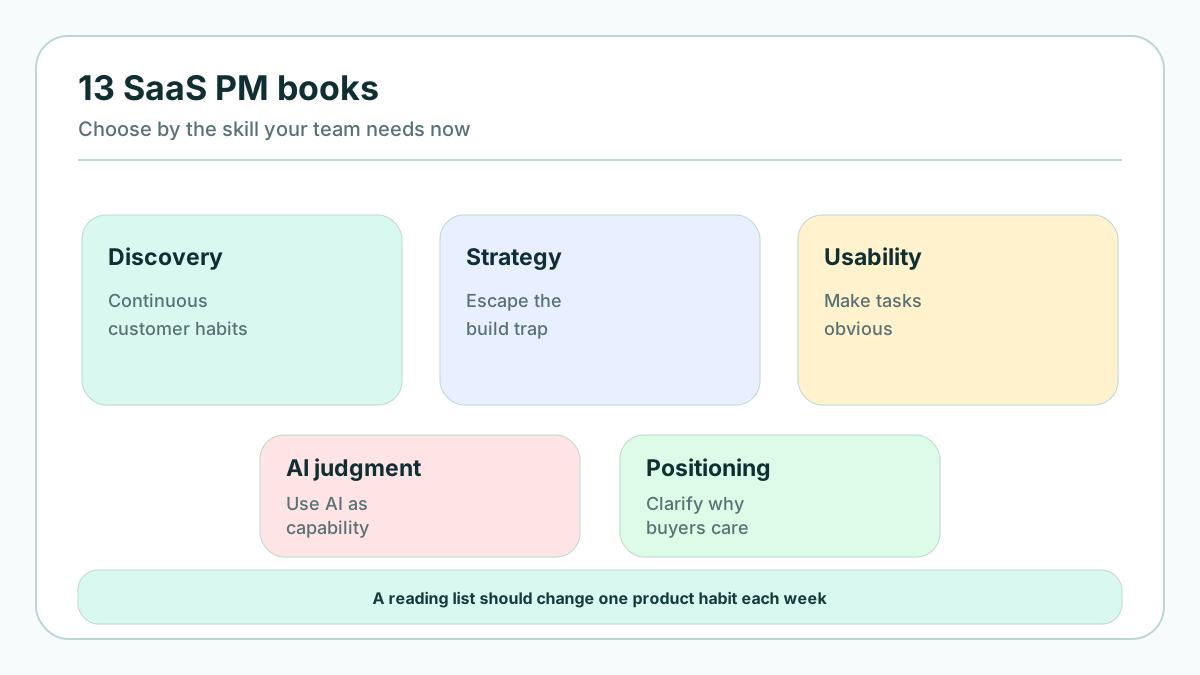
The best SaaS product management books do not replace customer conversations, support tickets, usage data, or product judgment. They give you language for problems you are already feeling: shipping output instead of outcomes, interviewing too late, designing for internal opinions, or treating a roadmap as a list of promises instead of a learning system.
This guide uses Frill's list as search-intent inspiration, but it is built for small SaaS teams that need practical reading choices, not a decorative bookshelf. For each book, you will find the main lesson, when it is most useful, and how to apply it. The goal is to choose the book that improves your next product decision.
If one of these books gives your team a feature hypothesis, use FeaturAsk to test whether users actually care. It has a 1 month free trial, no credit card required, and costs $29.95/year after the trial.
How to choose the right SaaS product management book
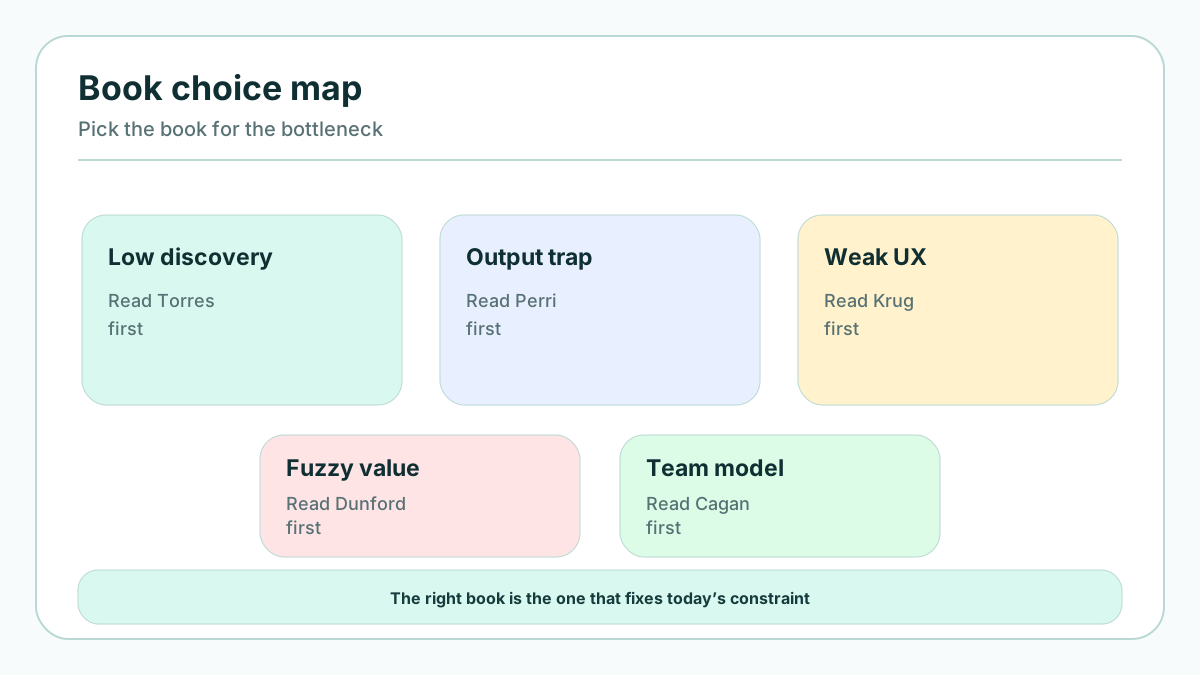
Start with the decision in front of you. If you are unsure what customers need, read discovery books. If your roadmap is crowded, read strategy books. If the team ships frequently but misses value, read books about outcomes, UX, and build traps. If growth makes leadership chaotic, read founder and operating books.
A useful reading system is simple: pick one book, connect it to one current product question, and decide what artifact should change. That artifact might be an interview script, roadmap filter, product brief, release checklist, or feedback board.
1. The AI-Powered Product Manager by Luis Jurado
AI is now part of the product manager's toolkit, but the trap is treating AI as a feature strategy by itself. The AI-Powered Product Manager is useful when your SaaS team wants to understand how generative AI, automation, and data-assisted workflows can improve product work without becoming gimmicks.
Read it when your team is asking, "Should we add AI?" The better question is, "Which customer workflow becomes faster, clearer, or more valuable because AI is involved?" Use the book to explore opportunity areas, then validate ideas with customer examples and risk checks. For small teams, the biggest benefit is using AI to summarize feedback, draft research plans, compare options, and expose weak assumptions before engineering time is spent.
2. Continuous Discovery Habits by Teresa Torres
Teresa Torres's Continuous Discovery Habits is practical because it turns discovery into a weekly habit. The opportunity-solution tree helps teams connect customer needs, possible solutions, and experiments instead of jumping from request to feature.
Read it when your roadmap is full of opinions but thin on evidence. Apply it by scheduling recurring customer touchpoints, capturing quotes in a shared place, and linking every major roadmap item to the opportunity it supports. The habit matters more than the diagram. When discovery is continuous, customer feedback becomes a product input instead of a launch-afterthought.
3. Escaping the Build Trap by Melissa Perri
Escaping the Build Trap is essential for SaaS teams that ship a lot but struggle to prove that shipping improves the business. Melissa Perri explains how organizations confuse features with value and how product management should connect strategy, outcomes, and execution.
Read it when your team celebrates release volume but cannot explain which customer behavior changed. A practical exercise is to review the last five shipped features and write the intended outcome for each one. If the outcome is vague, the team probably shipped a solution without a clear product bet. Pair this book with a tighter product management process so discovery, prioritization, delivery, and measurement stay connected.
4. The Lean Product Playbook by Dan Olsen
Dan Olsen's The Lean Product Playbook is a strong choice when you need a structured way to think through product-market fit. It covers target customers, underserved needs, value propositions, MVPs, prototypes, and testing.
Read it when you are creating a new SaaS product, entering a new segment, or trying to rescue a feature that is not gaining adoption. Its biggest value for small teams is discipline: define the customer and problem before debating scope. Instead of saying, "Let's build a dashboard," say, "Which underserved workflow are we improving, for which segment, and how will we know it worked?" That shift saves months of polished-but-unused work.
5. Sprint by Jake Knapp, John Zeratsky, and Braden Kowitz
Sprint gives teams a five-day format for moving from big problem to tested prototype. It is not the right process for every decision, but it is excellent when a team is stuck in circular debate or needs to de-risk a high-visibility idea quickly.
Read it before redesigning onboarding, testing a new activation flow, validating a packaging change, or exploring a risky workflow. The lesson for SaaS PMs is not that every problem should be solved in five days. The lesson is that alignment, prototyping, and customer reaction can happen much earlier than most teams allow. Even if you do not run the full sprint, borrow the decision map, prototype mindset, and user test cadence.
6. The Lean Startup by Eric Ries
Eric Ries's The Lean Startup popularized build-measure-learn, MVP thinking, and validated learning. Some examples feel startup-era specific, but the core principle still matters: product teams should learn as cheaply and quickly as possible before scaling an assumption.
Read it when your team is overbuilding the first version of an idea. For SaaS, the useful question is, "What is the smallest test that teaches us whether this problem is real?" Sometimes that is a prototype, sometimes a concierge workflow, sometimes a waitlist, and sometimes a feedback board where customers vote and explain the need. The book is most valuable when you treat MVPs as learning tools, not as excuses to ship low-quality product.
7. Inspired by Marty Cagan
Marty Cagan's Inspired describes how strong product teams operate: empowered, customer-focused, technically informed, and accountable for outcomes. It is especially useful for SaaS PMs moving from project coordination into real product leadership.
Read it when your organization treats product management as ticket writing. The book gives you language for product discovery, product strategy, team empowerment, and the difference between feature teams and product teams. For small SaaS companies, apply it carefully: you may not have every role Cagan describes, but you can still adopt the principle that product, design, and engineering should solve problems together instead of passing documents through a factory.
8. The AI Product Manager's Handbook by Irene Bratsis
The AI Product Manager's Handbook is a useful companion to AI strategy discussions because it focuses on building products that use AI responsibly and practically. It is most relevant when your SaaS team is considering AI-powered recommendations, summarization, search, classification, or automation.
Read it when you need to evaluate AI opportunities beyond excitement. Good AI product work includes data quality, user trust, explainability, workflow fit, privacy, and failure modes. A lightweight application is to add an "AI risk and value" section to product briefs: what user job improves, what data is required, what happens when the model is wrong, and how users stay in control.
9. The Hard Thing About Hard Things by Ben Horowitz
Ben Horowitz's The Hard Thing About Hard Things is not a product tactics book, but SaaS product leaders should read it because product decisions are often company decisions. Tradeoffs about focus, pricing, hiring, quality, and timing happen under pressure.
Read it when leadership feels messier than frameworks suggest. The book is valuable because it does not pretend there is always a clean playbook. For a PM or founder, the lesson is to communicate reality clearly, make decisions with incomplete information, and avoid hiding hard tradeoffs behind vague roadmap language. Customers and teams both trust clarity more than optimism.
10. Universal Principles of UX by Irene Pereyra
Universal Principles of UX gives product managers a broad vocabulary for usability, interaction design, perception, accessibility, and decision-making. SaaS PMs do not need to become full-time designers, but they do need enough UX literacy to avoid prioritizing features that make the product harder to use.
Read it when your product is powerful but customers struggle to reach value. Apply it by reviewing high-friction flows such as onboarding, empty states, settings, invitations, reports, and billing. Many retention problems look like missing features but are actually comprehension problems. Better UX can reduce support load, speed activation, and make existing functionality feel more valuable.
11. Product Management for Dummies by Brian Lawley and Pamela Schure
Product Management for Dummies is a useful baseline for new PMs, founders doing product work for the first time, or cross-functional teammates who need a shared vocabulary. It covers lifecycle thinking, market research, roadmaps, competitive analysis, requirements, launches, and stakeholder management.
Read it when your team lacks common definitions. In early SaaS companies, people often use the same words differently: roadmap, requirement, strategy, release, beta, validation, and priority. A beginner-friendly reference can reduce confusion. The important move is to translate generic product management language into your company's actual operating system, including how you collect requests, decide priorities, and communicate changes.
12. Don't Make Me Think, Revisited by Steve Krug
Steve Krug's Don't Make Me Think, Revisited remains relevant because SaaS products still lose customers through avoidable confusion. The book's core idea is simple: users should not have to decode your interface to get value.
Read it before redesigning navigation, onboarding, forms, dashboards, or permission flows. Then run quick usability tests with real users or prospects. Watch where they hesitate, misread labels, ignore calls to action, or fail to recover from errors. The book pairs well with public-facing launch work because even a valuable feature can underperform if users do not understand it; see the related workflow in successfully announcing product updates.
13. The Mom Test by Rob Fitzpatrick
Rob Fitzpatrick's The Mom Test earns the added thirteenth spot because SaaS teams often collect misleading feedback. Customers are polite, prospects speculate, and friends say ideas sound good. The book teaches you to ask questions that reveal real behavior instead of fishing for compliments.
Read it before customer interviews, win-loss calls, churn research, or founder-led sales. Replace "Would you use this?" with questions about the last time the customer experienced the problem, what they tried, what they paid for, and what happened when they ignored it. This is especially useful for small SaaS teams because a few bad interviews can send a tiny roadmap in the wrong direction.
A practical reading order for small SaaS teams
If you are new to product management, start with Product Management for Dummies, then read Inspired for the shape of strong product work. If your team is pre-product-market fit or exploring a new segment, read The Mom Test, Continuous Discovery Habits, and The Lean Product Playbook. If you ship too many low-impact features, read Escaping the Build Trap and The Lean Startup. If the problem is usability or adoption, read Don't Make Me Think and Universal Principles of UX. If you are navigating leadership pressure, add The Hard Thing About Hard Things.
For AI-related product work, read the two AI books after you understand the customer's workflow. AI should amplify a valuable job, not disguise an unclear one. A product team that has not defined the user problem will not be saved by a model, prompt, or automation layer.
Turn reading into operating practice
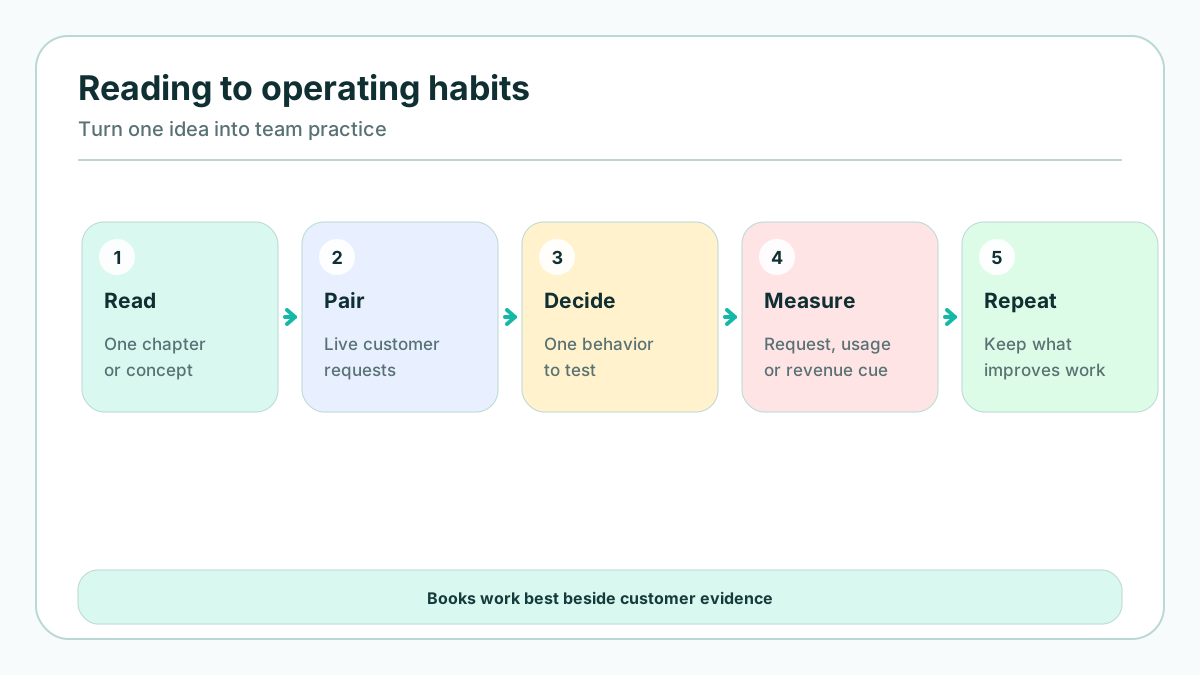
Books become valuable when they change team rituals. After reading a chapter, ask four questions: what assumption did this challenge, which current roadmap item does it affect, what customer evidence do we need, and what decision will we make differently? Capture the answer near the work, not in a forgotten notes document.
You can also turn each book into a one-week experiment. After The Mom Test, rewrite your interview script. After Continuous Discovery Habits, schedule three customer conversations. After Escaping the Build Trap, add outcome statements to the roadmap. After Don't Make Me Think, run a usability test on your highest-friction flow. After Sprint, prototype the riskiest part of a new idea before writing production tickets.
When reading creates multiple possible product bets, FeaturAsk helps small SaaS teams collect, organize, and prioritize user feedback without a heavy suite. The first 30 days are free, no credit card required, and the plan is $29.95/year.
Where books fall short
Books are generalized. Your customers are specific. A framework that worked for a marketplace, enterprise platform, or venture-backed consumer product may not apply cleanly to a bootstrapped B2B SaaS tool. Treat each book as a lens, not an instruction manual.
The missing ingredient is local evidence: support conversations, churn reasons, sales objections, usage analytics, and customer votes. Before adopting a book's advice, check whether it matches your segment, pricing model, buying process, and product maturity. A public roadmap, for example, needs different detail depending on whether customers want broad direction, exact delivery dates, or simply confidence that their feedback was heard. For more context, compare roadmapping basics and product strategy examples.
Conclusion
The 13 best SaaS product management books are not a checklist for looking well read. They are tools for making better decisions: discovering real problems, choosing sharper strategy, designing clearer experiences, and avoiding feature work that does not create value.
Choose one book, apply it to one live product question, and test the lesson with customers. If the discussion turns into a set of competing feature ideas, FeaturAsk gives your users a simple place to vote, comment, and show what matters most during a free first month with no credit card required.