The 11 Expert Steps in the Product Management Process
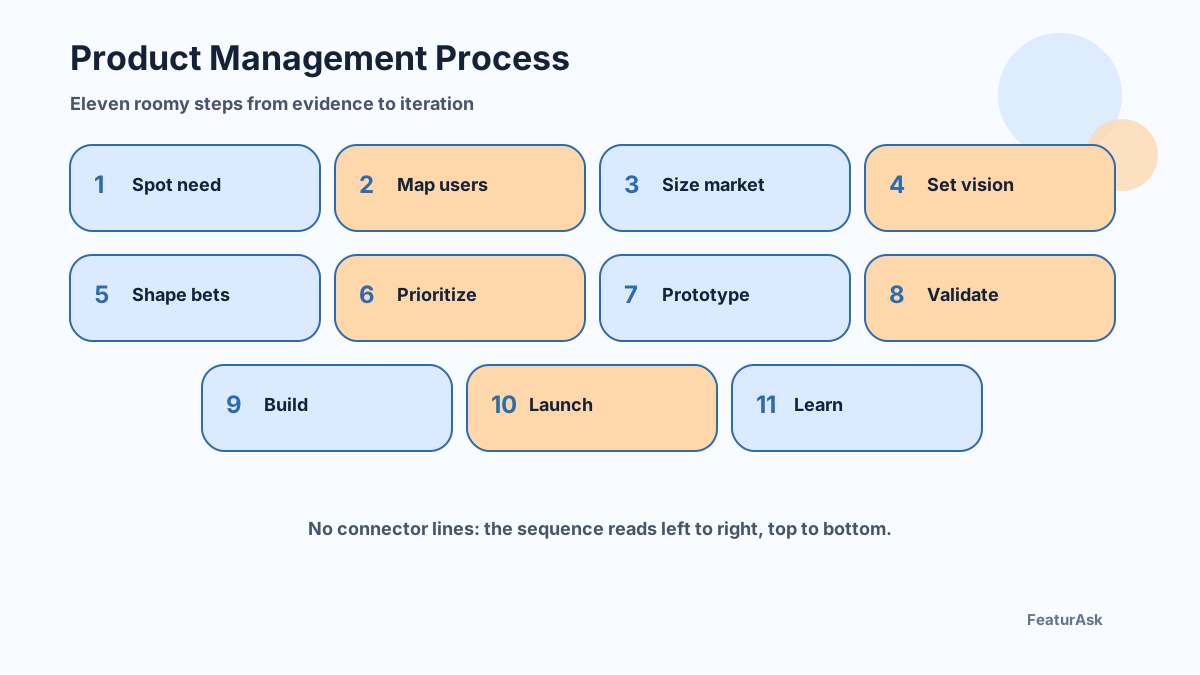
A strong product management process is not a ceremony collection. It is the operating system that helps a team decide which customer problems deserve attention, what to build next, how to launch it, and how to learn after it reaches real users. The process should reduce confusion, not create extra meetings.
For a small SaaS team, the best process is lightweight, visible, and customer-backed. You need a way to capture feedback, compare requests, write small specs, sequence work, communicate changes, and keep learning. You do not need a giant governance framework to make better product decisions. You need one clear loop that turns customer evidence into roadmap choices.
This guide lays out 11 steps. The extra step matters: before you reopen the roadmap, you should close the loop with customers. That single habit improves trust, reduces repeated support tickets, and makes future feedback better because users can see that their input is handled seriously.
If your current process lives across spreadsheets, chat threads, and forgotten support notes, consider starting with a public feedback hub. You can try FeaturAsk for one month free with no credit card and keep it if the simple $29.95/year plan fits your team.
1. Capture ideas and feedback in one place
The process starts when customer signals enter the system. Those signals may come from support tickets, sales calls, churn notes, usability tests, roadmap comments, community posts, analytics, or direct feature requests. The biggest mistake is letting each channel become a separate mini-backlog.
Create one intake point where requests can be stored, tagged, merged, and connected to customer context. A feedback board works well because users can submit requests, vote, comment, and see what already exists. Internal teams should be able to add requests too, but they should include the source and the customer problem rather than only the solution someone suggested.
Good intake is not about collecting infinite ideas. It is about making demand visible enough to compare. Add fields such as customer segment, revenue impact, workflow affected, urgency, and evidence type. When the same request appears repeatedly, merge duplicates and preserve the comments. That gives product managers a cleaner view of demand without erasing nuance.
2. Separate problems from solutions
Customers usually describe the change they want, not the root problem. A request for a new export format may really be a reporting workflow problem. A request for permissions may be a compliance or collaboration issue. A request for a dashboard may be a visibility problem that could be solved in several ways.
Before prioritization, rewrite the request as a problem statement. Who is affected? What are they trying to do? What fails today? How often does it happen? What is the cost of ignoring it? This step prevents teams from blindly building the first suggested solution.
Use interviews, support examples, and product usage data to test the problem. The Nielsen Norman Group continues to emphasize that direct user observation and research reduce design risk because teams see behavior rather than relying on opinion alone. A few focused conversations can save weeks of unnecessary development.
3. Group opportunities by theme
Once raw feedback is cleaned up, group it into themes such as onboarding friction, admin controls, reporting, integrations, performance, billing, collaboration, or mobile usage. Themes make prioritization easier because they reveal strategic patterns. Ten small requests may point to one large workflow gap.
Theme grouping also helps stakeholders understand why a roadmap contains certain bets. Instead of defending a random feature, you can say, “We are improving onboarding because new accounts are taking too long to reach first value, and these requests all connect to that bottleneck.” That story is easier to support than a disconnected list.
Keep themes flexible. They should help you understand demand, not become permanent departments. Review them monthly and archive themes that no longer matter.
4. Prioritize with transparent criteria
Prioritization is where a product management process either earns trust or becomes political. Pick a simple scoring model and publish the criteria. Common inputs include customer impact, strategic fit, revenue or retention potential, reach, confidence, effort, and risk.
Avoid false precision. A score of 74 versus 76 is rarely meaningful. The point is to force conversation about trade-offs. Why does one opportunity matter more? What evidence supports it? What would we not build if we choose this? Who needs to be informed?
ProductPlan’s roadmap guidance and Atlassian’s agile planning resources both stress that roadmaps work best when they communicate outcomes and priorities rather than a rigid promise list. Your scoring model should support that behavior.
5. Write a small product brief
Before a feature enters delivery, write a brief. It should include the problem, audience, evidence, goal, non-goals, success metric, constraints, launch considerations, and open questions. Keep it short enough that people read it.
A good brief prevents scope creep. It gives design, engineering, marketing, support, and leadership a shared artifact. It also creates a decision record. If someone asks why a feature looks a certain way three months later, the brief explains the context.
For small teams, the brief may be one page. The goal is not documentation theater; the goal is shared thinking.
6. Turn the brief into a roadmap slice
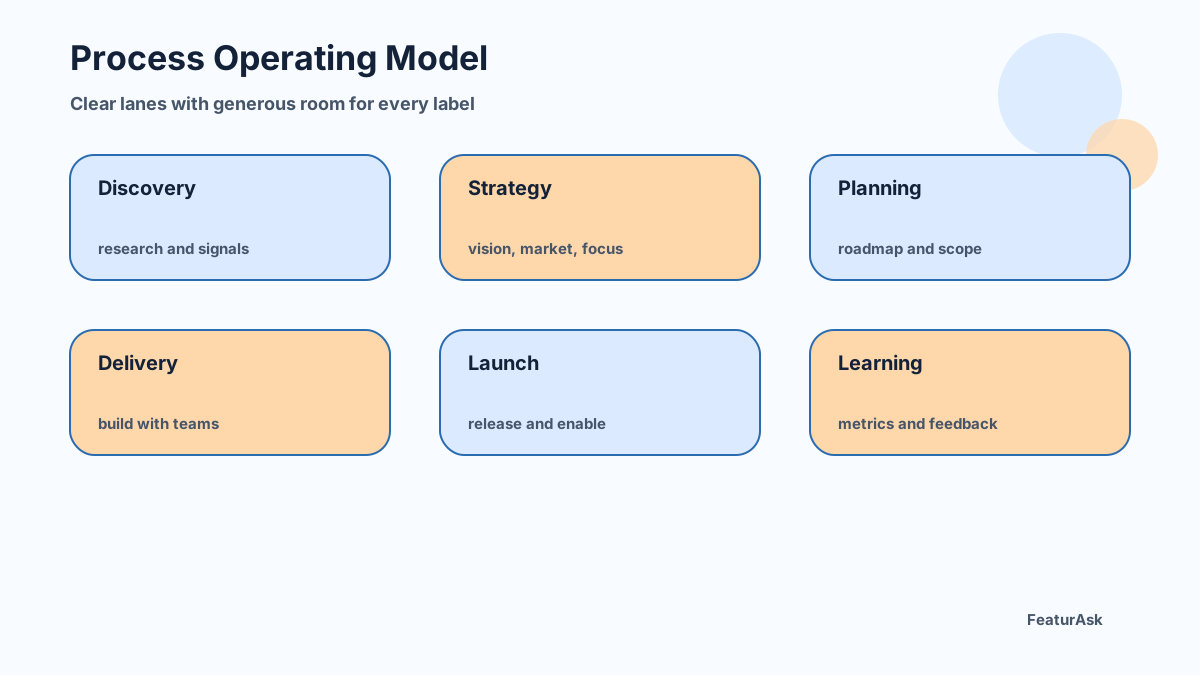
A roadmap slice translates the brief into a visible plan. Use a now, next, later format when dates are uncertain. Use dates only when the team has real delivery confidence or a market event requires them. Each item should include the customer problem, expected outcome, and current status.
This is where a public or customer-facing roadmap can help. Customers do not need every engineering detail, but they appreciate knowing whether a request is under consideration, planned, in progress, or released. Transparency reduces duplicate questions and improves trust.
If you need a practical starting point, launch a FeaturAsk roadmap and feedback board with one month free, no credit card required. The annual plan is $29.95/year, which keeps the feedback loop affordable for bootstrapped teams.
7. Define the smallest useful release
Product teams often overbuild because they confuse a complete vision with a useful first release. Define the smallest version that solves the core problem for a real segment. Remove nice-to-have options until the scope is small enough to learn quickly.
Ask: What must be true for a user to get value? What can wait? What would make this unsafe or confusing? What support documentation is required? What analytics event or feedback prompt will show whether the release works?
The smallest useful release is not a low-quality release. It is a focused release. Quality, accessibility, security, and clarity still matter.
8. Build with continuous clarification
During delivery, product management shifts from decision framing to clarification. Engineers and designers will find edge cases. Support may surface related customer concerns. Leadership may ask about timing. The product manager or product owner must keep trade-offs aligned with the original problem.
Hold short check-ins around decisions, not status theater. Update the brief when important choices change. Keep acceptance criteria clear. If the team discovers that the problem is larger than expected, decide whether to narrow scope, split the release, or stop.
9. Launch with customer context
A launch is not finished when code is merged. Users need to understand what changed, why it matters, and how to use it. Prepare release notes, help content, internal enablement, and customer messaging before the final scramble.
Tie the launch back to the feedback that inspired it. Mention the use case, not just the feature name. If customers voted for or commented on the request, notify them. This is one of the easiest ways to prove that feedback is not disappearing into a black box.
10. Measure adoption and outcomes
After launch, compare actual behavior with the success metric from the brief. Look at activation, usage depth, retention, support tickets, qualitative comments, and any relevant revenue or expansion signals. Do not declare victory just because the release shipped.
The best teams combine quantitative and qualitative evidence. Analytics can show whether people used the feature; comments explain why they did or did not. The 2024 DORA research program also continues to connect strong software delivery performance with fast feedback and learning cultures, which is exactly what product teams need after launch.
11. Close the loop and refresh the roadmap
The final step is closing the loop. Tell customers what happened to their request. Thank contributors. Explain if the shipped solution differs from the original suggestion. If the idea was rejected or deferred, say why in respectful language.
Then refresh the roadmap. Archive stale items, update scores, merge duplicates, and use launch learning to reprioritize. The product management process becomes a loop rather than a queue.
A practical weekly rhythm
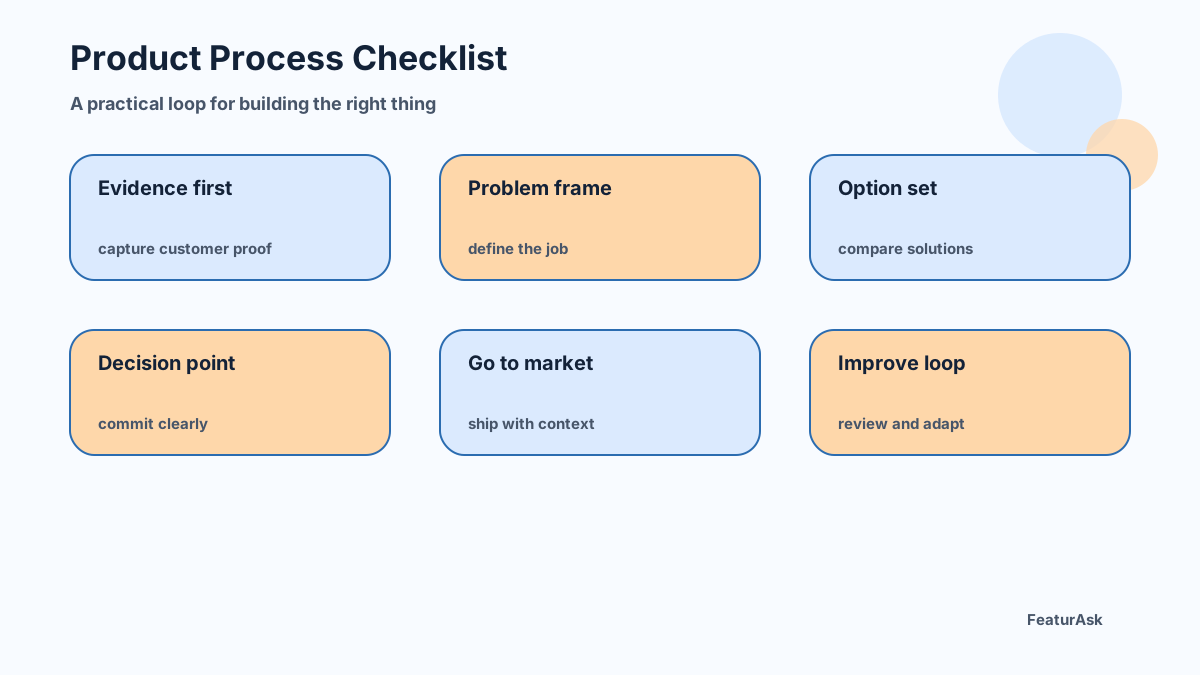
A lightweight weekly rhythm keeps this process alive. On Monday, triage new feedback. On Tuesday, review top opportunities and clarify evidence. Midweek, refine briefs for items near delivery. At the end of the week, update roadmap statuses and close any loops from releases.
Monthly, review themes and metrics. Quarterly, revisit strategy. The cadence should be predictable enough for stakeholders but flexible enough for learning.
Common process mistakes
The first mistake is treating the backlog as a promise. A backlog is an inventory of possibilities, not a contract. The second mistake is measuring output only. Shipping ten features does not matter if customers still cannot complete the job. The third mistake is hiding decisions. When customers and internal teams cannot see what changed, trust erodes.
The fourth mistake is separating feedback from roadmapping. Feedback without prioritization becomes noise. Roadmapping without feedback becomes guesswork. The process works when both live together.
How this process scales without becoming heavy
The same 11-step loop works when a team grows, but the artifacts become a little more explicit. A founder-led product team may keep prioritization in a short weekly note. A larger team may need a monthly product council, a shared scoring model, and separate roadmap views for executives, customer-facing teams, and engineering. The principle stays the same: every view should trace back to customer evidence and strategic intent.
When multiple squads share one product, add ownership boundaries. One person should own intake hygiene. Each area owner should review themes for their domain. A product leader should resolve conflicts across domains, especially when one team’s roadmap depends on another team’s platform work. Without this layer, local optimization can make the whole product feel inconsistent.
Scaling also requires better communication. A roadmap item should not change status silently. If a planned item moves back to discovery, explain why. If a release is split into phases, describe the customer value in each phase. The more people depend on the roadmap, the more important decision history becomes.
A simple product process scorecard
Review the health of your process once a month. Ask whether new feedback is triaged within a reasonable time, whether top roadmap items have clear problem statements, whether each planned feature has a success metric, whether customers are notified after relevant releases, and whether stale items are archived. These questions reveal operational debt before it becomes cultural debt.
You can also track cycle indicators: average time from request to first review, percentage of roadmap items linked to customer evidence, percentage of releases with adoption measurement, and percentage of released features with a customer-facing update. These are not vanity metrics. They show whether your product operating system is actually being used.
Keep the scorecard lightweight. The goal is not to punish teams for messy reality. The goal is to notice where the loop breaks and repair that part deliberately.
Useful references
Helpful external references include the Nielsen Norman Group research methods overview, Atlassian guidance on product roadmaps, ProductPlan roadmap resources, and the DORA research program. For deeper follow-up, pair this guide with FeaturAsk resources on feedback board software, customer feedback tools, and feature request software.
A product management process should make better decisions easier. Start with one feedback home, one prioritization model, one roadmap, and one habit of closing the loop. If you want that system without enterprise overhead, try FeaturAsk free for one month with no credit card. It stays simple at $29.95/year when you are ready to keep it.