What Is Roadmapping? Definition, Examples, and Exercises
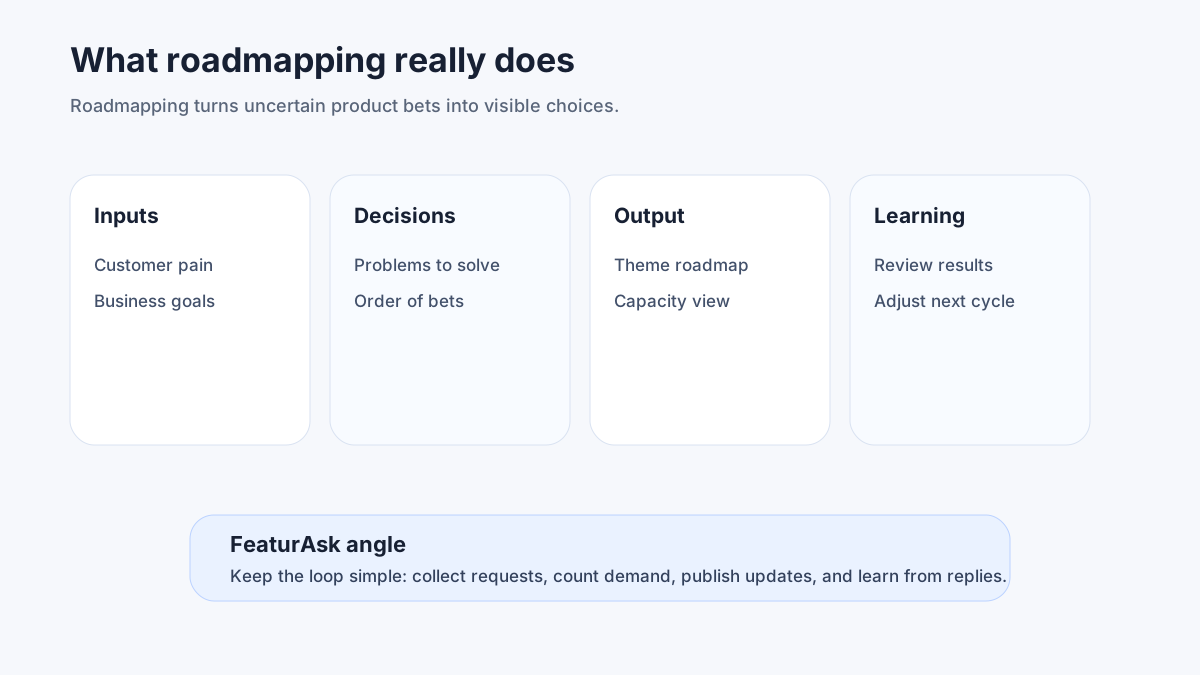
Roadmapping is the process of turning strategy, evidence, constraints, and stakeholder input into a clear plan for how a product, team, or business will move forward. In product management, roadmapping usually means deciding which customer problems to solve next, sequencing the work, communicating the direction, and updating the plan as new information arrives.
A roadmap is the artifact people see. Roadmapping is the thinking and collaboration that make the artifact useful.
That distinction matters. A roadmap can look polished and still be weak if it is only a list of features. Good roadmapping connects customer pain, company goals, product vision, technical reality, and communication. It helps teams answer three practical questions: where are we going, why does that direction matter, and what tradeoffs are we making?
This guide explains roadmapping in plain language, shows how it differs from product strategy, gives you a seven-step process, walks through examples, and includes team exercises. It is written for SaaS teams, founders, product managers, and anyone who needs a roadmap that is trusted rather than merely presented.
If you want to collect feature requests and turn the strongest ideas into a public roadmap, FeaturAsk gives you a 1 month free trial with no credit card required and simple $29.95/year pricing.
What is roadmapping?
Roadmapping is a structured planning practice. It gathers inputs, compares opportunities, chooses priorities, sequences work, and communicates progress. The output can be a product roadmap, technology roadmap, marketing roadmap, operations roadmap, or company roadmap. In SaaS, the most common version is a product roadmap that shows what the team is considering, planning, building, and shipping.
Roadmapping is not the same as brainstorming. Brainstorming creates options. Roadmapping chooses among options. It is also not the same as project management. Project management coordinates execution once decisions have been made. Roadmapping sits between strategy and execution.
A healthy roadmapping process includes five ingredients.
First, it starts with a goal. The team should know whether the roadmap is meant to improve activation, reduce churn, expand into a new segment, increase reliability, support sales, simplify onboarding, or strengthen a core workflow.
Second, it uses evidence. Customer feedback, analytics, revenue signals, support tickets, market research, and technical constraints all matter.
Third, it makes tradeoffs visible. A roadmap that says yes to everything is not a roadmap. It is a backlog with nicer formatting.
Fourth, it communicates uncertainty. The further out the roadmap goes, the less precise it should be. This is why many modern teams use Now, Next, Later instead of fixed dates.
Fifth, it gets reviewed. Roadmapping is not a quarterly ceremony that everyone forgets. It is a loop.
The ProductPlan guide to product roadmaps describes a roadmap as a high-level visual summary of product direction. Atlassian also describes product roadmaps as shared plans for communicating priorities, progress, and strategy in its guide to product roadmaps.
Roadmapping versus product strategy
Product strategy explains the game you are trying to win. Roadmapping explains the path you will take next.
Strategy defines the target customer, the problem space, the product position, the business model, the differentiators, and the outcomes that matter. Roadmapping translates those choices into priority themes, initiatives, releases, experiments, and communication.
For example, a strategy might say: “We will help early-stage B2B SaaS teams build customer-led products without hiring a full product operations team.” A roadmap might then include feedback intake improvements, voting workflows, public roadmap statuses, release note automation, and lightweight customer segmentation.
When teams confuse strategy with roadmapping, two problems appear. If strategy is missing, the roadmap becomes reactive. Every request looks equally plausible because there is no higher-level filter. If the roadmap is missing, strategy becomes abstract. People agree with the direction but do not know what should happen next.
Use strategy to decide what kind of opportunities belong on the table. Use roadmapping to choose, sequence, and communicate the opportunities you will pursue.
The seven-step roadmapping process
Step 1. Gather and analyze customer feedback
Start by collecting feedback from places where customers already speak: in-app widgets, support conversations, sales calls, success reviews, churn surveys, review sites, community threads, and direct interviews. The goal is not to copy every request into the roadmap. The goal is to understand recurring pain.
Tag feedback by product area, user segment, company size, plan type, pain level, frequency, and business relevance. Then merge duplicates. Ten separate requests for “export improvements” may actually represent three different needs: finance reporting, migration, and internal compliance.
A centralized feedback system saves roadmapping time because the evidence is already organized when planning begins. For a deeper workflow, read our guide to feature request management.
Step 2. Define the product vision and objectives
Before choosing roadmap items, clarify the product vision and the planning objective. A vision gives long-term direction. Objectives define what success should look like during the next planning period.
Objectives should be concrete enough to guide tradeoffs. “Improve onboarding” is better than “make the product better.” “Increase new workspace activation by helping teams invite colleagues and publish their first roadmap item faster” is even better.
This step prevents the roadmap from becoming a popularity contest. The team can ask whether a request supports the current objective, supports the long-term vision, or should wait.
Step 3. Identify and prioritize opportunities
Turn raw feedback into opportunity statements. Instead of “build Slack integration,” write “teams want to receive feedback and roadmap status updates where they already collaborate.” This opens multiple solution paths and keeps the discussion focused on user value.
Prioritize opportunities using a framework such as RICE, ICE, value-versus-effort, MoSCoW, or opportunity scoring. The framework matters less than the discipline of comparing items consistently. Include customer impact, business impact, effort, confidence, risk, and strategic fit.
Do not let scoring hide judgment. A high score with weak evidence should trigger discovery, not automatic implementation. A low-glamor platform item may deserve priority if it protects reliability.
Step 4. Create the roadmap
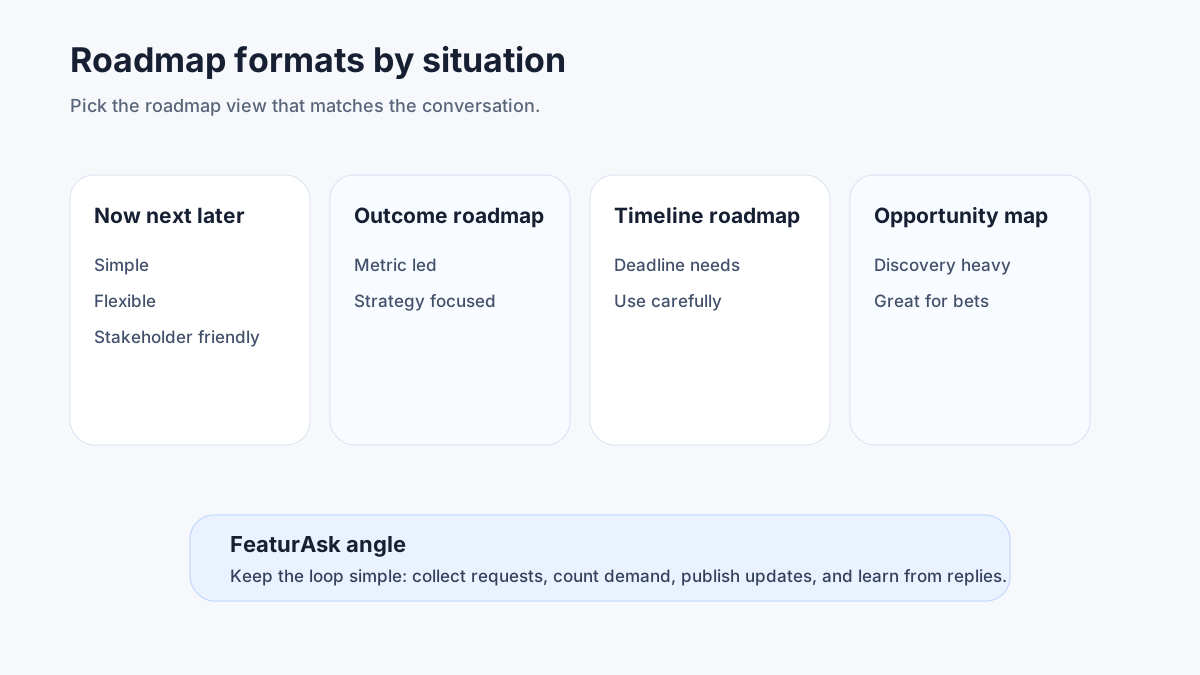
Now turn priorities into a roadmap view. Choose a structure that matches your audience. Now, Next, Later works well for public SaaS roadmaps because it shows direction without overpromising dates. Timeline views can work for internal planning when dependencies and capacity must be visible. Theme-based views are useful when leadership wants to understand strategic focus.
Each roadmap item should include a short problem statement, expected outcome, status, target segment, evidence links, and owner. If the roadmap is public, keep the language simple and avoid internal ticket names.
Step 5. Develop implementation plans
Roadmapping is not detailed project planning, but it should create enough clarity for project planning to begin. For items in the “Now” column, define discovery tasks, design needs, engineering dependencies, risks, acceptance criteria, and communication steps.
This is where product and engineering should challenge assumptions together. A feature that sounds small might touch billing, permissions, data models, and customer education. A roadmap that ignores implementation reality will lose trust quickly.
Step 6. Communicate the roadmap with stakeholders
Different audiences need different levels of detail. Leadership needs strategic rationale and business impact. Engineering needs constraints and sequencing. Sales needs honest positioning and deal risk guidance. Support needs customer-facing explanations. Customers need status, context, and a way to follow progress.
Use the roadmap as a conversation tool, not a poster. Invite questions. Explain why some requests are not being prioritized. Share what would change your mind. Roadmaps build trust when the logic is visible.
For public communication, connect the roadmap to release notes. When an item ships, update the roadmap and announce the release. See our guide to release notes best practices for practical announcement ideas.
Step 7. Monitor progress and gather ongoing feedback
Once the roadmap is live, keep listening. Watch usage metrics, customer comments, votes, support trends, and sales objections. If evidence changes, update the roadmap. If an item ships, measure whether it produced the intended outcome.
The loop matters more than the document. Roadmapping improves when every cycle teaches the next one.
Roadmapping examples you can learn from
Example 1: Public product roadmap for a SaaS app
A public roadmap shows customers what the team is considering, planning, building, and shipping. It often includes voting and comments so customers can add context. This style is useful for SaaS companies that want transparency and a steady feedback loop.
The risk is overcommitment. If the public roadmap shows exact dates for uncertain work, users may treat every item as a promise. A safer pattern is to publish statuses such as Under Consideration, Planned, In Progress, and Shipped. This gives visibility while leaving room for discovery.
A public roadmap works best when paired with a feedback portal. Customers submit requests, others vote or comment, the product team promotes validated ideas to the roadmap, and shipped work is announced back to the people who asked.
Example 2: Quarterly theme roadmap
A quarterly theme roadmap organizes work around a strategic focus. For example, a team might choose “reduce onboarding friction” as the theme. Roadmap items could include guided setup, sample data, invite flows, documentation improvements, and activation analytics.
This format is helpful because it tells a story. Stakeholders can see why different items belong together. It also helps the team say no to unrelated work without debating every request from scratch.
Theme roadmaps are especially useful for founder-led SaaS teams because they reduce context switching. Instead of scattering effort across ten product areas, the team makes a concentrated push where the business needs movement.
Example 3: Internal platform roadmap
Not every roadmap is customer-facing. An internal platform roadmap might focus on reliability, performance, billing infrastructure, security, permissions, or developer productivity. These items may not attract votes, but they can be essential for growth.
The key is to communicate internal work in customer-impact language. “Reduce API error rates during sync spikes” is more meaningful than “refactor worker queue.” When stakeholders understand the customer or business risk, platform work becomes easier to prioritize.
Example 4: Experiment roadmap
An experiment roadmap lists bets the team wants to test before making large investments. Items might include prototype interviews, fake-door tests, pricing experiments, onboarding variations, or concierge workflows.
This is useful when confidence is low. Instead of committing to a large build, the team commits to learning. If evidence improves, the opportunity can move into the product roadmap.
Roadmapping exercises for better decisions
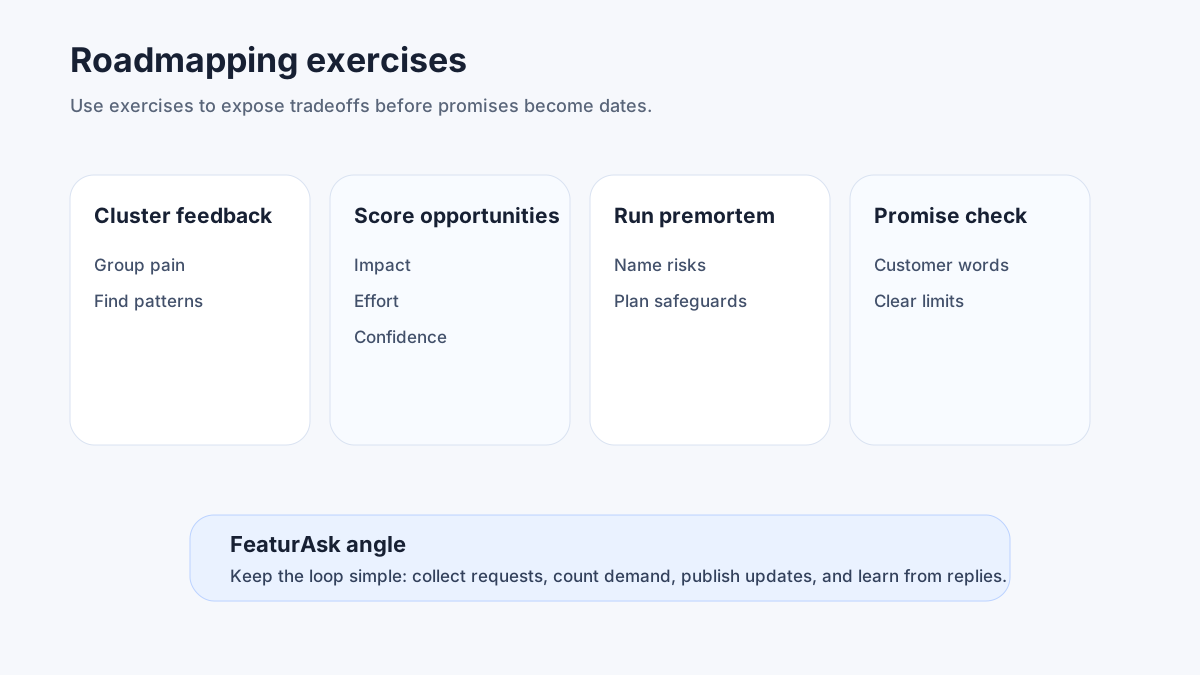
Exercise 1: The feedback clustering workshop
Export recent feedback and put each request on a virtual sticky note. Group notes by underlying problem rather than requested solution. Name each cluster with a customer pain statement. Then mark which clusters align with the current product objective.
This exercise helps teams see patterns instead of reacting to individual requests. It also reveals when different customer segments are asking for different things under the same feature label.
Exercise 2: The opportunity scoring session
Create a shortlist of opportunities and score each one on impact, reach, confidence, effort, and strategic fit. Discuss disagreements out loud. If one person scores confidence as high and another scores it as low, ask what evidence each person is using.
The conversation is more valuable than the final number. Scoring exposes assumptions.
Exercise 3: The pre-mortem
Choose a roadmap item and imagine that it failed six months from now. Ask: why did it fail? Possible answers include unclear user problem, underestimated engineering effort, poor launch communication, missing integration, weak onboarding, or wrong customer segment.
Turn the answers into risk-reduction tasks. This exercise is simple, fast, and especially useful for large roadmap bets.
Exercise 4: The customer promise check
Review every public roadmap item and ask what a reasonable customer would think you promised. If the answer is more specific than you intended, rewrite the item. Replace exact dates with statuses where possible. Replace internal feature names with user outcomes.
This exercise prevents accidental commitments and improves roadmap language.
Best roadmapping software capabilities
Roadmapping software should help teams collect evidence, prioritize ideas, communicate direction, and close the loop. You may not need a heavyweight product suite. For many SaaS teams, the essential capabilities are feedback intake, voting, comments, roadmap statuses, internal notes, customer notifications, and release updates.
Look for a tool that matches your team size. A large enterprise platform may offer portfolio views and complex permissions, but it can be overkill for a small SaaS team that mainly needs to hear customers and show progress. A lightweight tool is often better if it gets used every week.
If you are comparing approaches, our guide to public roadmap software explains what to look for.
Common roadmapping mistakes
The first mistake is treating the roadmap as a promise list. It should show direction and current priorities, not lock the team into every detail before discovery.
The second mistake is building from internal opinions only. Stakeholders have useful context, but the roadmap should be grounded in customer evidence and product data.
The third mistake is ignoring capacity. Include engineering constraints, design capacity, QA needs, and operational work.
The fourth mistake is never removing stale items. If an item no longer fits the strategy, archive it or explain why it is not moving forward.
The fifth mistake is separating roadmap communication from release communication. Customers who vote for an idea should hear when it ships.
How to choose the right roadmapping format
Choose the format based on the decision you need to support.
Use Now, Next, Later when you want flexible prioritization and public transparency. Use a timeline when cross-functional dependencies matter and the audience understands that dates may change. Use a theme roadmap when leadership needs strategic focus. Use a portfolio roadmap when multiple product lines share resources. Use an experiment roadmap when the goal is learning before commitment.
Many teams need more than one view. The internal roadmap can include dates, dependencies, and capacity. The public roadmap can use statuses and plain-language outcomes.
Final takeaway
Roadmapping makes product direction explicit. It turns strategy into choices, feedback into evidence, and plans into communication. A good roadmap does not predict everything. It helps the team learn, align, and explain what matters next.
Start small. Gather feedback in one place, define the objective, cluster problems, prioritize opportunities, publish a simple roadmap, and update it regularly.
If you want a lightweight way to run that loop, start FeaturAsk's 1 month free trial with no credit card required, then continue for $29.95/year.