Guide to Customer Satisfaction: NPS in SaaS
NPS can be useful for SaaS teams, but only when the score leads to follow-up and product learning. This guide explains how to use NPS as one customer satisfaction signal, connect comments to feature requests, and avoid treating a single number as the whole customer experience.
Quick answer: how NPS helps SaaS teams
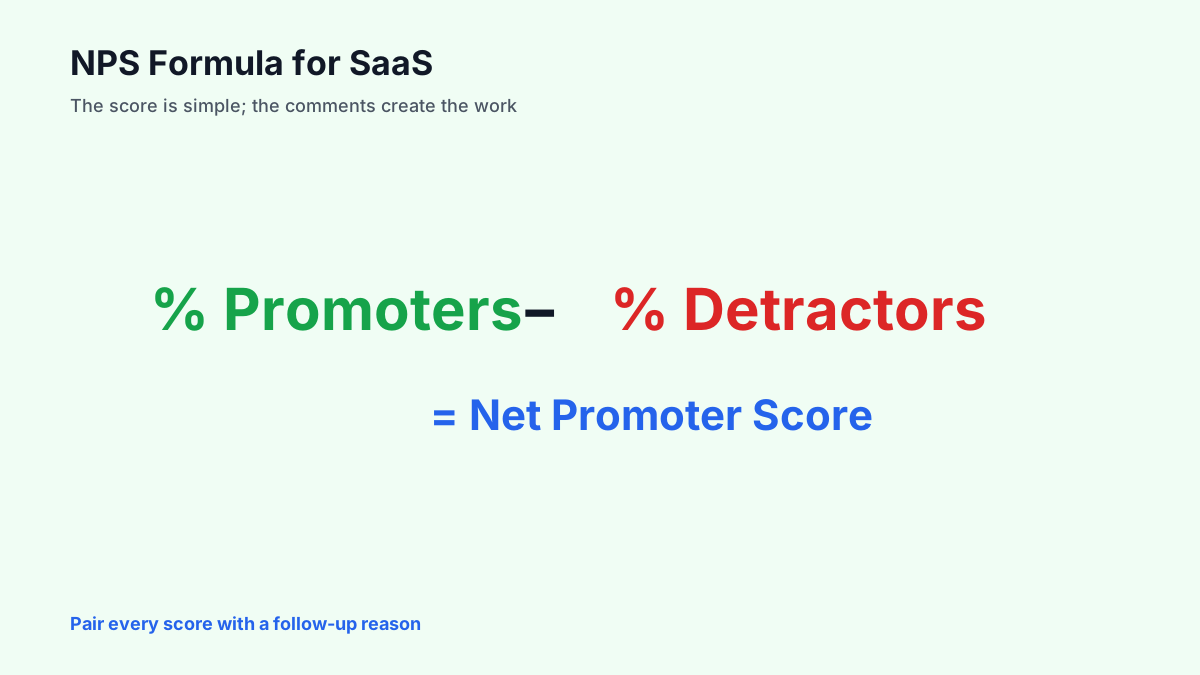
NPS, or Net Promoter Score, is a customer satisfaction metric that asks how likely a user is to recommend your product. Respondents choose a score from 0 to 10. Scores of 9 or 10 are promoters, 7 or 8 are passives, and 0 through 6 are detractors. The score is the percentage of promoters minus the percentage of detractors.
NPS is useful in SaaS because subscription businesses depend on retention, expansion, and word of mouth. A single score will not explain everything, but the follow-up comments reveal product friction, missing features, onboarding gaps, support problems, and moments customers value.
For more context, connect this NPS workflow to customer feedback management, in-app feedback widgets, and a practical stack of customer feedback tools.
If you want a lighter way to turn scattered ideas into a useful feedback loop, try FeaturAsk for 1 month free — no credit card required. After the trial, it is only $29.95/year, which makes it practical for small SaaS teams, indie products, content sites, and creators who need a simple feedback widget without enterprise pricing.
What is NPS in SaaS?
NPS is a loyalty signal, not a complete satisfaction program. It asks one simple question: “How likely are you to recommend us?” The simplicity makes it easy to trend over time, compare segments, and trigger follow-up conversations.
In SaaS, the most important part is usually the open-ended follow-up: “What is the main reason for your score?” A detractor might complain about missing permissions. A passive might like the product but find onboarding confusing. A promoter might reveal the workflow your marketing should emphasize.
The metric was introduced by Bain and popularized as a loyalty measure. You can read the original framing from <a href="https://www.netpromotersystem.com/about/" rel="nofollow">Net Promoter System</a>, but modern SaaS teams should treat it as one signal among many.
Why track NPS?
Track NPS to identify problems before they become churn. A drop in scores after a pricing change, onboarding redesign, or major release is a warning that deserves investigation. The earlier you see the pattern, the easier it is to respond.
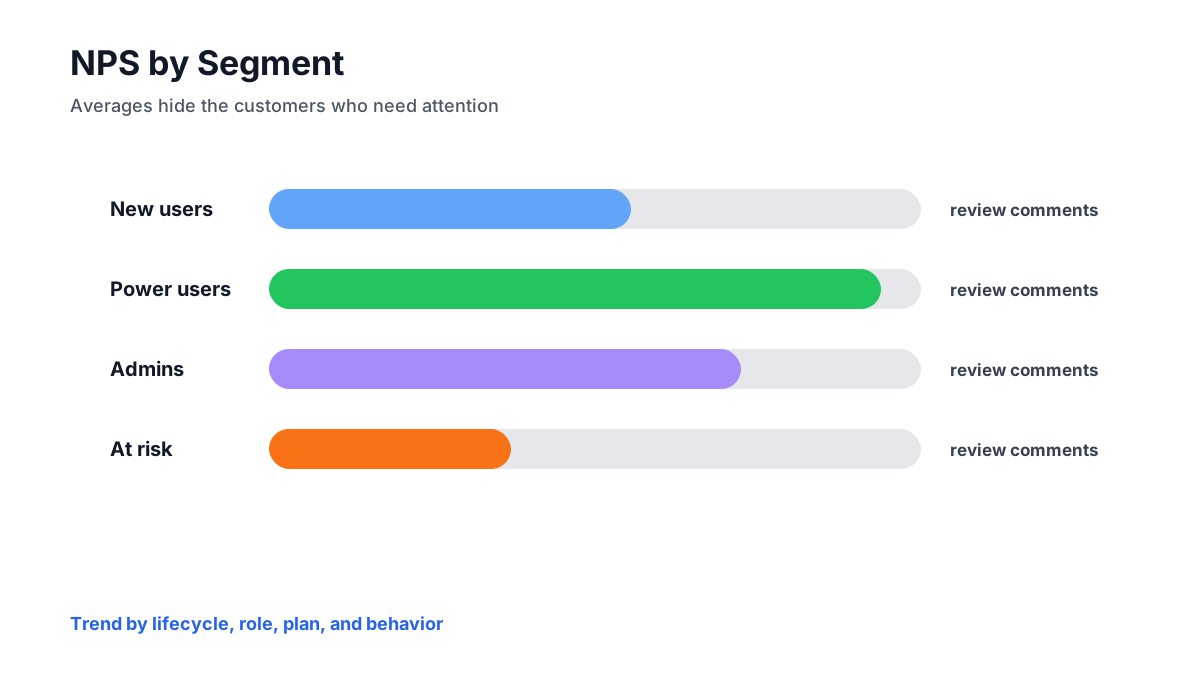
Track it to understand segments. Your overall score may look stable while new users struggle, agencies become promoters, or enterprise accounts become detractors. Segmenting by plan, lifecycle stage, role, and product usage turns a broad metric into a useful operating signal.
Track it to prioritize. If many detractors mention the same missing feature, that request deserves a closer look. If promoters praise a specific workflow, strengthen it in product education and content.
FeaturAsk is built for teams that want feedback collection to stay simple: add a widget, let users submit ideas, collect votes and comments, and review requests from one dashboard. You can start with 1 month free on FeaturAsk, no credit card needed, then keep it for $29.95/year if it fits your workflow.
Promoters, passives, and detractors
Promoters are enthusiastic users who are likely to recommend your product, write positive reviews, and tolerate occasional rough edges because the product solves a real problem. Ask them what they value most and whether they would share a testimonial, review, or case study.
Passives are satisfied but not loyal. They may stay until a competitor offers a cleaner workflow, lower price, or better integration. Their comments often reveal gaps that do not create anger but do limit enthusiasm.
Detractors are at risk. Some are unhappy because the product truly fails their need. Others may be confused, poorly onboarded, or blocked by one missing feature. The follow-up question tells you which type you are dealing with.
How to run NPS without annoying users
Choose timing carefully. A user needs enough experience to answer. For a self-serve SaaS product, that might be after activation, after several sessions, or after completing a core workflow. For annual contracts, relational NPS every quarter or twice a year may be enough.
Keep the survey short. Ask the score, ask the reason, and optionally ask whether the user is willing to be contacted. Long surveys reduce response quality and make the NPS moment feel like homework.
Do not survey users during outages, immediately after a support escalation, or before they have used the product. If you need transactional feedback after a support case, use a customer satisfaction question instead of relational NPS.
Turning NPS comments into product work
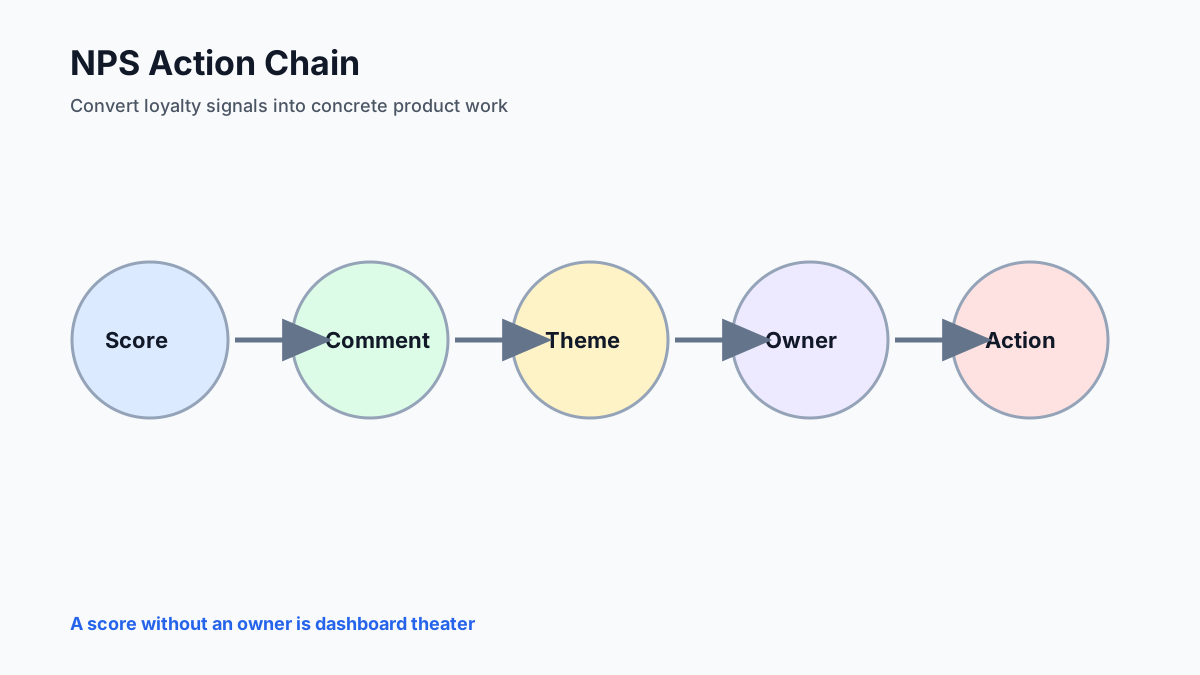
Tag comments by theme: onboarding, performance, missing feature, pricing, support, integrations, reporting, mobile experience, and documentation. Then compare the themes against behavior. A complaint from a user who churns next week should carry different urgency from a casual suggestion.
Push repeated product requests into your feedback board so they can collect votes and context. NPS tells you a customer is unhappy or enthusiastic; the board helps you understand whether the underlying request is broad enough to prioritize.
Close the loop. Thank promoters, ask passives what would make the product a clear recommendation, and respond quickly to detractors with specific help. The goal is not to chase the score; the goal is to improve the experience that produces the score.
NPS benchmarks and cautions
Benchmarks can be helpful, but they are often less useful than your own trend. A niche B2B SaaS product with demanding expert users may have a different baseline than a consumer app. Compare segments and time periods before comparing yourself to broad industry averages.
Avoid using NPS as an employee performance weapon. If teams fear the number, they will optimize for survey timing instead of customer value. Treat the score as a diagnostic tool.
For current context, recheck benchmark pages before using any number in a board deck. <a href="https://www.qualtrics.com/articles/customer-experience/net-promoter-score/" rel="nofollow">Qualtrics' NPS guide</a> was live on May 22, 2026 and still explains the promoter/passive/detractor calculation. <a href="https://www.retently.com/blog/good-net-promoter-score/" rel="nofollow">Retently's benchmark discussion</a>, also checked May 22, 2026, emphasizes that “good” varies by industry and audience. Treat public SaaS benchmark ranges as directional only; your own segmented trend is more reliable than a single cross-industry target.
A practical NPS cadence for SaaS
For new users, wait until they complete a meaningful action before asking. A survey shown before activation measures confusion more than satisfaction. For active accounts, send relational NPS at a predictable interval, such as quarterly or twice a year, depending on contract length and product usage.
For transactional moments, use a different question. After a support conversation, ask whether the answer solved the issue. After onboarding, ask whether setup felt clear. NPS is broad; transactional satisfaction is specific. Mixing them can make trends harder to interpret.
Create an owner for follow-up. Detractor comments should not sit in a spreadsheet. Assign them to support, success, product, or marketing based on the theme. Promoter comments should be routed to advocacy, testimonials, reviews, or referral programs when appropriate.
How NPS works with product feedback
NPS tells you who feels loyal, neutral, or frustrated. Product feedback tells you what to change. The strongest SaaS teams connect the two. When a detractor mentions a missing feature, add that request to the feedback board and preserve the NPS context. When a promoter praises a workflow, use that insight in onboarding and positioning.
Do not chase a higher score by hiding the survey from unhappy users. That creates a comforting number and a weaker product. It is better to hear from frustrated customers early than to discover the same problem through churn.
The best NPS programs produce decisions. If comments repeatedly point to billing confusion, improve billing content and interface copy. If detractors mention performance, prioritize reliability. If passives mention setup friction, improve onboarding.
30-day rollout plan for NPS in SaaS
In week one, decide which users should receive the survey and which moments are off limits. Exclude brand-new users who have not reached activation, users in the middle of outages, and accounts already in an active support escalation unless the follow-up is personal.
In week two, set up the survey and write the follow-up question. In week three, review responses daily and route comments to the right owner. A detractor who reports billing confusion needs a different response from a detractor requesting an enterprise feature.
In week four, summarize themes for the whole team. Share the score, but spend more time on comments and decisions. NPS becomes useful when it changes onboarding, support, product priorities, or education content. Add one sentence to each theme explaining what evidence would make the team reconsider the next action during the next review.
Common NPS mistakes SaaS teams should avoid
The most common mistake is treating NPS as the goal instead of the signal. A higher score is nice, but the real value is learning what improves loyalty. If teams celebrate the number without reading comments, they miss the problems and strengths that created the score. Always review verbatim feedback and connect it to product, support, onboarding, and content decisions.
Another mistake is surveying at the wrong moment. Asking too early produces shallow answers from users who have not experienced the product. Asking during an incident produces results dominated by the incident. Asking too often creates fatigue. Choose a cadence that respects the customer relationship and gives the team enough time to act between survey waves.
Avoid comparing broad benchmarks without context. A score that looks low in one category may be strong for a demanding B2B segment, while a high score can hide churn risk in a specific user group. Segment results by lifecycle stage, plan, account type, and product behavior. Trends inside your own business are usually more actionable than generic industry comparisons.
Finally, do not ignore passives. Detractors are urgent and promoters are encouraging, but passives often explain what prevents stronger loyalty. They may like your product but find it replaceable. Their comments can reveal the improvements that move customers from “fine” to “recommended,” which is exactly where SaaS retention and word of mouth improve.
End each NPS cycle with three outputs, not one score. First, publish the trend by segment so the team can see whether new users, power users, agencies, or administrators are moving differently. Second, list the top comment themes and assign owners. Third, decide which responses belong in support, onboarding, product, or the public feedback board.
That discipline keeps NPS from drifting into dashboard theater. A score of 42 with no owner is less useful than three detractor comments that expose a fixable onboarding gap. The practical question after every survey wave is: what will we change before asking again?
One extra safeguard is to pair every score review with a decision log. Record the theme, affected segment, evidence level, owner, and next action. That keeps NPS from becoming a vanity metric and makes it easier to explain why one complaint became a roadmap item while another became a help article or onboarding fix.
When you are ready to collect clearer customer signals, launch a FeaturAsk board and test it for a full month free with no credit card. It gives small teams an affordable path to idea capture, voting, moderation, and status updates for $29.95/year after the trial.
Previous: 7 Ways to Handle Feature Requests [+The Ideal Process]
Next: Top 11 Hellonext Alternatives for Collecting and Managing User Feedback