Crafting Your Product Management Path: 8 Unconventional Ideas
crafting your product management path 8 unconventional idea is an odd phrase, but the search intent behind it is useful: product people want a more interesting way to grow than copying enterprise playbooks. If you run a small SaaS, a creator business, a niche marketplace, or an ecommerce store, you may not have a formal product department. You might be the founder, marketer, support lead, designer, and product manager in the same afternoon.
That reality changes the job. Product management becomes less about maintaining a perfect process and more about building a repeatable loop: notice customer pain, test a small bet, invite feedback, prioritize honestly, and communicate what changed. Conventional advice can help, but only after it is resized for lean teams that cannot spend months creating decks before deciding what to ship.
The good news is that unconventional does not mean chaotic. The best alternative tactics help you learn faster, reduce waste, and make product decisions visible. This guide uses eight ideas because if a title promises seven, a useful product manager should ask what the missing next move might be.
If your current product path is scattered across inboxes, calls, and notes, start a FeaturAsk trial and collect customer ideas in one organized place — one month free, no credit card required, then $29.95/year.
Evolution of product management
Product management has moved through several eras. Early software product work often centered on delivery coordination: define requirements, hand them to engineering, and keep releases moving. As SaaS matured, the role expanded into discovery, positioning, pricing, analytics, customer research, and growth. Today, product management is also shaped by AI-assisted building, creator-led businesses, and users who expect rapid improvement.
For a large company, the product manager may specialize in one slice of a bigger machine. For a small team, the product path is more blended. You may interview customers in the morning, triage feature requests after lunch, write release notes in the afternoon, and decide whether a Shopify integration deserves two weeks of development by evening. That breadth can feel messy, but it also creates an advantage: you are close to the customer and close to the code.
Modern product work is less about having all the answers and more about designing the system that finds better answers. ProductPlan connects product management with strategy, roadmap, and execution, while the Nielsen Norman Group emphasizes observing real behavior instead of relying only on opinions. Those principles matter even more when every wrong bet hurts a small roadmap.
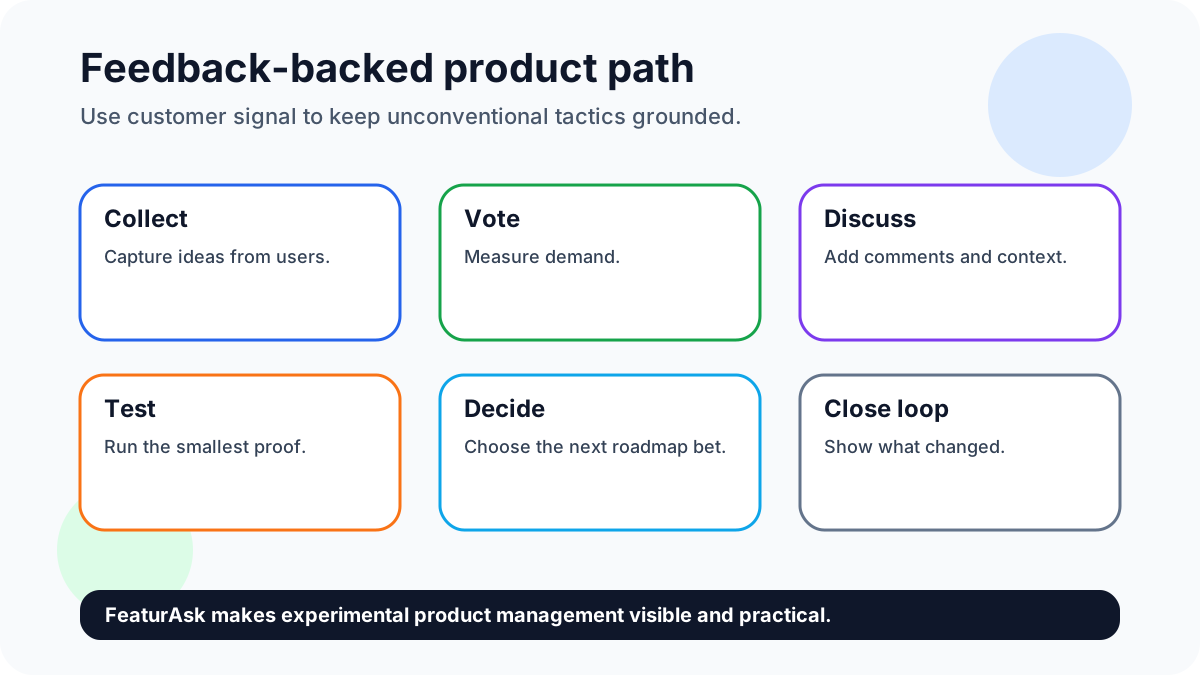
For FeaturAsk-style teams, the evolution is simple: treat feedback as product evidence. A visible feedback board, request templates, vote counts, comments, and status updates create a lightweight operating system for decisions. If you need the basics first, see building better products with user feedback and feature request tools.
Need for unconventional tactics
Traditional product advice often assumes abundant resources: dedicated researchers, analytics teams, sales operations, UX writers, and quarterly planning rituals. Small teams need the same clarity, but they need tactics that fit into a week rather than a quarter.
Unconventional tactics help because they create sharper evidence earlier. Instead of building a feature because three customers asked loudly, you can pretotype it. Instead of debating roadmap priorities from memory, you can map outcomes to opportunities. Instead of asking users whether they “like” an idea, you can turn the conversation into a game that reveals tradeoffs. Instead of guessing whether demand is broad, you can publish a request, collect votes, and ask commenters about the problem behind the request.
This is especially useful for creators and ecommerce businesses. A course creator might need to know whether customers want templates, coaching, or a community. An online store might decide between subscription bundles, size guides, and loyalty perks. A small SaaS might choose between integrations, onboarding improvements, and admin controls. Each option sounds reasonable. The product manager’s path is the process for discovering which option creates the most value now.
Unconventional does not mean ignoring discipline. It means choosing tools that reveal reality faster. Teresa Torres popularized continuous discovery habits: regular customer touchpoints and a clear connection between opportunities, solutions, and outcomes. Strategyzer’s testing approach also pushes teams to validate business ideas before scaling investment. Both ideas match the small-team advantage: talk to users often, test cheaply, and tie decisions to evidence.
Limitations of traditional methods
The classic roadmap can become a trap. A polished timeline may look strategic even when the inputs are weak. A feature scoring spreadsheet may appear objective while hiding assumptions nobody validated. A customer interview program may produce beautiful notes but no prioritization. A brainstorming workshop may produce energy without commitment.
Small teams also face a different cost structure. If a corporation wastes two weeks aligning stakeholders, the company survives. If a bootstrapped SaaS wastes two weeks building the wrong feature, support, marketing, and cash flow all feel it. Traditional methods often create delay because they separate discovery from delivery. The people hearing customer pain are not always the people deciding the roadmap.
Another limitation is that traditional processes can overvalue internal confidence. Teams are good at making stories sound coherent. “Customers need a dashboard redesign” may actually mean “three power users cannot find one setting.” “We need an AI assistant” may really mean “new users do not understand the first workflow.” “Everyone wants mobile” may mean “one sales prospect asked during a demo.” Without a feedback system, assumptions travel faster than evidence.
A lightweight alternative is to make product management visible. Capture requests in one place. Merge duplicates. Ask clarifying questions. Let users vote. Label statuses. Review themes weekly. Use frameworks only when they improve the decision. The FeaturAsk guide to feature voting explains how to use votes as signal without turning them into automatic orders, while feature request templates can help you collect better context from the start.
8 unconventional ideas
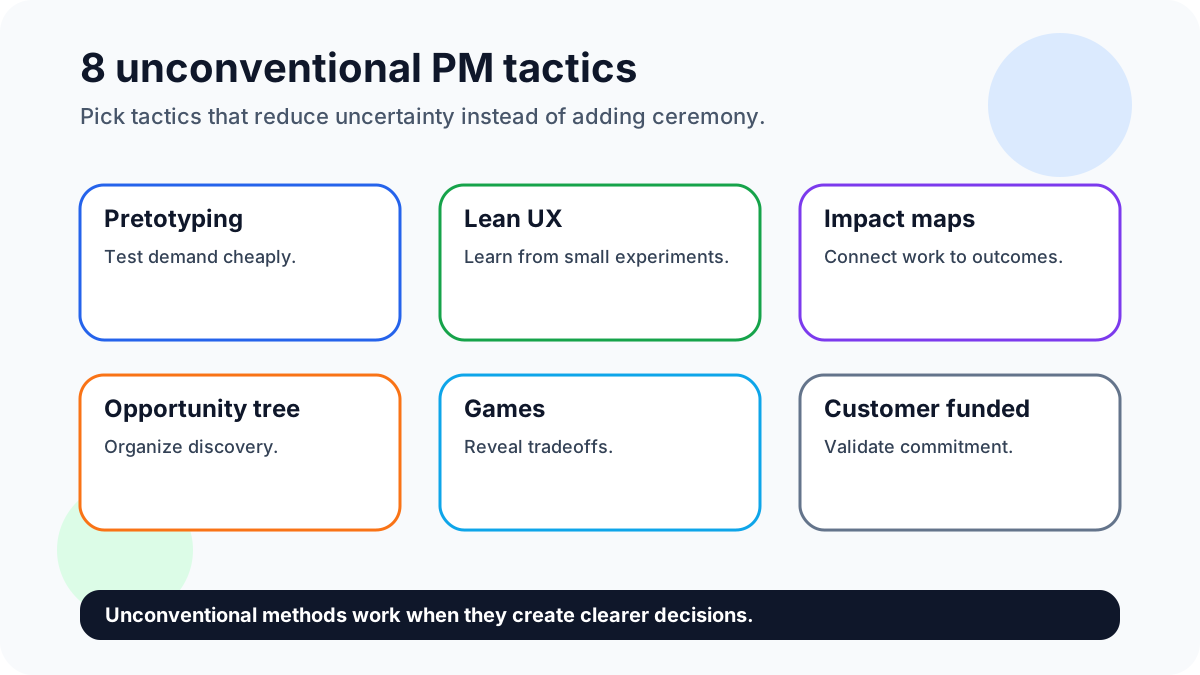
This section keeps the requested heading but applies the useful “plus one” product instinct: here are eight tactics. Treat them as a menu, not a maturity model. Pick the one that reduces your current uncertainty.
Pretotyping
Pretotyping asks, “Should we build this at all?” before asking, “Can we build it well?” It is intentionally rough. You might add a fake-door button for a potential integration, create a landing page for a premium add-on, place a “request access” link inside your app, or manually deliver a service before automating it.
For a small SaaS, pretotyping prevents weeks of speculative development. Ecommerce teams can list a potential bundle as “coming soon” and invite shoppers to vote. Creators can share three possible workshop topics and ask the audience to reserve a seat. The key is ethics and clarity: do not trick users into paying for something unavailable, but do measure real behavior such as clicks, signups, replies, votes, and willingness to wait.
Lean UX
Lean UX moves product work away from long documentation cycles and toward hypotheses, experiments, and collaborative learning. Instead of writing a detailed specification for a new onboarding flow, you define the assumption: “If first-time users see example requests, more of them will submit useful feedback in the first session.” Then you test a smaller version.
This is powerful for lean teams because design, development, and customer learning happen together. You can sketch, test, ship a limited change, and learn from behavior. Use Lean UX when the main risk is usability or comprehension: abandoned setup, unclear pricing, or request forms people do not complete. Nielsen Norman Group’s usability research resources are a useful reminder that watching users attempt real tasks often reveals problems surveys miss.
Impact mapping
Impact mapping starts with the desired business outcome, then works backward to actors, behavior changes, and deliverables. The structure is simple: why are we doing this, who can help or block it, how should their behavior change, and what could we build to support that change?
Imagine a small SaaS wants to reduce churn. The traditional response might be “build more requested features.” Impact mapping slows that down. Which users churn: new admins who fail setup, teams that never invite collaborators, or customers who cannot justify renewal? Each actor needs a different behavior change. For creators or ecommerce teams, the same map can connect repeat purchases, waitlists, polls, and product education to a measurable outcome.
Opportunity solution tree
An opportunity solution tree connects a target outcome to customer opportunities and possible solutions. Teresa Torres uses this structure to keep discovery organized: one outcome at the top, opportunities beneath it, solutions under each opportunity, and experiments to test the most promising options.
This is one of the best product management tools for small teams because it turns scattered feedback into a map. Suppose your outcome is “increase trial-to-paid conversion.” Customer feedback might reveal opportunities such as unclear setup, missing import options, uncertainty about value, or concern about price. Each opportunity can have multiple solutions. Unclear setup might be addressed with templates, a checklist, sample data, or a concierge onboarding session.
The tree prevents solution jumping. If a user asks for a feature, capture the underlying opportunity before committing. Votes show demand, but the tree shows where that demand fits.
Innovation games
Innovation games are structured activities that make customers reveal priorities through play, constraints, and tradeoffs. They are especially useful when direct questions produce polite or vague answers. Asking “what features do you want?” often creates a wishlist. Giving users a limited budget of tokens and asking them to spend it across possible improvements reveals preference intensity.
A small SaaS could run a “buy a feature” exercise with top customers. Give each participant ten coins and show eight roadmap candidates. Ecommerce teams can do the same with perks: faster shipping, bundles, loyalty credits, personalized recommendations, or easier returns. The conversation matters as much as the score because users explain why they invested.
Platform thinking
Platform thinking asks you to design capabilities, not just isolated features. Even a small product can benefit. Instead of building one-off custom fields for a single customer, you might build a flexible field system. Instead of creating a separate page for every audience, a creator might build a reusable request-and-vote workflow for course topics, community events, and digital products.
The danger is overengineering. Platform thinking should not become an excuse to build infrastructure before demand exists. Use it after evidence appears. When several requests share the same underlying capability, step back and design the reusable layer so the team avoids special-case clutter while staying responsive.
10x rule
The 10x rule is a prioritization challenge: do not ask whether a feature is slightly better; ask what would make the customer’s situation ten times better. This does not mean every release must be revolutionary. It means your discovery should search for disproportionate value.
For example, changing button colors may improve polish, but eliminating a weekly spreadsheet might create 10x value for an operations manager. Adding another report may help, but automatically collecting and ranking feature requests might save a founder hours every month. For an ecommerce team, a better filter may help shoppers, but a size recommendation that reduces returns could change margins.
The 10x rule protects small teams from incremental clutter. When reviewing requests, ask: which idea would remove a major workaround, unlock a new use case, or make customers feel they could not go back? Then validate it. Big value still needs evidence.
Customer-funded roadmap bets
The eighth unconventional tactic is to let customers fund or pre-commit to risky roadmap bets. This can mean paid beta access, deposits, annual upgrade commitments, sponsored development, or a simple “join the waitlist if this would change your workflow” campaign. The point is not to turn every roadmap decision into a sales negotiation. The point is to separate compliments from commitment.
For bootstrapped SaaS and creators, this is practical. If customers say they want an advanced reporting module, ask whether they would join a paid beta. If an audience asks for a course, ask for early enrollment. If store customers request a new product line, collect waitlist demand before ordering inventory. Commitment is stronger evidence than applause.
FeaturAsk can support this by collecting public interest first, then letting you follow up with voters and commenters. You might move a request from “Under review” to “Beta interest” and ask who wants early access. That creates a visible path from idea to validation to build decision.
Applying the tactics without process bloat
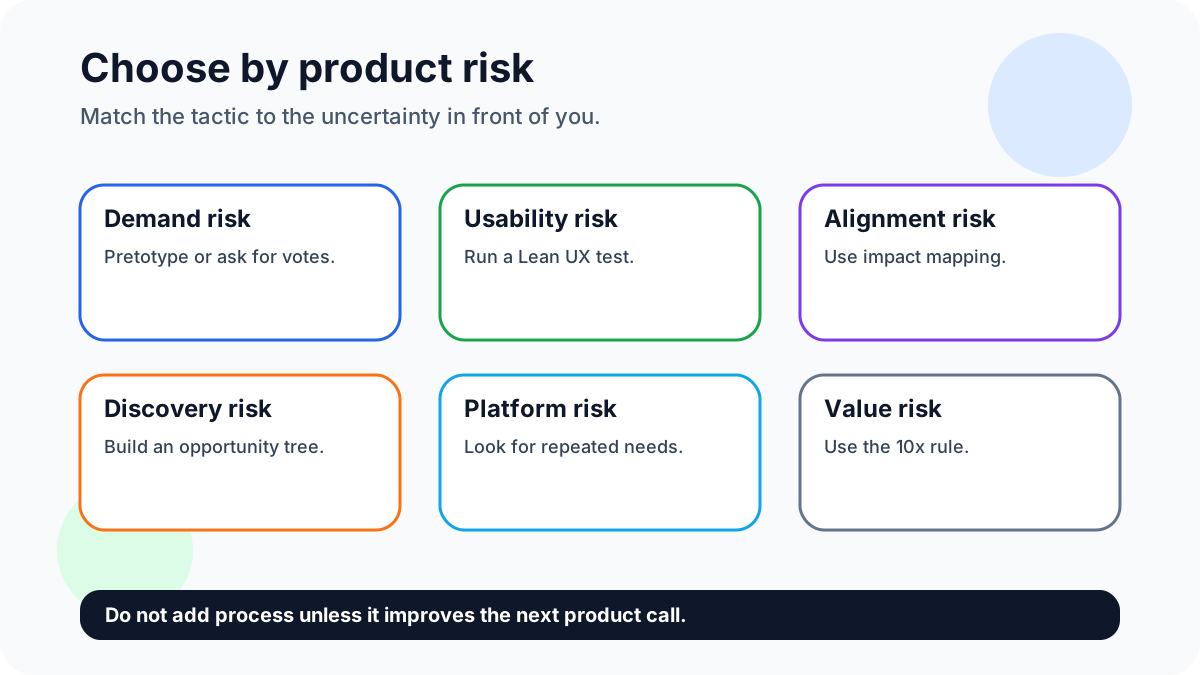
Do not adopt every tactic at once. Match the method to the risk: pretotyping for demand, Lean UX for usability, impact mapping for outcome alignment, opportunity trees for scattered feedback, innovation games for tradeoffs, platform thinking for repeated patterns, the 10x rule for value, and customer-funded bets for commitment.
A simple weekly rhythm is enough: review new requests, ask follow-up questions, test one assumption, ship or share the smallest experiment, then update statuses. When users see that ideas are acknowledged and decisions are explained, they become more willing to contribute. Even a thoughtful “not planned” builds more trust than silence.
Try FeaturAsk free for one month to turn requests, votes, and comments into a clearer product path — no credit card required, and the plan is only $29.95/year after the trial.
Conclusion
Crafting your product management path is not about choosing between “professional process” and “founder instinct.” The strongest small teams combine customer closeness with lightweight structure. They listen continuously, test before building, connect requests to outcomes, and communicate decisions clearly.
The eight tactics in this guide are unconventional only because they resist the illusion that product management is mostly documentation. Pretotyping tests demand. Lean UX tests usability. Impact mapping tests alignment. Opportunity solution trees organize discovery. Innovation games reveal tradeoffs. Platform thinking turns repeated needs into reusable capabilities. The 10x rule searches for meaningful value. Customer-funded bets test commitment.
Use the methods that match your current risk, then keep the loop visible. A product path becomes easier to navigate when customers can submit ideas, vote, add context, and see progress. Sign up for FeaturAsk and start building your feedback loop today — one month free, no credit card required, then $29.95/year.