UserVoice vs Productboard: Feedback System or Product OS?
For roadmap context, Atlassian recommends using roadmaps to communicate direction and outcomes, while Productboard publishes its current pricing and packaging separately from customer feedback workflows (Atlassian roadmaps; Productboard pricing).
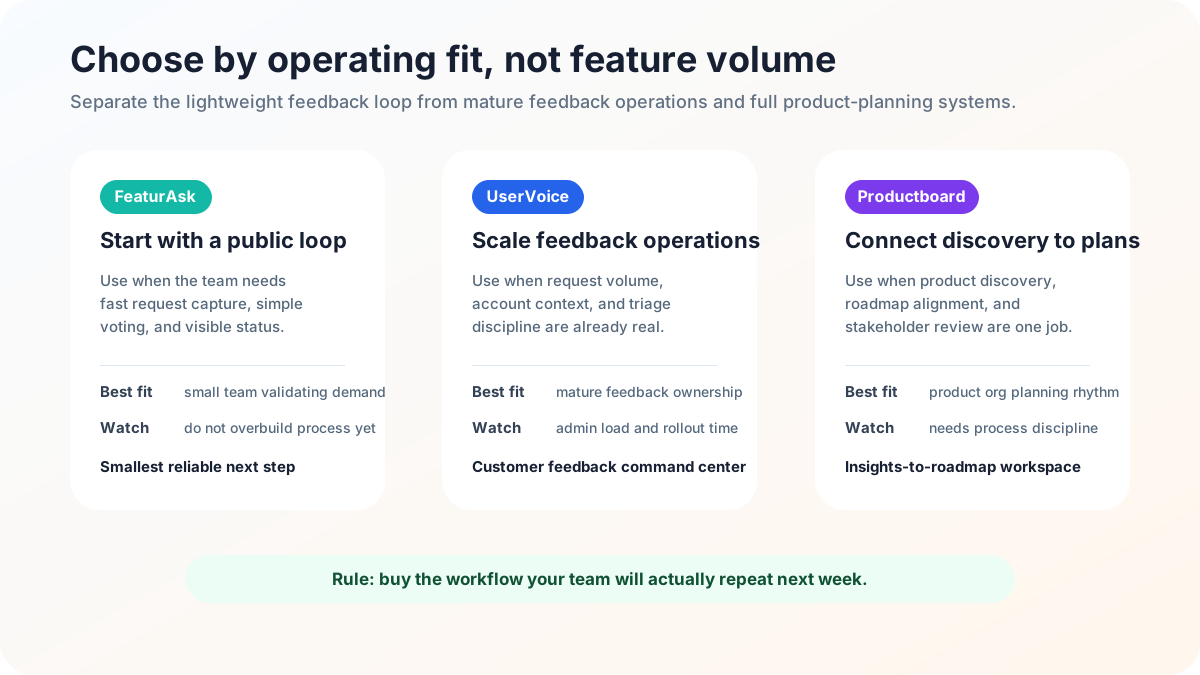
UserVoice vs Productboard is not a simple feature-to-feature contest. It is a decision about where your product organization is breaking down. UserVoice is usually evaluated when feedback from customers, sales, support, and success needs to become reliable customer intelligence. Productboard is usually evaluated when a team wants to connect insights to feature ideas, prioritization, roadmaps, and product strategy. Both can touch customer feedback, but they solve different operating problems.
Public information reinforces the difference. UserVoice's current pricing page describes a customer-intelligence platform with pricing starting at $16,000 per year, no per-seat charges, and a 30-day trial through a demo. Productboard's public site emphasizes customer insights, product roadmapping, product operations, and now Productboard Spark as an AI product-management experience with public-beta language. This guide uses those public references plus product-management best practice from Atlassian roadmaps to build a buyer decision framework. For more context, read customer feedback tools, feature prioritization framework, and product roadmap prioritization.
The short answer
Choose UserVoice if the primary pain is messy feedback intake. Examples: requests arrive through too many channels, customer-facing teams cannot see whether an idea already exists, product managers lack account context, and executives want clearer evidence behind roadmap tradeoffs. UserVoice is a better candidate when the company already has enough feedback volume to justify formal governance.
Choose Productboard if the primary pain is product operating discipline. Examples: insights are collected but not connected to features, prioritization debates are inconsistent, stakeholders cannot see why roadmap items matter, and product managers need a workspace for discovery, planning, and communication. Productboard is a better candidate when the team is ready to manage the path from insight to roadmap.
Choose a lighter feedback board first if the team has not proven the input side. If customers do not yet have one obvious place to submit requests and vote, FeaturAsk can establish the loop before you buy a full customer-intelligence or product-operations platform.
Where UserVoice fits best
UserVoice fits teams that need a structured system of record for customer feedback. The key word is structured. A company may receive hundreds of signals each month, but those signals do not automatically become useful evidence. They need source, segment, account, product area, status, and ownership. They need duplicate handling and a review cadence. They need enough context that product leaders can distinguish a broad market need from a loud account escalation.
The buying case is strongest when feedback has real economic weight. Enterprise B2B teams often need to understand whether a request belongs to a strategic account, a renewal risk, an expansion opportunity, or a broad usability issue. A public board alone may not capture that nuance. UserVoice can be attractive when customer-facing teams must contribute feedback without creating a chaotic backlog.
The risk is overbuying governance before the organization is ready. A platform cannot decide your criteria for you. If every request is urgent, if product strategy is unclear, or if no one will own weekly triage, a more capable feedback platform can simply centralize confusion.
Where Productboard fits best
Productboard fits teams that want to manage the broader product decision workflow. Its public site highlights customer insights, roadmapping, product operations, and strategy use cases. That breadth matters when the team already has a flow of insights but struggles to connect them to features, objectives, and communication. Productboard is less about a single feedback board and more about a product operating system.
This can be powerful for product organizations with multiple squads, stakeholder groups, and roadmap horizons. A PM can connect customer evidence to feature ideas, compare priorities, communicate a roadmap, and explain tradeoffs. The value grows when the team has a real planning cadence and enough discovery inputs to justify a central workspace.
The risk is adopting a product operating system to compensate for weak product judgment. Productboard can organize evidence and conversations, but the team still needs strategy, decision rights, and a willingness to say no. If the main problem is that customers have nowhere to submit requests, Productboard may be deeper than necessary for the first step.
Compare the complete workflow
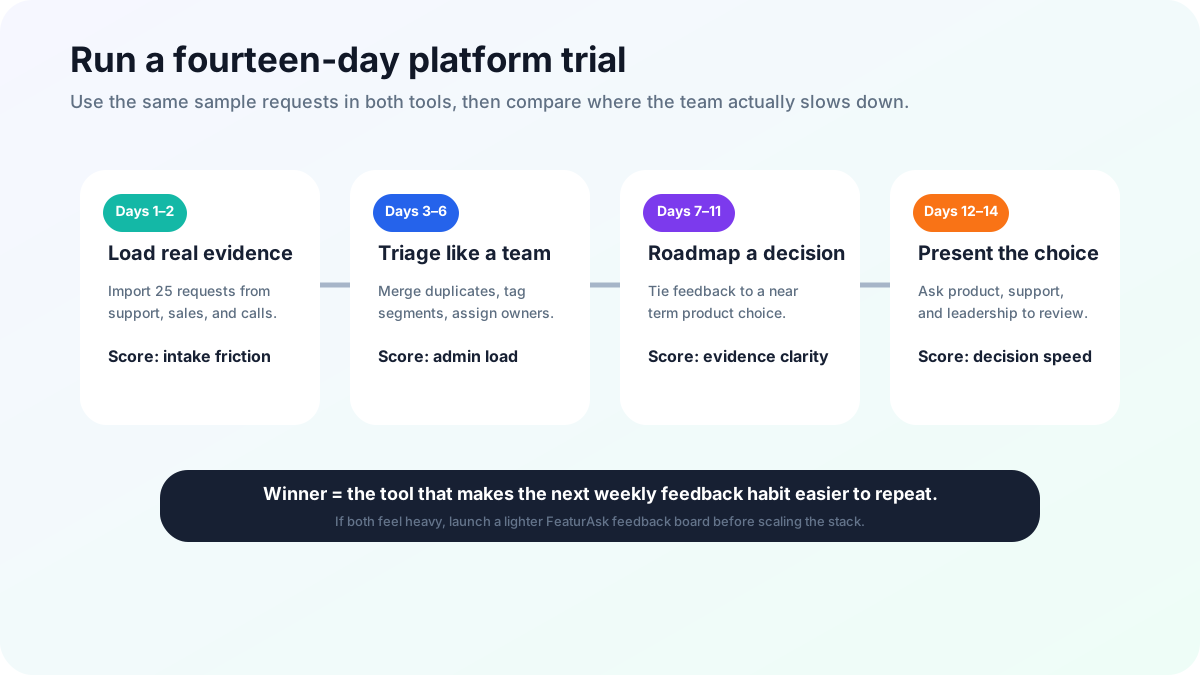
A useful comparison follows one customer signal from origin to decision. Start with a raw comment: "We need better permissions for regional managers." In UserVoice, test how that comment is captured, associated with accounts, merged with similar requests, and surfaced to product. In Productboard, test how the same insight becomes evidence for a feature idea, how it is prioritized, and how it appears in roadmap communication.
The first test reveals intake quality. Can sales, success, support, and customers add feedback without losing the customer's words? Are duplicates handled cleanly? Can teams search past requests before creating new ones? Can the tool show demand by segment, plan, or account type?
The second test reveals decision quality. Can product managers connect insights to opportunities, features, objectives, and roadmap items? Can stakeholders understand why one idea outranks another? Can the roadmap communicate direction without promising false certainty? Atlassian's roadmap guidance emphasizes that roadmaps should evolve as teams learn; whichever tool you choose must support that adaptive habit.
Pricing and procurement implications
UserVoice publishes a relatively high annual starting price. That can simplify budgeting for a mature organization because the decision is clearly a strategic purchase. It can also make the tool a poor fit for a team that is still discovering whether customers will participate in a feedback process. The commitment should be justified by feedback volume, cross-functional users, and the value of better customer intelligence.
Productboard's pricing details vary by package and sales motion, and the company positions multiple product-management capabilities. The evaluation should focus less on headline price and more on whether the team will use the planning depth. Paying for product operations makes sense when it changes roadmap decisions, reduces stakeholder churn, and improves discovery quality. It does not make sense if the workspace becomes a prettier backlog.
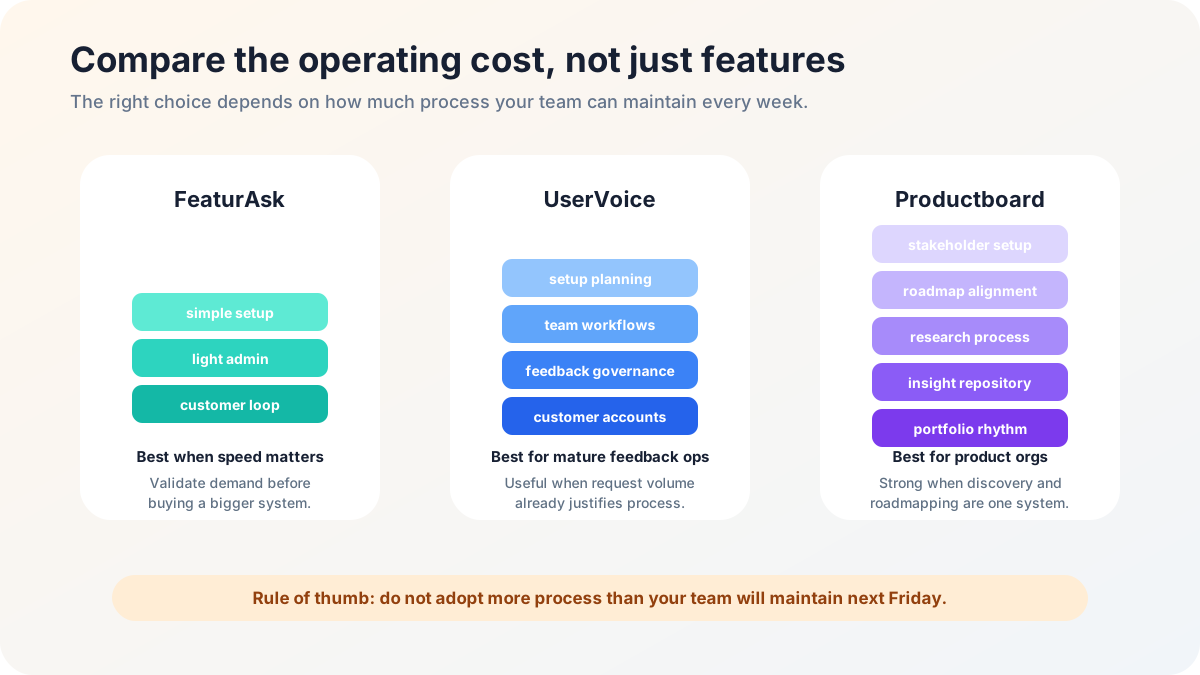
Procurement should include training and governance time. Productboard may require PM enablement and process design. UserVoice may require feedback taxonomy, integrations, and customer-facing rules. Neither system is free operationally.
A maturity model for the decision
At maturity level one, the team needs a single place for requests. Customers ask for features through email, chat, and calls; the team loses track; duplicate questions are common. A lightweight request board is often enough.
At level two, feedback volume is meaningful and needs structure. The team wants tags, segments, account context, duplicate management, and a weekly triage process. UserVoice becomes more compelling here.
At level three, product discovery and roadmap decisions need a central operating rhythm. Insights must connect to opportunities, features, priorities, objectives, and stakeholder communication. Productboard becomes more compelling here.
At level four, the organization needs an integrated product-ops ecosystem with governance, analytics, stakeholder alignment, and repeatable communication. Either tool may play a role, but the purchase should be part of a designed operating model rather than a one-off tool swap.
FeaturAsk fits the transition from level one to level two: prove public request intake and voting, learn the vocabulary of your customers, and then decide how much workflow depth you actually need.
Evaluation exercise: run five real requests through both models
Select five requests from different sources: a support ticket, a sales objection, a customer success note, a public comment, and an executive escalation. For each request, answer six questions. Where is the original wording stored? How are duplicates merged? What customer or account context is attached? Who reviews it? How does it influence a roadmap decision? How is the result communicated back?
This exercise quickly exposes the difference. UserVoice should shine if the hard work is gathering, cleaning, and understanding customer demand. Productboard should shine if the hard work is connecting evidence to product decisions and communicating a roadmap. If both workflows feel excessive, your team probably needs a simpler feedback loop first.
Also test the unhappy path. What happens when a request is declined? What happens when a request is popular but strategically wrong? What happens when one large account wants something that conflicts with the broader market? Software can support these decisions, but the team needs principles.
When FeaturAsk is enough
Not every product team needs a customer-intelligence platform or product operating system today. Many teams need a visible, low-maintenance feedback loop: collect feature requests, let users vote, show statuses, and learn which ideas repeat. FeaturAsk is intentionally lightweight for that stage. It lets teams create a public board without spending weeks designing taxonomy and governance.
The economics are intentionally simple too. FeaturAsk costs $29.95/year; the trial lasts one month, asks for no credit card, and is enough time to see whether customers actually submit useful ideas to start. That makes it a sensible validation step before a larger UserVoice or Productboard evaluation. If the board becomes active and feedback starts influencing decisions, you will know exactly which advanced capabilities matter.
Final recommendation
Do not ask, "Which platform has more features?" Ask, "Which workflow failure costs us the most right now?" If the answer is scattered feedback and weak customer intelligence, evaluate UserVoice seriously. If the answer is connecting insights to strategy, prioritization, and roadmaps, evaluate Productboard seriously. If the answer is that customers still need a simple way to submit and vote on requests, start with a smaller board and build the habit first.
A good tool should make your product judgment more visible, not replace it. Define the decision process, choose the smallest system that supports it, and upgrade only when the next level of complexity produces better decisions.
Stakeholder alignment questions
A UserVoice vs Productboard decision should include the people who will rely on the output, not only the administrator who will configure the tool. Ask support what information would help them answer repeat questions faster. Ask customer success what account context they need before renewal meetings. Ask sales which feature objections appear in late-stage deals. Ask product managers which evidence would genuinely change prioritization. Ask executives which roadmap explanations they expect to see.
These conversations often reveal that the company is trying to buy two different things. One group wants a cleaner feedback intake system; another wants a strategic planning workspace; another wants a customer-facing roadmap. Buying the broadest platform may seem efficient, but it can create confusion if the organization has not agreed on the operating model. A narrower tool with clearer ownership can outperform a richer tool with vague expectations.
Decision rights are especially important. Who can promote an insight into a feature idea? Who can change a public status? Who can commit roadmap language to customers? Who can reject a popular request? Productboard may help document and communicate these decisions, while UserVoice may help gather the evidence behind them, but neither product should be used to avoid assigning responsibility.
Implementation sequence
The safest implementation sequence is input first, decision second, communication third. First, make sure customer signals are captured with source, segment, and context. Second, create a repeatable review cadence where product leaders compare that evidence with strategy and capacity. Third, communicate the outcome through statuses, roadmap notes, or release updates.
Teams often reverse the order by publishing a roadmap before they have reliable input or decision rules. That creates expectation debt. Customers see a polished page, but the team cannot maintain it. Start with the evidence flow, then add planning depth, then widen communication. If a public request loop is still missing, FeaturAsk is a low-friction way to build that first layer before choosing a heavier system.
A successful implementation should reduce parallel work. If support still keeps a spreadsheet, success still keeps account notes in a CRM field, product still keeps a separate idea backlog, and executives still ask for custom slides, the tool has not become the operating system. The purchase should replace scattered rituals, not add another one.
End the comparison by mapping every must-have feature to a decision owner. If product managers need discovery notes, prioritization frameworks, and roadmap planning in one workspace, Productboard may earn its weight. If customer-facing teams need to capture and close the loop on requests before a roadmap system is ready, a lighter board can reduce risk. The useful choice is the one that makes the next roadmap review clearer, not the one that looks most complete in a procurement spreadsheet.
FAQ
Is UserVoice a Productboard alternative?
It can be, depending on the job. UserVoice is stronger as a structured feedback and customer-intelligence system. Productboard is stronger as a broader product-management and roadmapping workspace.
Which should a startup choose?
A startup should first identify the bottleneck. If request intake is the problem, start with a feedback board. If roadmap alignment and insight-to-feature workflows are the problem, Productboard may be worth evaluating.
How does FeaturAsk fit?
FeaturAsk is a lightweight way to prove request collection, voting, and statuses before committing to a larger platform. It is $29.95/year with a one month free, no-credit-card trial.
What is the biggest implementation risk?
The biggest risk is unclear ownership. Without weekly triage, status updates, and decision rules, any feedback or product-management platform will become stale.