Feature Prioritization for Product Managers: A Comprehensive Guide
What feature prioritization means for product managers
Feature prioritization is the discipline of deciding what to build, what to defer, and what to reject when the team has more ideas than capacity. Product managers use it to connect customer needs, product strategy, engineering effort, business goals, risk, and timing into decisions the team can explain.
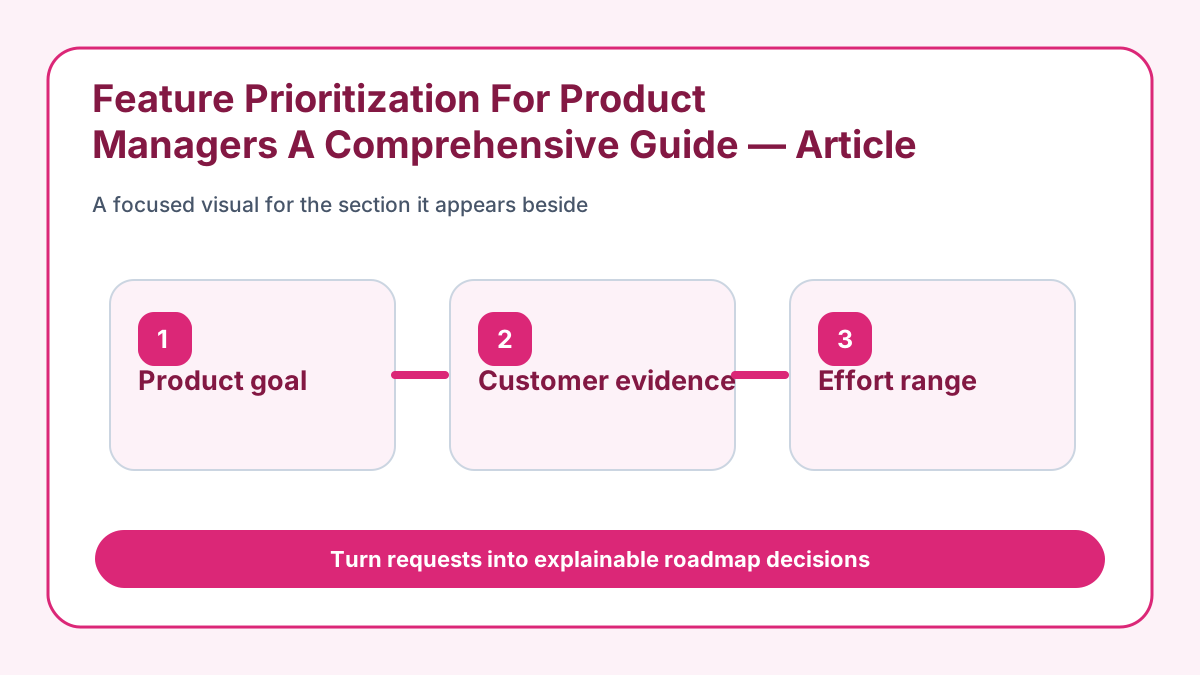
The work starts before scoring. A backlog full of vague ideas cannot be prioritized well. Each candidate feature needs a clear problem, target user, evidence, expected impact, effort range, dependencies, and success measure. Without that context, prioritization frameworks create false precision.
In 2026, the pressure is higher because teams can prototype faster and competitors can imitate visible features quickly. The advantage is not simply shipping more. It is choosing the work that compounds: fewer support tickets, better activation, stronger retention, clearer differentiation, or a customer segment you can serve especially well.
How to know what and when to build
Start with product strategy. A feature that customers want may still be wrong if it pulls the product away from the audience you intend to serve. Strategy defines the boundaries: who matters most, what promise the product makes, and which problems are worth solving now.
Then gather evidence. Feature requests, voting data, sales calls, support conversations, churn notes, usability tests, analytics, and competitor research all help. None is perfect alone. Votes show demand, interviews reveal context, usage data shows behavior, and support tickets show pain. Product managers need a balanced view.
Finally, consider timing. Some features unlock other work, reduce immediate churn risk, or support a launch window. Others are useful but can wait. A roadmap is a sequence, not only a ranked list. For request-heavy products, feature request templates help collect the context needed before ideas reach prioritization.
Why feature prioritization matters
Prioritization protects focus. Without it, teams overcommit, ship scattered improvements, and struggle to explain why important requests are still waiting. A clear process makes tradeoffs visible and reduces the emotional weight of saying no.
It also improves trust. Customers may not agree with every decision, but they are more patient when they see a rational process and status updates. Internal teams benefit too: sales, support, design, engineering, and leadership can understand how requests are evaluated.
Prioritization creates learning. When you document why a feature was chosen, you can later compare expected impact with actual results. This turns roadmap decisions into a feedback loop rather than a series of disconnected bets.
Prominent prioritization methods product managers should know
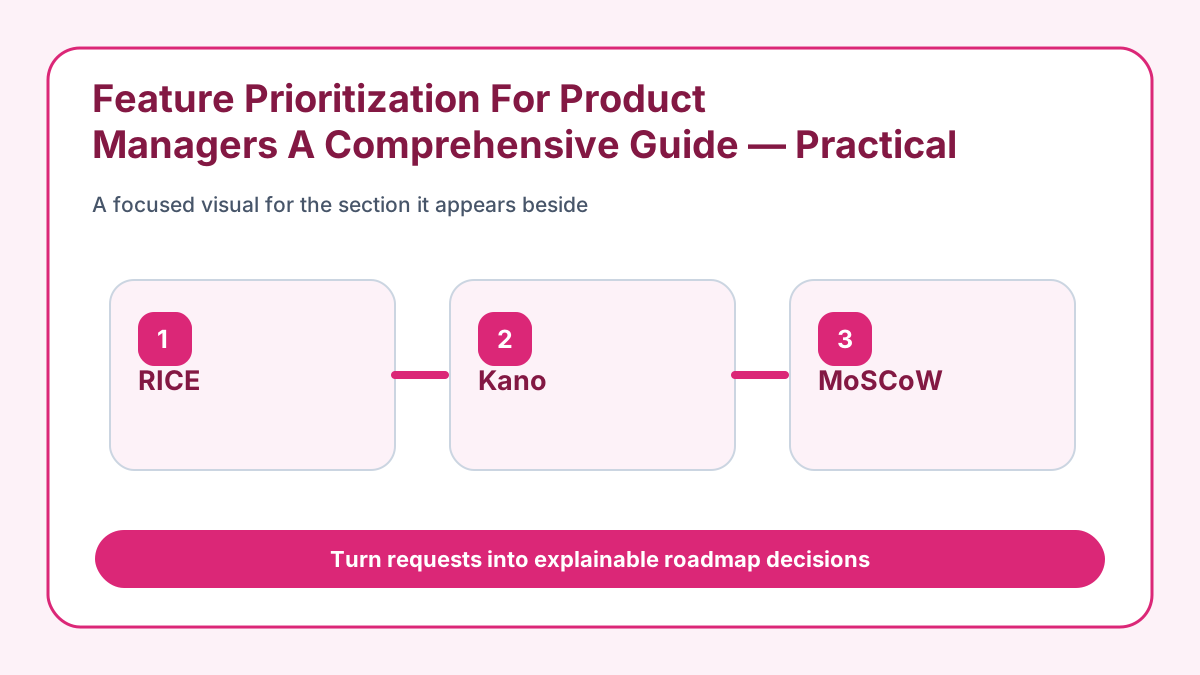
RICE scores reach, impact, confidence, and effort. It is useful when you can estimate how many users are affected and how strongly the work may influence an outcome. The danger is overconfidence: if your inputs are guesses, the final score can look more scientific than it is.
Kano groups features into basic expectations, performance improvements, delighters, indifferent items, and dissatisfiers. It helps teams see why not all requests are equal. Fixing a basic expectation may matter more than adding a flashy feature, even if the latter sounds more exciting.
MoSCoW separates must-have, should-have, could-have, and won’t-have items. It works well in release planning because it forces tradeoff language. Opportunity scoring, cost of delay, and impact-effort matrices can also help. Atlassian has a useful overview of prioritization techniques at <a href="https://www.atlassian.com/agile/product-management/prioritization-framework" rel="nofollow">Atlassian’s product prioritization framework guide</a>. Use frameworks as conversation tools, not decision machines.
How to include customer evidence without letting votes rule everything
Feature votes are valuable because they reveal repeated demand. They are not enough because customers do not see all constraints. A request with many votes might be a usability issue, documentation gap, or narrow use case. A request with fewer votes might matter deeply to a high-retention segment.
The best approach is to pair voting with comments and segmentation. Ask what problem the feature solves, how users handle it today, how often it happens, and what happens if it remains unsolved. Then compare the request with product goals and effort. For a deeper view, see feature voting.
If you need a simple way to gather that evidence, FeaturAsk lets users submit and vote on requests while admins moderate and review analytics. It costs $29.95/year, includes a 30-day free trial, and requires no credit card, so product managers can test demand before adding heavier roadmap software.
Communicating prioritization decisions clearly
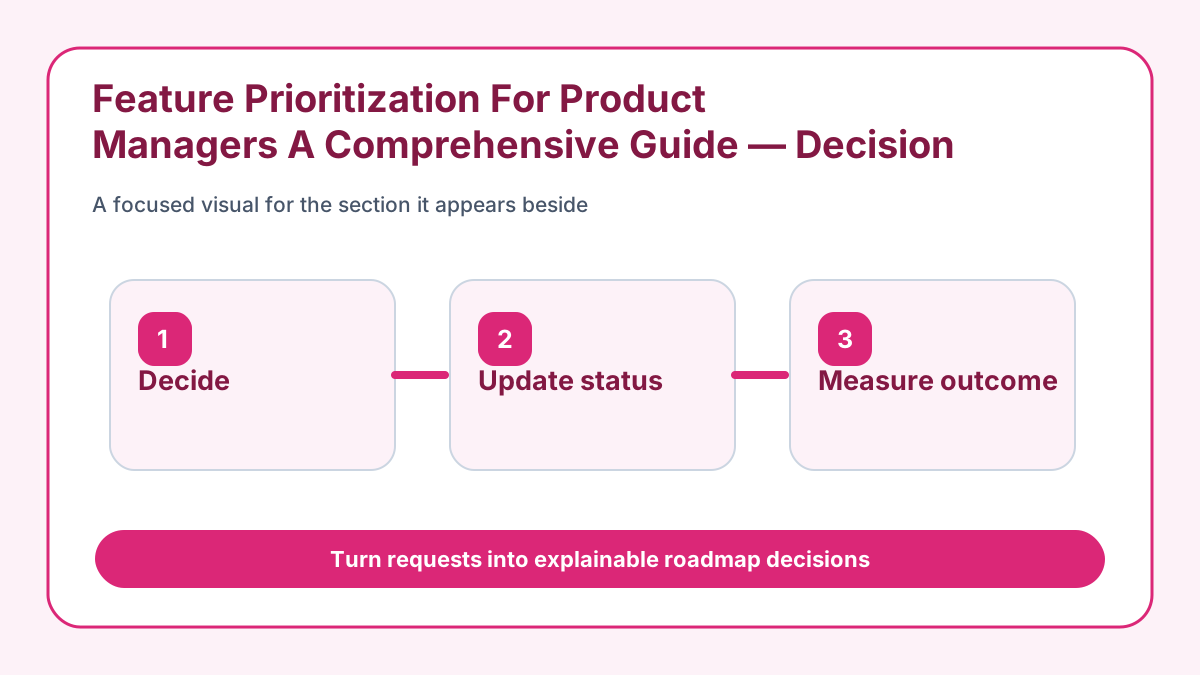
A prioritization decision is not complete until it is communicated. Internally, explain the customer problem, evidence, expected impact, tradeoffs, owner, and success measure. Externally, use careful status language: under review, planned, in progress, shipped, or not planned. Avoid promising dates unless the team has real confidence.
When you say no, be respectful and specific. “Not planned” is more useful when paired with a reason: outside current focus, too narrow for the product, solved by an existing workaround, or dependent on another project. This honesty reduces duplicate requests and shows that the team reads feedback.
When you ship, close the loop with the people who asked. Connect prioritization to launch communication using product launch communication plans and release notes. FeaturAsk helps small teams keep that loop visible from request to decision for $29.95/year after a one-month free trial, no credit card required.
A worked example of feature prioritization
Imagine a small SaaS team receives three requests: export reports to PDF, add a public roadmap, and create a new admin role. PDF export has 42 votes from many small accounts, the roadmap has 17 votes from trial users who want transparency, and the admin role has 8 votes from larger paying customers. A raw vote count would put PDF export first.
A product manager should add context. PDF export may be easy and broadly useful. The public roadmap may improve trust and reduce support questions. The admin role may protect expansion revenue and reduce security objections. The right decision depends on strategy, effort, risk, and customer segment, not only votes.
A balanced decision might ship a lightweight roadmap status page first because it improves communication around all requests, then scope PDF export, then validate the admin role with paying accounts. The important point is that prioritization turns a backlog into a sequence.
Evidence checklist before a feature enters the roadmap
Before promoting an idea, collect a short evidence note: target user, problem statement, number of requesters, vote count, representative comments, affected revenue or retention risk, current workaround, strategic fit, effort estimate, confidence level, and success metric. This note prevents vague ideas from becoming vague roadmap items.
Also record what would make the team change its mind. Maybe the feature requires ten more customers from a target segment, a clearer willingness-to-pay signal, a lower-effort design, or evidence that the problem appears during onboarding. Decision criteria make prioritization more transparent.
If you collect feature ideas in FeaturAsk, the request, votes, and comments become the starting evidence. Product managers can then add effort and strategy context during review instead of rebuilding the customer story from scattered channels.
Prioritization meeting agenda
A useful prioritization meeting is short and evidence-led. Start by reviewing goals for the quarter. Then review new high-signal requests, duplicate clusters, churn or sales objections, and recently shipped outcomes. Score only the candidates that are mature enough to compare.
For each candidate, ask five questions: who needs this, what problem does it solve, why now, what is the smallest useful version, and how will we know it worked? If the team cannot answer those questions, the item should return to discovery instead of being forced into a roadmap slot.
End with communication decisions. Which requests move to planned? Which remain under review? Which are not planned? Who updates the public board, sales notes, support macros, or release plan? Prioritization without communication creates confusion.
If you need an affordable place to collect and review the raw requests before this meeting, FeaturAsk gives you voting, comments, moderation, and analytics for $29.95/year. The 30-day free trial requires no credit card, making it easy to test with real users.
Common prioritization mistakes
The first mistake is scoring too early. If the problem, user, evidence, and expected outcome are unclear, a RICE or impact-effort score only hides uncertainty. Move unclear ideas back to discovery and ask for better context before comparing them with mature candidates.
The second mistake is treating effort as a single engineering estimate. Effort includes design complexity, QA, documentation, migration, support training, launch communication, and future maintenance. A feature that looks small in code can be expensive if it creates long-term product complexity.
The third mistake is ignoring opportunity cost. Choosing one feature means delaying another. Product managers should make the tradeoff explicit: what will not happen if this work moves forward? Clear opportunity-cost language helps stakeholders understand why even good ideas sometimes wait.
How to prioritize for different stages
Early-stage products should prioritize learning and activation. The best features are often those that help the team understand a target segment, reduce onboarding friction, or make the core promise clearer. Avoid building advanced edge cases before the main workflow is reliable.
Growing SaaS teams should prioritize retention, expansion, and operational leverage. Requests from paying customers matter, but they should be compared against churn risk, support burden, and strategic differentiation. A feature that reduces repeated support work may be more valuable than a flashy addition.
Mature teams should prioritize portfolio balance. Some work protects the core product, some expands market reach, some reduces risk, and some improves platform health. A single score may not capture that mix, so product managers should review roadmap balance as well as individual feature rank.
A final prioritization habit is to review recently shipped work before choosing the next set of features. If a shipped item did not achieve the expected outcome, the team may need iteration, better discovery, or improved launch communication before adding more scope. This keeps prioritization honest: the goal is not to keep the roadmap full, but to create measurable product progress.
Product managers should also keep a visible parking lot for good ideas that are not ready. This prevents stakeholders from feeling ignored while protecting the active roadmap. Review the parking lot during planning, remove stale items, and promote only the requests with fresh evidence, strategic fit, and a realistic path to delivery. A parking lot is not a graveyard; it is a transparent holding area with review dates, evidence gaps, and ownership. That extra clarity keeps useful ideas alive without letting them interrupt committed roadmap work every single week.
FAQ about feature prioritization
What is the best prioritization framework?
There is no universal best framework. RICE is useful for quantified reach and effort, Kano is useful for customer satisfaction tradeoffs, MoSCoW is useful for release scope, and impact-effort is useful for quick comparison. Choose the method that improves the conversation.
Should customer votes drive the roadmap?
Votes should influence the roadmap, not control it. They show demand, but product managers must add strategy, segment value, effort, risk, and timing. The best decisions combine customer evidence with product judgment.
How often should product managers reprioritize?
Review intake weekly or biweekly and reprioritize roadmap candidates monthly or at planning milestones. Reprioritizing every day creates churn; ignoring new evidence for months creates stale plans.