Product Launch Communication Plan: 5 Phases, Channels, and Template for 2026
A product launch communication plan is the shared playbook for what you will say, who needs to hear it, where each message will appear, and how you will keep momentum after release day. In 2026, that plan needs to connect product strategy, customer feedback, sales enablement, support readiness, lifecycle email, community updates, and AI-assisted search answers into one clear launch story.
The goal is adoption, not noise. A small SaaS team, creator business, e-commerce brand, or solo developer can ship a useful feature and still miss the opportunity if users do not understand why it matters. A modest release can create meaningful retention gains when the communication is specific, timely, and based on real customer needs.
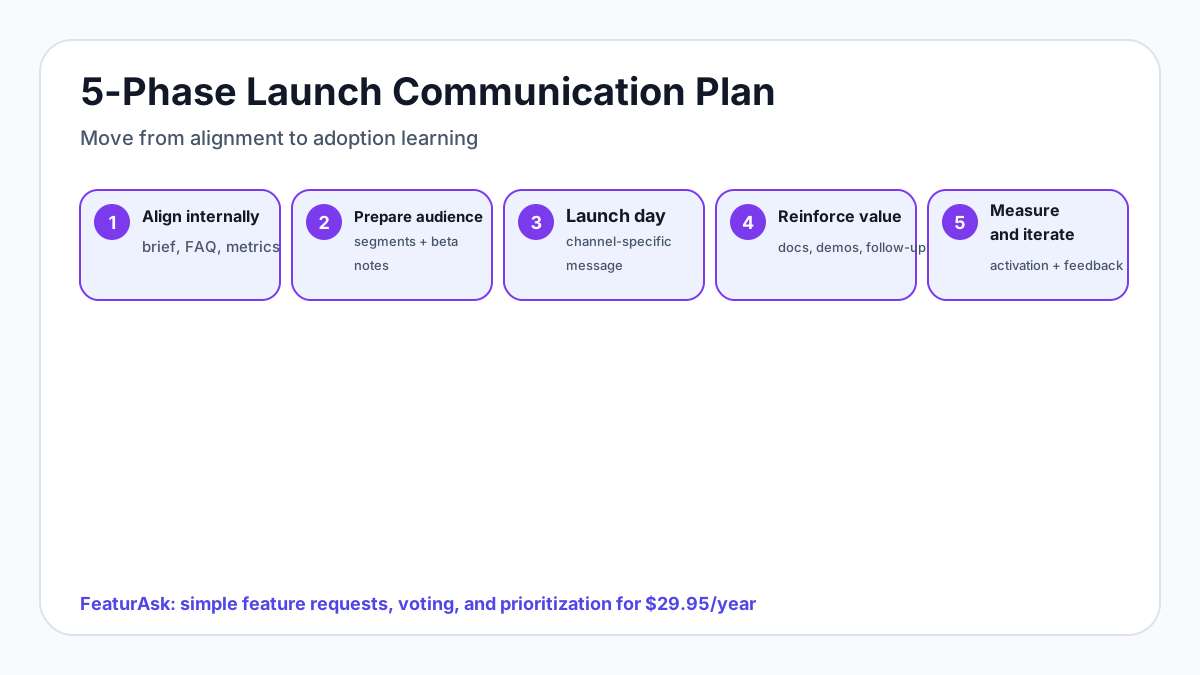
Use this guide as a practical template for five phases: internal alignment, pre-launch readiness, launch-day messaging, post-launch reinforcement, and activation measurement.
Recent benchmarks point in the same direction. Salesforce reports that 88% of customers say a company’s experience is as important as its products or services (<a href="https://www.salesforce.com/resources/research-reports/state-of-the-connected-customer/" rel="nofollow">Salesforce</a>). Pendo’s product benchmarks frame health around usage, feature adoption, retention, and stickiness rather than release volume alone (<a href="https://www.pendo.io/product-benchmarks/" rel="nofollow">Pendo</a>). Wyzowl’s 2025 research reports that most video marketers see video improving product understanding, which is why short demos belong in many launch plans (<a href="https://www.wyzowl.com/video-marketing-statistics/" rel="nofollow">Wyzowl</a>).
Why product launch communication is about adoption, not announcements
Many launch plans start with the wrong question: “Where should we announce this?” A better question is: “What does each audience need to believe, understand, and do next?” That shift changes the entire communication plan.
Your internal team may need positioning, objection handling, support macros, and release timing. Existing users may need a simple explanation of the problem solved, who the update is for, and how to try it. Prospects may need proof that the product is actively improving. Power users may want technical details, limitations, and roadmap context. New visitors may never see the original announcement, so the product page, onboarding flow, and help docs also need to reflect the launch.
A useful plan answers five questions:
- What is changing, and why does it matter now?
- Which customer segments should care most?
- What actions should each audience take?
- Which channels will carry each message?
- How will the team measure adoption, feedback, and follow-up?
For small teams, the plan can stay simple: a one-page launch brief, a lightweight timeline, a channel checklist, and a feedback loop. If your launch is tied to customer requests, connect it to your broader feature request management process.
Collecting and organizing feature requests doesn't have to be messy. FeaturAsk gives you a clean, embeddable widget and simple dashboard for $29.95/year. Get your 30-day free trial—no credit card required—and streamline your product decisions.
Phase 1: Internal alignment before anything goes public
Internal alignment is the quiet phase that determines whether the external launch feels polished. It is where you turn product details into shared language. Skip this step and every team member explains the release differently.
Start with a short launch brief. Keep it direct enough that a founder, marketer, support rep, developer, or contractor can understand it in five minutes. Include:
- Launch name and release date
- Customer problem solved
- Primary audience and secondary audiences
- Core positioning statement
- Top three benefits
- Screenshots, demo links, or walkthrough video
- Pricing or packaging impact
- Known limitations and edge cases
- Support notes and escalation owner
- Success metrics
The positioning statement should be plain: “This update helps Shopify merchants collect product-specific feature requests from their storefront so they can prioritize improvements with customer votes.” That is stronger than “We improved our feedback workflow,” because it names the audience, action, and value.
Next, build an internal FAQ. Ask the uncomfortable questions before customers do. Does it work on mobile? Is it on all plans? Can data be exported? Does it replace an old workflow? What happens to existing settings? If there are limitations, name them honestly. A launch does not need to promise perfection; it needs to set expectations.
Finally, align on the adoption path. If the release requires setup, decide who will create the tutorial, how users will find it, and what “activated” means. Adoption could be enabling a widget, importing data, inviting a teammate, publishing a board, or receiving a first vote. Define that moment before launch, because your communication should lead users toward it.
A practical internal alignment checklist:
- Product has confirmed release scope and timing.
- Marketing has approved the headline, benefit bullets, and audience segments.
- Support has macros, help docs, and known issue notes.
- Sales or founder-led demos have a short talk track.
- Analytics events are ready for activation and retention tracking.
- Feedback collection is live before the announcement goes out.
For launches based on user feedback, add one more step: tag the original requests or customer segments that influenced the release. This helps you close the loop later with messages like, “You asked for this, and it is now live.” If you are still building that system, read the related guide on organizing customer feedback for product decisions.
Phase 2: Pre-launch communication that builds readiness
Pre-launch communication is not about hyping every release. It prepares the right people so launch day feels expected, useful, and easy to act on. For a small improvement, this may be a beta email and support note. For a major release, it may include a waitlist, customer interviews, partner previews, sales enablement, community teasers, and early access onboarding.
Segment your audience before writing. Separate current users who requested the feature, current users who fit the use case, trial users, warm prospects, public followers, and internal team members. Each group needs a different angle.
Pre-launch channels can include:
- Beta invitation email
- In-app banner for eligible users
- Private community post
- Founder note to high-value accounts
- Sales one-pager or demo script
- Support documentation draft
- Landing page update scheduled for launch day
- Social teaser only if the release is broad enough
The best pre-launch messages are specific. Avoid “Something exciting is coming soon.” Instead say, “Next week, you will be able to let users vote on requests directly from your site, without sending them to a separate portal.” Specificity attracts the right attention and filters out people who are not affected.
This phase is also the time to test your onboarding path. If your call to action is “Try the new workflow,” then someone outside the product team should follow that path before launch. Can they find the feature? Do they understand what to do first? Does the help article answer the obvious question? Launch communication often fails because the message is good but the next step is unclear.
Phase 3: Launch-day communication across the right channels
Launch day is when timing, clarity, and coordination matter most. Do not treat every channel as a copy-paste destination. The same core message should adapt to the format and intent of each channel.
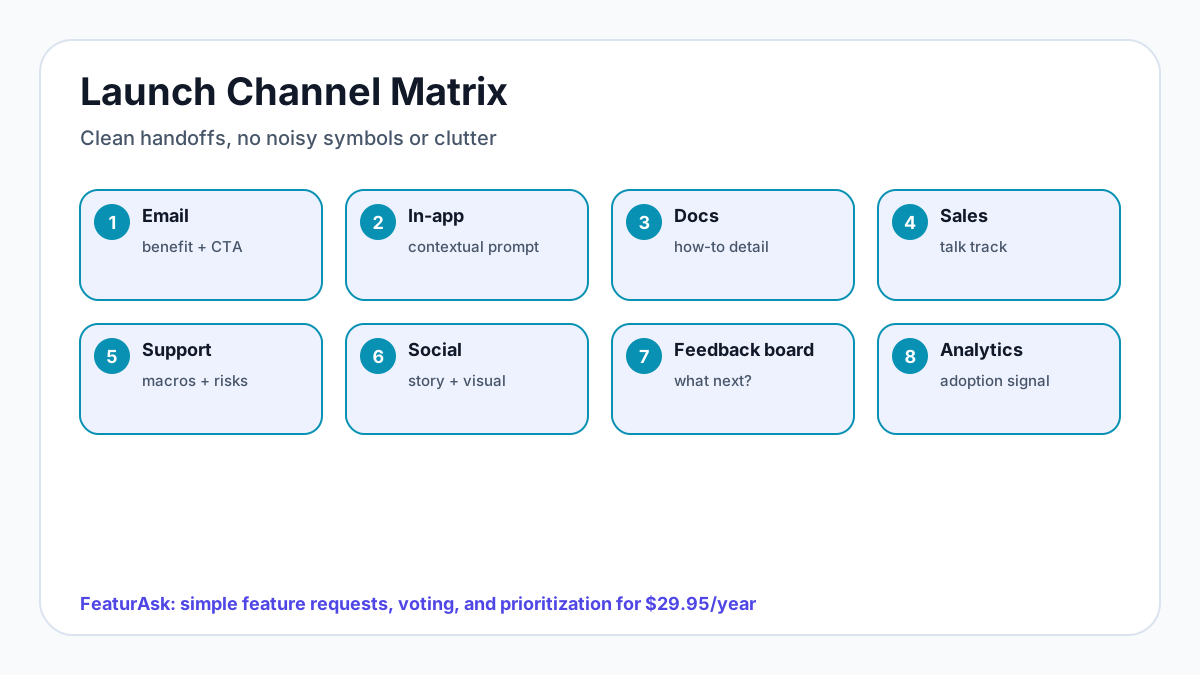
A launch-day message should include four parts: the outcome, the reason, the proof, and the action. State what users can now do, why it matters, show a screenshot or short demo when possible, and point people to one clear next step.
For email, lead with the user benefit and keep the message skimmable. Use one primary CTA. For in-app messages, be shorter and context-aware. If the feature appears inside a dashboard, link directly to that page. For social posts, focus on the story and visual. For a changelog or release note, include more detail, limitations, and links to documentation.
A simple launch-day schedule can be compact: update product pages and docs first, confirm internally, send segmented email, enable in-app messaging, publish the public note, post to social or community, follow up with warm prospects, and review support plus feedback before the day ends.
This is also where launch communication should connect directly to feedback collection. Add a prompt like, “What should we improve next?” or “Was this update useful for your workflow?” The more specific the prompt, the more useful the responses. A launch is one of the best moments to learn what users expected, what confused them, and what adjacent needs appear next.
Turn scattered customer feedback into clear product direction. FeaturAsk helps you gather ideas, prioritize requests, and communicate updates—all from a single dashboard. Start your free 30-day trial today—no credit card required.
Phase 4: Post-launch reinforcement and feedback loops
The most common launch mistake is stopping after the announcement. Users are busy. They miss emails, dismiss banners, postpone setup, and forget features that are not repeated in context. Post-launch reinforcement turns a one-day spike into sustained adoption.
Plan follow-up before launch day. Useful post-launch activities include reminder emails to users who did not activate, success emails to users who tried the feature, tutorial content, short demo clips, beta surveys, support reviews, and roadmap updates showing what changed because of feedback.
The message should change after launch. Before launch, you promise value. On launch day, you announce availability. After launch, you teach, prove, and improve. For example, a week-two message might say: “Teams using the new voting widget are getting clearer request prioritization because customers can support existing ideas instead of submitting duplicates. Here are three setup tips.”
Measure more than opens and clicks. Those are useful, but they do not prove adoption. Track metrics such as:
- Feature activation rate
- Setup completion
- Repeat usage after seven or thirty days
- Support tickets by topic
- Feedback volume and sentiment
- Upgrade or conversion influence
- Requests for adjacent features
Post-launch is also when you close the feedback loop with users who shaped the release. If a customer requested the capability, tell them it is live. If multiple users voted for the same request, notify them. If the launch creates new questions, collect them in one place and prioritize them. That loop builds trust because users see that feedback is not disappearing into a backlog.
For product teams building this habit, the next related step is turning user feedback into a product adoption strategy. Launch communication is not separate from adoption; it is one of the main ways adoption happens.
Phase 5: Activation measurement and iteration
A fifth phase keeps the launch from ending too early. After reinforcement messages are live, measure whether users actually adopted the change and decide what to improve next.
Track a small set of signals: activation rate, first meaningful action, repeat use, support tickets, feedback submissions, and related feature requests. Review the data by segment so you can see whether the release works for new accounts, power users, mobile users, and high-value customers.
Then close the loop. Thank users who requested the release, update docs with real questions, and add follow-up requests to your feedback board. Honest iteration builds more trust than pretending every launch was perfect.
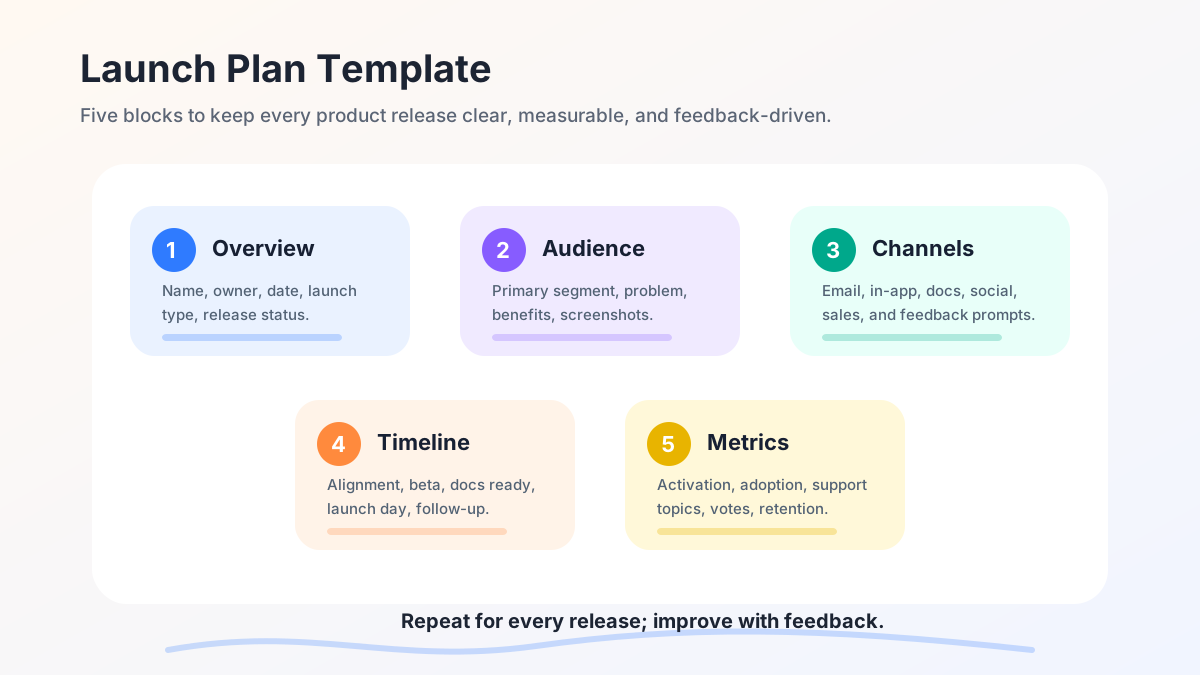
Product launch communication plan template
Use this template for each launch. Copy it into a document, task, or dashboard note. Keep it short enough to maintain.
Launch overview
- Launch name, owner, target date, launch type, and status.
Audience and positioning
- Primary audience, customer problem, main value proposition, one-sentence announcement, top three benefits, and proof points.
Channel plan
- Internal announcement, help docs, email segment, in-app message, blog or changelog, social or community post, sales follow-up, and feedback collection point.
Timeline
- Internal alignment, beta or preview, documentation ready, launch day, first follow-up, feedback review, and second reinforcement.
Success metrics
- Activation event, adoption target, feedback target, support watchlist, conversion or retention signal, and review owner.
Message examples
Email opener: “You can now [do specific action] so that [benefit].”
In-app message: “New: [feature name]. [One benefit]. Try it now.”
Feedback prompt: “What would make this release more useful for your workflow?”
Best channels for a 2026 product launch communication plan
The best channel depends on intent. Use email when the message needs attention outside the product. Use in-app messages when the user is near the action. Use a blog post when the launch needs discoverability and context. Use documentation when setup matters. Use a public roadmap or feedback portal when the release connects to user requests.
A strong 2026 launch plan often combines segmented email, contextual in-app messaging, website updates, help docs, changelog notes, community or social posts, feedback widgets, sales notes, and analytics dashboards. AI can help draft variations, summarize benefits, or create support macros, but the source of truth should come from your launch brief and customer context.
For answer engine optimization, make your public launch content easy to summarize. Include the feature name, audience, use case, benefits, availability, and next step in plain language. Add screenshots with descriptive alt text. Keep the canonical page updated after launch if details change. These small steps help people and AI systems understand what changed.
Common launch communication mistakes to avoid
The first mistake is announcing features instead of outcomes. “We added filters” is weaker than “You can now find high-priority requests by segment, status, or vote count in seconds.” Features matter because of what they help users do.
The second mistake is treating all users the same. A power user, trial user, inactive account, and prospect do not need identical messages. Even basic segmentation improves relevance.
The third mistake is forgetting support. If support learns about a launch from the customer, the plan failed. Give the team the brief, screenshots, limitations, and escalation path early.
The fourth mistake is launching without a feedback destination. Every launch creates praise, confusion, and new requests. Capture those reactions while attention is high.
The fifth mistake is measuring only announcement performance. Opens, clicks, likes, and impressions are communication metrics. Activation, retention, and qualitative feedback are adoption metrics. You need both.
A launch is not finished when the announcement is published. It is finished when the right users understand the value, take the next step, and have a clear way to respond. Build your product launch communication plan around that loop and every release becomes a chance to strengthen trust.
Whether you're a solo developer or a growing team, FeaturAsk helps you stay in sync with your users. Collect suggestions, manage priorities, and close the feedback loop—all in one place. Start your 30-day free trial—no credit card required.