8 Steps for Prioritizing Feature Requests +Top 11 Factors
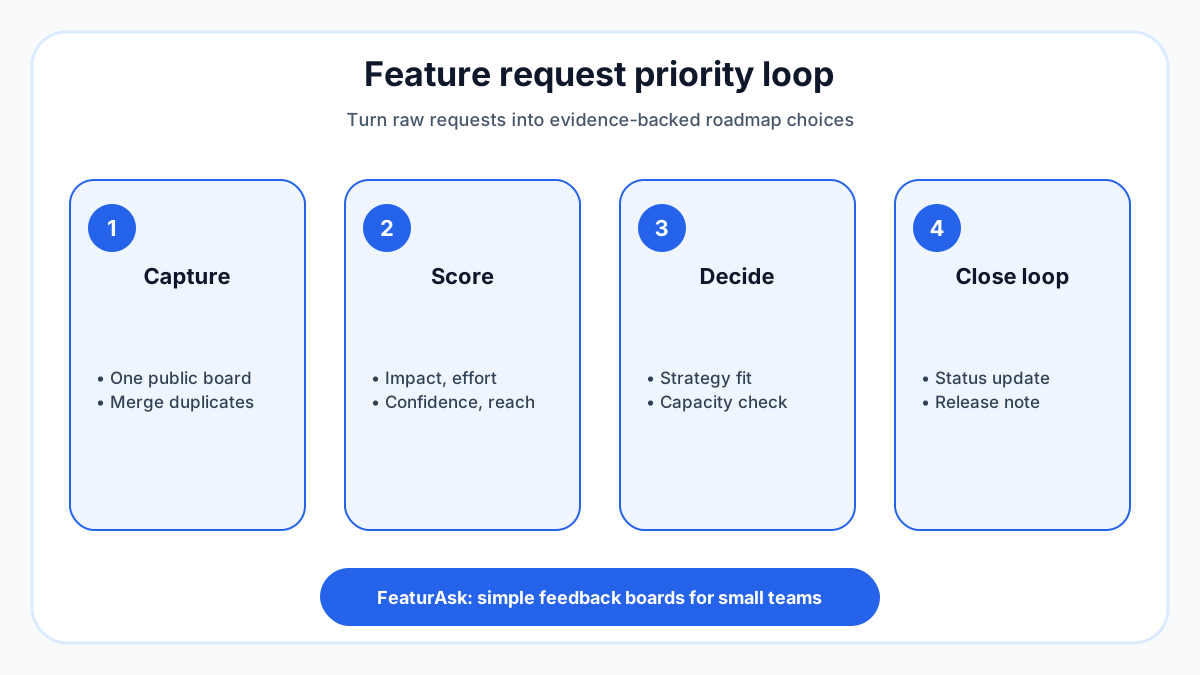
Feature requests are useful only when your team can separate signal from noise. A public board full of ideas may look customer-centric, but without prioritization it becomes another inbox. The best teams do not build every popular request, ignore quiet users, or let the newest sales opportunity rewrite the roadmap. They collect evidence, compare trade-offs, make a decision, and tell customers what happened.
This guide explains how to prioritize feature requests in a way that works for small SaaS teams, founders, product managers, and support-led product teams. It follows the same intent as common feature-prioritization advice, but the angle is deliberately lighter: you need a repeatable decision system, not a spreadsheet so complex that nobody updates it.
If your request intake is scattered across email, chat, support tickets, and private notes, start by reading FeaturAsk's guides to feature requests, the feature request process, and a practical feature prioritization matrix. Those pieces explain the surrounding workflow; this article focuses on deciding what should move next.
Quick answer: how to prioritize feature requests
Prioritize feature requests by centralizing every request, merging duplicates, clarifying the customer problem, tagging context, scoring each idea by value and effort, checking strategic fit, reviewing constraints with stakeholders, choosing a visible status, and closing the loop. Votes matter, but they are evidence rather than a command. A request with fewer votes from a critical segment may outrank a popular idea that does not support your current strategy.
A healthy process has eight steps: collect, clean, clarify, tag, score, compare, decide, and communicate. Use a framework such as RICE, value-versus-effort, MoSCoW, or weighted scoring only after the requests are clean enough to compare. Otherwise the framework gives false precision to messy inputs.
For small teams that want the intake and feedback loop without enterprise bloat, try FeaturAsk for one month free with no credit card required. If it fits, it is only $29.95/year, so you can keep a public feedback board, votes, comments, and status updates affordable while you learn what users actually need.
What counts as a feature request?
A feature request is a suggestion for a new capability, workflow, integration, customization option, report, permission, or product behavior. It is different from a bug report, complaint, support question, or broad opinion. “The CSV export fails” is a bug. “Let me schedule CSV exports every Monday” is a feature request. “The dashboard is confusing” is feedback. “Add a view that groups dashboard cards by client” may become a request after clarification.
The distinction matters because each item needs a different workflow. Bugs need severity and reproduction steps. Complaints need diagnosis. Feature requests need demand evidence, customer context, effort estimates, and product alignment. If every input goes into one undifferentiated backlog, prioritization becomes political instead of evidence-based.
Why feature request prioritization is hard
Prioritization is hard because every request carries a different kind of truth. Sales hears what would close deals. Support hears what frustrates active users. Founders protect the product vision. Engineering sees hidden complexity. Customers describe their desired solution, but not always the underlying problem. None of these perspectives is automatically wrong, yet any one of them can distort the roadmap if it dominates the process.
There is also an emotional challenge. Customers who take time to submit ideas want to feel heard. Teams often confuse “listening” with “saying yes.” The result is a bloated roadmap, long delivery cycles, and disappointed users when promised work slips. Good prioritization protects trust by making the decision criteria visible and consistent.
The 8-step workflow for prioritizing feature requests
1. Centralize every request
Put feature requests in one searchable place before you try to score them. Inputs can still arrive from support, sales calls, social media, community threads, and interviews, but the request itself should land in a shared system. A central board prevents duplicate ideas from splitting demand across ten tickets and stops important feedback from living in a single employee's memory.
For a small team, the intake should be simple: title, description, optional email, votes, comments, status, and tags. Long forms look rigorous but reduce participation. Ask for the problem and context first; you can collect more detail when a request becomes serious.
2. Clean titles and merge duplicates
Raw request titles are often vague. “Better reports,” “Slack,” and “mobile please” are not useful decision units. Edit titles so other users can recognize the idea, then merge duplicates. This is not cosmetic work. A request with 42 scattered duplicates may look weak until the demand is combined.
Keep merged comments attached to the main request. The strongest evidence is often not the vote count but the repeated wording customers use to describe why the problem matters.
3. Clarify the underlying problem
Users usually describe the solution they imagine. Your job is to understand the job they are trying to complete. Ask: What are you doing when this problem appears? How often does it happen? What do you do today instead? Who else is affected? What would success look like?
Nielsen Norman Group's guidance on user need statements is useful here: frame the user, need, and reason before jumping to a solution. Their article on <a href="https://www.nngroup.com/articles/user-need-statements/" rel="nofollow">user need statements</a> was rechecked on May 22, 2026, and remains a good reminder that clear problem framing improves product decisions.
4. Tag context, not just category
Tags should help future prioritization. Common tags include account type, use case, plan, industry, request source, customer stage, affected workflow, revenue relevance, churn risk, and strategic theme. Avoid tag sprawl. Ten useful tags beat fifty clever ones that nobody applies consistently.
Context is what prevents vote counts from becoming a popularity contest. A request from one large customer may be important if it affects retention, but a request from many free users may be important if it removes activation friction. Tags let you compare those signals without pretending they are identical.
5. Score value and confidence
A scoring model should be simple enough to survive normal work. RICE is a common option: reach, impact, confidence, and effort. ProductPlan's explainer on the <a href="https://www.productplan.com/glossary/rice-scoring-model/" rel="nofollow">RICE scoring model</a> and Intercom's original discussion of <a href="https://www.intercom.com/blog/rice-simple-prioritization-for-product-managers/" rel="nofollow">RICE prioritization</a> were both accessible when rechecked on May 22, 2026. The main lesson is that confidence matters. A big idea with weak evidence should not automatically beat a smaller idea with strong proof.
For lean teams, a five-point score for user impact, business value, effort, and confidence is often enough. Do not score every idea forever. Score the short list that might realistically enter discovery or planning.
6. Compare against product strategy
The highest-scoring request is not always the right next feature. Strategy is the filter that keeps your product coherent. If your current goal is improving onboarding for solo creators, an advanced enterprise permission system may be valuable but poorly timed. If your strategy is moving upmarket, that same permission system might become essential.
Write the current strategic themes somewhere visible. During prioritization, ask which theme each request supports. Requests that support no current theme can stay open, but they should not quietly enter the build queue because they are loud.
7. Check effort, risk, and dependencies
Engineering effort is more than “small, medium, large.” Consider backend work, data migration, permissions, UI complexity, documentation, support load, analytics, performance risk, security review, and maintenance cost. A feature that looks simple may touch billing, roles, exports, or integrations.
Atlassian's overview of <a href="https://www.atlassian.com/agile/product-management/prioritization-framework" rel="nofollow">product prioritization frameworks</a>, rechecked on May 22, 2026, is a helpful reference because it compares multiple methods instead of treating one framework as universal. The practical takeaway is to match the framework to the decision. A quarterly roadmap decision deserves more rigor than a small usability improvement.
8. Decide, publish status, and close the loop
A prioritized request still needs a visible decision. Use plain statuses such as open, under review, planned, in progress, shipped, not now, and closed. Define what each status means. “Planned” should not mean “maybe someday.” “Not now” should not mean “we ignored you.”
Close the loop when the decision changes. Thank users when you ship. Explain respectfully when you decline. Invite more evidence when you are unsure. This is where customer trust compounds: users see that requests do not disappear into a black hole.
Top 11 factors to consider
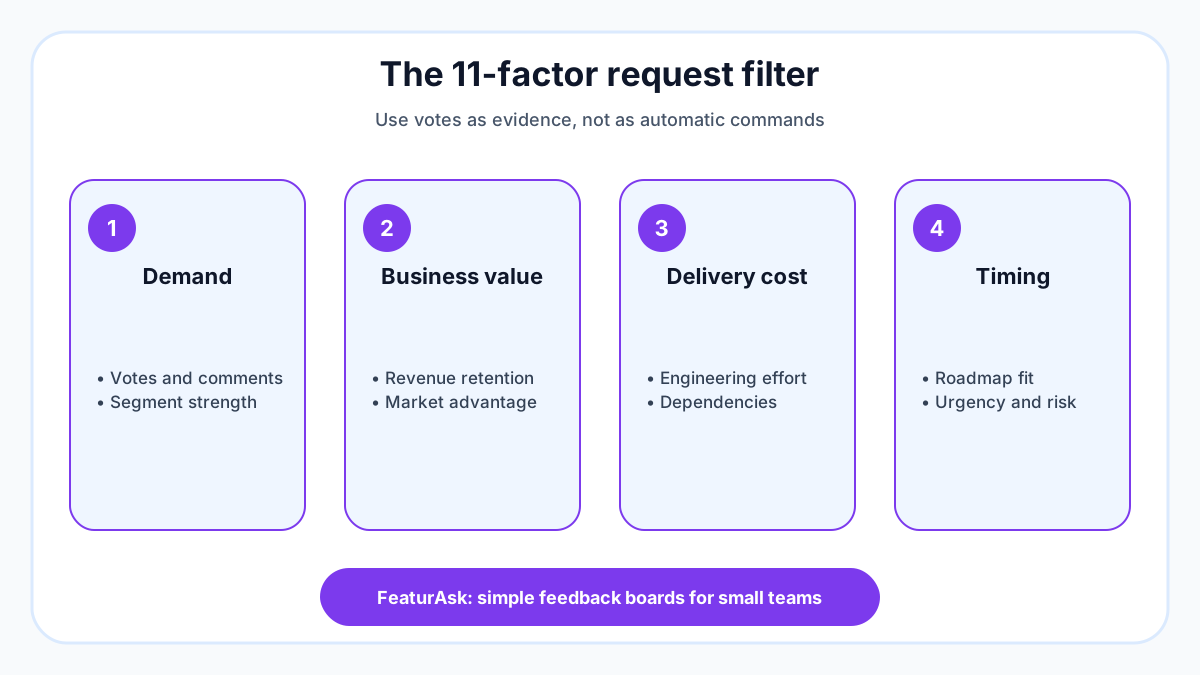
- User demand: votes, comments, duplicates, and repeated themes. 2. Customer segment: whether the request comes from your ideal customers, high-retention accounts, trial users, or a segment you do not serve. 3. Strategic alignment: how directly the request supports the current product direction. 4. Problem severity: whether the missing capability blocks work or merely adds polish. 5. Revenue impact: expansion, retention, conversion, or sales enablement. 6. Activation impact: whether the feature helps new users reach value faster. 7. Effort: engineering, design, QA, documentation, and maintenance. 8. Dependencies: other features, infrastructure, APIs, or partner work required first. 9. Risk: security, performance, legal, migration, or support risk. 10. Confidence: how strong the evidence is. 11. Timing: whether the feature fits the next planning cycle or should wait.
These factors should not all receive equal weight. A bootstrapped SaaS may weight retention and effort more heavily. A product-led growth team may weight activation and reach. A regulated B2B product may weight risk and strategic fit. The point is not to copy someone else's formula; it is to make your own trade-offs explicit.
Frameworks that work without overcomplicating the process
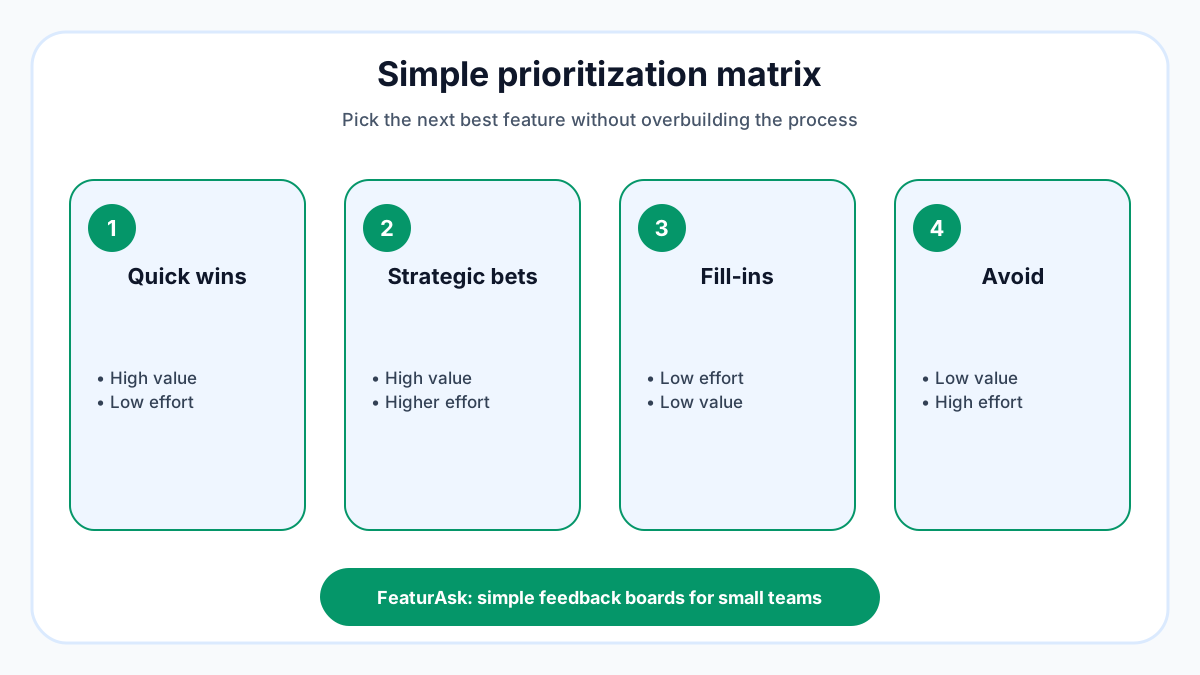
RICE is useful when you can estimate reach and effort with reasonable confidence. Value-versus-effort is best for fast visual comparison. Weighted scoring works when stakeholders disagree and need to see criteria side by side. MoSCoW can help with release scope by separating must-have, should-have, could-have, and will-not-have items. Opportunity scoring is useful when customers rate importance and satisfaction, revealing important needs that are poorly served today.
For many small teams, the best workflow is hybrid: use a feedback board for intake, tags for context, a value-versus-effort matrix for discussion, and a lightweight score for final short-list decisions. Keep the system understandable. A process that nobody maintains is worse than a simple process that runs every week.
Common mistakes to avoid
Do not treat votes as binding. Votes reveal demand, but they do not know your architecture, positioning, margins, or roadmap capacity. Do not let one enterprise prospect hijack the roadmap unless the strategic trade-off is intentional. Do not hide declined requests; a respectful “not now” is often better than silence. Do not score unclean requests; merge duplicates and clarify the problem first. Do not use too many statuses; customers should understand the board at a glance.
Another mistake is prioritizing without communicating. If users submit ideas and never see updates, the board becomes a frustration archive. Even a short note can help: “We are not building this now because our current focus is faster onboarding. We are leaving the request open for more examples.”
A lightweight monthly prioritization cadence
Every week, clean new requests, merge duplicates, remove spam, and ask clarifying questions. Every month, review the strongest themes and choose a short list for scoring. Before planning, compare the short list against strategy and capacity. After planning, update statuses. After shipping, notify contributors and link the release note.
This cadence works because it separates moderation from roadmap decisions. You do not need a strategy meeting every time a user asks for something. You do need a habit that keeps evidence clean enough for the next real decision.
If you want that loop without a heavyweight product suite, start a FeaturAsk board free for one month, no credit card required. It gives small teams a simple place to collect ideas, votes, comments, and statuses, and the paid plan is $29.95/year after the trial.
Templates for priority decisions
For a request moving to review: “Thanks for the detailed suggestion. We have merged similar requests here and are reviewing demand, impact, and effort during our next planning cycle.” For a planned request: “This is now planned because it supports our current onboarding focus and has repeated demand from active teams.” For a declined request: “We understand the use case, but it does not fit our current direction. We are keeping the request visible so others can see the decision and add context if the need changes.”
Templates keep communication consistent without making your team sound robotic. The best messages are short, specific, and honest about uncertainty.
FAQ
Should the highest-voted request always win?
No. Votes are one input. A lower-vote request may be more important if it affects activation, retention, security, accessibility, or your core customer segment.
How often should we reprioritize requests?
Clean requests weekly and reprioritize monthly or before each planning cycle. Reprioritizing every day creates churn; waiting six months lets stale assumptions harden.
What should we do with requests we will not build?
Use a clear not-now or closed status and explain why. Customers can handle a respectful no better than silence or false hope.
Build what matters next
Feature prioritization is not about proving that your team is customer-led by saying yes to everyone. It is about turning customer evidence into focused product decisions. Centralize requests, clarify the problem, score the realistic candidates, compare them against strategy, and close the loop.
FeaturAsk is designed for that simple cycle. You can collect requests through a lightweight widget, let users vote and comment, and keep everyone updated from one board. Try FeaturAsk for one month free with no credit card required; after that, it is only $29.95/year.