How to Map the SaaS Buyer Journey in 7 Steps
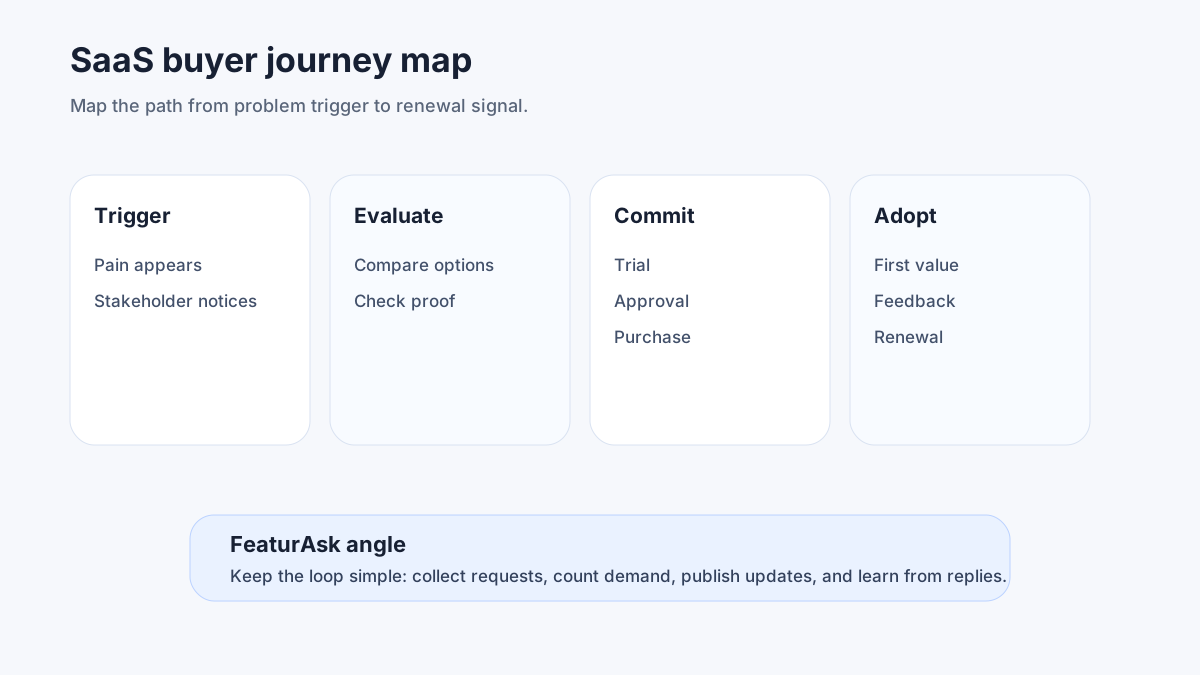
The SaaS buyer journey is no longer a tidy line from ad click to demo to contract. A buyer might read comparison pages for weeks, ask peers for recommendations, start a trial with a personal email, invite a technical teammate, disappear, return after a budget meeting, and only then speak to sales. In product-led SaaS, the buyer may also become the first user, internal champion, admin, renewal owner, and referral source.
That is why a useful journey map must include more than marketing funnel stages. It should show the moments when the customer forms a belief, encounters risk, tests value, asks for missing functionality, and decides whether your product deserves more time, budget, or trust. Good mapping helps small SaaS teams stop guessing. It connects analytics, sales notes, support tickets, customer interviews, and feature requests into one shared picture.
If you need a lightweight way to collect customer ideas while you map the journey, try FeaturAsk free for one month with no credit card. You can gather requests, votes, comments, and roadmap statuses in one place, then keep it for $29.95/year if it becomes part of your feedback loop.
For related workflows, see FeaturAsk's guides to how to prioritize feature requests, product roadmap templates, and product feedback software tools.
What is a SaaS buyer journey map?
A SaaS buyer journey map is a working model of how target customers move from problem awareness to purchase, adoption, renewal, expansion, and advocacy. It identifies the questions buyers ask, the actions they take, the proof they need, the blockers they hit, and the signals your team can measure at each stage.
The most common mistake is treating the map as a marketing artifact. Marketing matters, but SaaS buying depends on many functions. Product shapes the trial experience. Sales hears objections and procurement concerns. Customer success sees onboarding friction and renewal risk. Support hears recurring confusion. The roadmap influences whether customers stay, upgrade, or recommend the product.
Research supports a more evidence-based approach. Gartner's overview of the B2B buying journey emphasizes that business buyers complete many activities in parallel rather than following a simple sequence. Ipsos' discussion of 2025 B2B buyer journey trends also points to a more digital, complex, and buyer-controlled path. For SaaS teams, the implication is clear: your map should describe behavior you can observe, not a fantasy path you hope buyers follow.
Why SaaS teams should map the buyer journey
Mapping the journey improves decisions because it shows where growth is actually constrained. If traffic is strong but qualified signups are weak, the problem may be positioning. If signups are high but activation is low, the problem may be onboarding or a missing integration. If customers activate but churn before renewal, the issue may be expectation mismatch, slow time to value, pricing anxiety, or a product gap.
A map also gives teams a shared vocabulary. Instead of saying "conversion is down," you can say, "technical buyers reach the proof stage but stall because they cannot find security details." Instead of saying "customers want dashboards," you can say, "admins in the adoption stage need a simple way to show weekly value to their manager." That shift turns vague feedback into targeted work.
Finally, a journey map prevents over-investing in the loudest stage. Many teams pour effort into acquisition while ignoring activation and renewal. Others keep adding features without fixing the first-week experience. A full lifecycle map reminds everyone that SaaS revenue compounds when the whole system works: right-fit acquisition, fast value, visible progress, reliable communication, and continuous learning.
The 7 steps of the SaaS buyer journey
The following seven-step model works for most B2B SaaS products. You can rename stages to fit your category, but keep the lifecycle complete. The goal is not to force every account into a rigid order. The goal is to understand what each stage requires and what evidence proves movement.
1. Identify the trigger and problem context
Every journey starts before the buyer visits your site. A trigger creates urgency: a team outgrows spreadsheets, a new manager inherits a broken workflow, a renewal with a competitor is coming up, a customer complains, a board metric slips, or a manual process becomes too expensive. Your map should capture the situation that makes the problem visible.
Collect triggers from interview notes, inbound forms, sales calls, community posts, review sites, and support conversations. Ask what changed recently, what alternatives the buyer already tried, who is affected, and what happens if nothing changes. If you describe the problem differently from how buyers experience it, even a good product will feel irrelevant.
2. Map discovery and research behavior
In discovery, buyers compare possible ways to solve the problem. They may not be comparing vendors yet. They might compare doing nothing, building internally, hiring an agency, using a spreadsheet, buying a broad platform, or selecting a focused tool. Your map should show which alternatives appear in the buyer's mind and what criteria they use to narrow options.
This stage often includes SEO pages, comparison content, templates, pricing pages, reviews, peer recommendations, and internal research shared in chat threads. Watch for questions such as: Is this for companies like ours? Can we implement it quickly? Will it integrate with our stack? What will this cost after the trial?
The best output is a decision-criteria list by segment. A founder-led startup may care about speed and price. A larger team may care about permissions, security, and reporting. A finance approver may care about measurable value.
3. Clarify the proof and trust stage
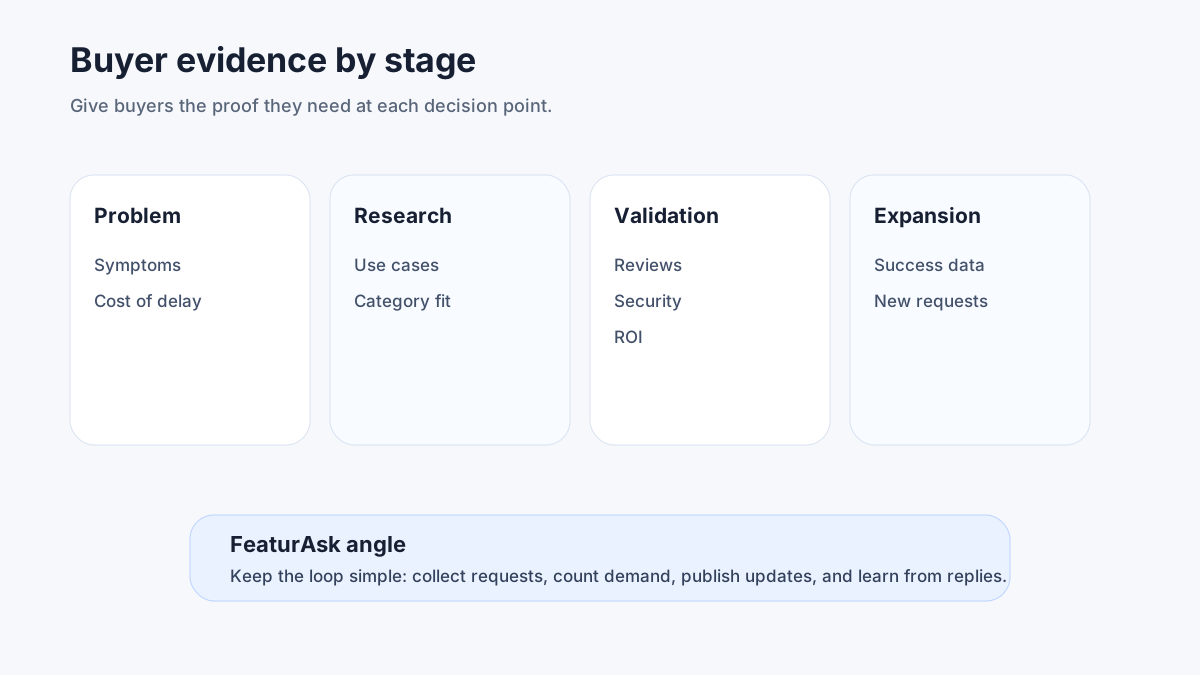
Once buyers have a shortlist, they need proof: case studies, documentation, live examples, security details, roadmap transparency, customer reviews, support responsiveness, and clear pricing. In many SaaS categories, buyers want to know not only whether the product works today, but whether the team will keep improving it.
Map the proof assets buyers use and the gaps that create hesitation. If prospects repeatedly ask for the same integration, security page, migration guide, or customer story, that is a journey signal. If they request roadmap visibility, that may indicate uncertainty about product direction. If they ask whether a feature exists, your site or onboarding may be failing to communicate.
At this stage, sales notes and product feedback are gold. Tag objections by theme and connect them to segments and outcomes. A request from one unqualified account should not steer the roadmap, but a repeated objection from right-fit accounts deserves attention.
4. Design the trial, demo, or evaluation path
Evaluation is where claims meet reality. Some buyers want a guided demo. Others want a self-serve trial. Many want both: a fast hands-on experience plus access to a human when the stakes rise. Your map should define the expected path for each segment and show how buyers reach first value.
For product-led SaaS, document the activation event that proves the buyer experienced meaningful value. It might be importing data, inviting teammates, publishing a roadmap, receiving the first customer vote, connecting an integration, or generating a report. Then identify the steps, delays, and questions before that event.
For sales-assisted SaaS, map demo requests, qualification, technical review, stakeholder follow-up, procurement, and trial success criteria. The important question is not "Did they attend the demo?" It is "Did the evaluation reduce uncertainty enough for the next commitment?"
5. Map the purchase and commitment decision
The purchase stage includes more than payment. Buyers may need budget approval, legal review, security review, data migration confidence, implementation planning, and internal alignment. Even small SaaS purchases can stall if the champion cannot explain the value to someone else.
Your journey map should separate the champion's needs from the approver's needs. The champion needs confidence that the product solves the workflow. The approver needs confidence that the cost, risk, and timing make sense. The admin may need confidence that setup will not create extra work. The end users need confidence that the product will not slow them down.
Create assets that support the internal sale: concise ROI notes, implementation checklists, security pages, pricing explanations, sample rollout plans, and clear cancellation terms. If buyers often ask the same late-stage questions, answer them earlier in the journey.
6. Map adoption and first value after purchase
The buyer journey does not end when the account pays. In SaaS, the purchase creates a promise. Adoption proves whether that promise becomes a habit. A customer who pays but fails to reach value is a future churn risk, not a success story.
Map the first 30, 60, and 90 days. What should the customer set up? Which teammates should be invited? What behavior predicts retention? What support questions appear? What features are ignored? What requests emerge only after real usage? This is where product analytics and customer feedback should meet.
For example, a team may buy feedback software to look more responsive to customers. If they collect requests but never publish statuses, they may not get the trust benefit they expected. The fix might be onboarding education or a simpler roadmap template rather than a new feature.
7. Connect renewal, expansion, and advocacy
Renewal is a decision point, not an invoice date. Customers renew when the product is useful, trusted, adopted, and worth the cost. They expand when new teams, seats, workflows, or use cases see value. They advocate when the experience is good enough to recommend publicly or privately.
Map renewal health with both quantitative and qualitative signals: active users, key feature usage, support sentiment, unresolved requests, roadmap fit, success outcomes, and pricing concerns. Expansion signals may include multiple teams using the product, new use cases, requests for admin features, or positive internal sharing.
How to build your map without overcomplicating it
Start with one high-value segment, not every possible customer. Choose a segment where you have enough data and a clear business reason to improve the journey. For a small SaaS company, that might be founder-led teams, product managers at seed-stage startups, agencies, or customer success teams.
Create a simple table with columns for stage, buyer goal, buyer questions, touchpoints, friction, evidence, owner, and metric. Fill it with what you already know, then mark assumptions. Assumptions are not bad; hidden assumptions are bad. Your next research and measurement tasks should target the biggest unknowns.
Interview a handful of recent customers, lost prospects, and churned accounts. Ask about the trigger, alternatives, evaluation steps, moments of doubt, internal stakeholders, and what finally caused action or inaction. Avoid asking people to recite your funnel. Ask for the story of what happened.
Then add behavioral data. Look at top landing pages, trial paths, activation events, feature usage, support tags, sales objections, churn reasons, and roadmap requests. Keep the map grounded in repeated patterns. One vivid comment can inspire a hypothesis, but repeated evidence should drive decisions. Do not drown the team in dashboards; pick one or two decision metrics per stage and review them with the qualitative evidence that explains why they moved.
Turn the map into product decisions
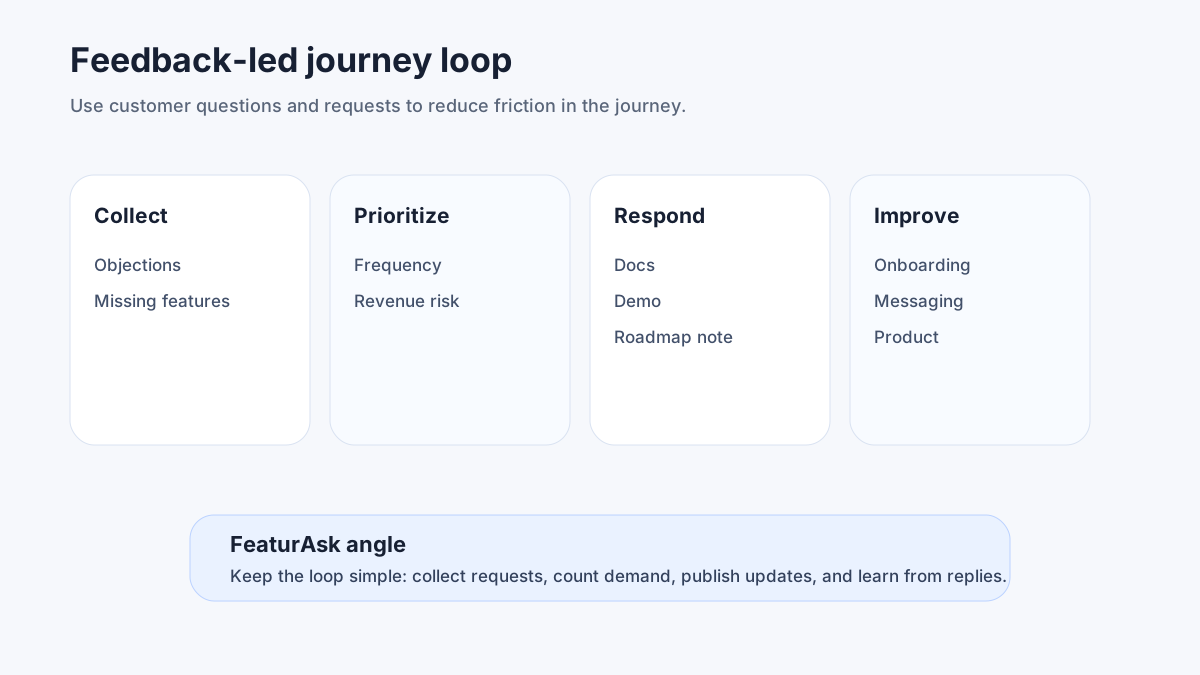
A journey map is valuable only if it changes what the team does. Use it to prioritize fixes by stage impact. If the proof stage is weak, improve documentation, comparison pages, social proof, and roadmap clarity. If evaluation is weak, shorten time to value. If adoption is weak, improve onboarding, templates, lifecycle messages, and in-product guidance. If renewal is weak, connect roadmap work to customer outcomes and close the loop when requested improvements ship.
This is where a feedback system helps. Instead of scattering requests across Slack, support tools, spreadsheets, and call notes, centralize them and tag them by journey stage. FeaturAsk is built for small teams that want this loop without enterprise overhead. Start with FeaturAsk's free month, no credit card required, then continue for $29.95/year when it is proving useful.
Common journey mapping mistakes
The first mistake is mapping the company's process instead of the buyer's reality. Your CRM stages may be useful internally, but buyers do not experience "MQL" or "SQL." They experience questions, risk, urgency, proof, setup, value, and trust.
The second mistake is stopping at purchase. In SaaS, post-purchase experience influences reviews, referrals, expansion, and the next buyer's confidence. A product that sells well but disappoints after purchase creates expensive growth.
The third mistake is ignoring negative evidence. Lost deals, churn notes, low-usage accounts, and repeated feature requests may be uncomfortable, but they show where the journey breaks. Treat them as design inputs.
A practical monthly review ritual
Once the first map exists, schedule a monthly 45-minute review with product, marketing, sales, support, and success. Pick one stage. Review the metric, read a few customer quotes, inspect the top blockers, and choose one improvement. Assign an owner and define what would prove the change helped.
The next month, review the result before choosing a new fix. This rhythm keeps the journey map alive. It also prevents teams from jumping from idea to idea without learning.
Small SaaS teams do not need a giant research function to do this well. They need a clear lifecycle model, consistent evidence capture, honest prioritization, and customer communication. If your team wants a simple place to collect and organize those customer signals, FeaturAsk gives you one month free with no credit card and stays affordable at $29.95/year.
Final takeaway
Mapping the SaaS buyer journey is not about drawing a perfect funnel. It is about understanding how customers notice a problem, compare solutions, build trust, test value, commit, adopt, renew, and recommend. The best maps combine behavior with customer language. They show where the journey creates confidence and where it creates friction.
Use the seven steps as a starting point: trigger, research, proof, evaluation, purchase, adoption, and renewal. Keep the map specific to one segment, attach evidence to every claim, and review it monthly. When the map becomes part of your operating rhythm, it stops being a slide and becomes a growth system.