Product Development Stages: A Comprehensive Guide
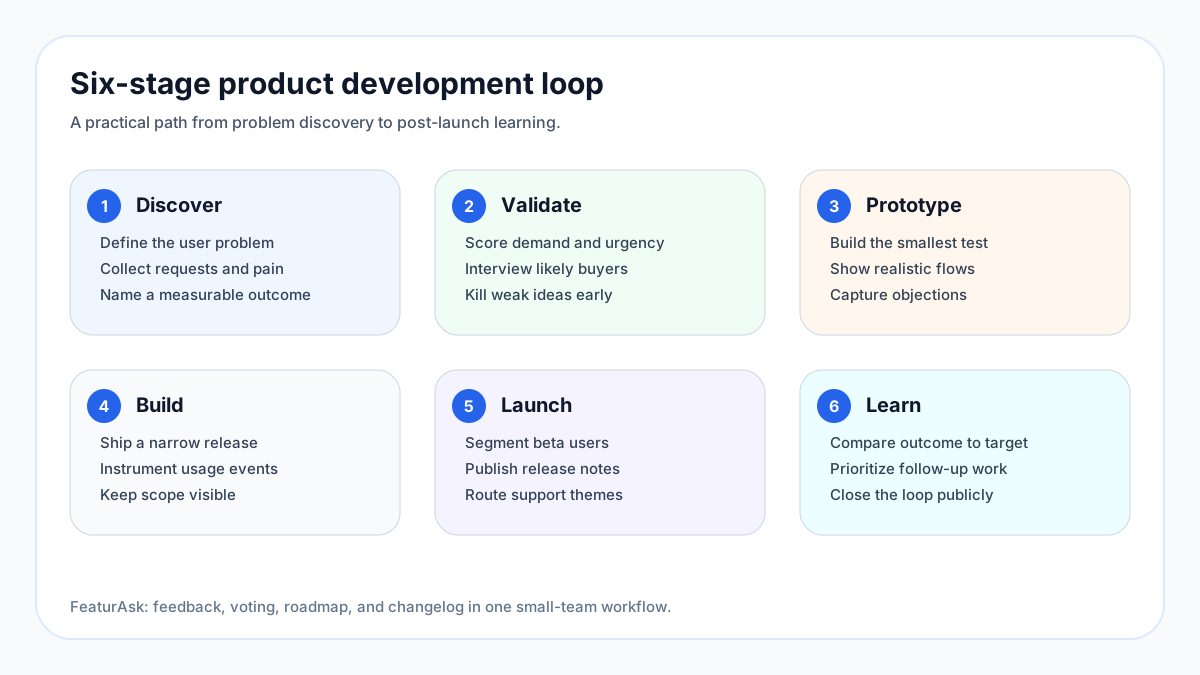
Product development is not a straight assembly line. For modern SaaS teams, it is a learning system: discover a meaningful problem, validate that the problem is worth solving, shape a small version of the solution, launch carefully, and use real feedback to decide what happens next. The stages still matter, but the handoffs are lighter and more evidence-driven than the old model of writing a long requirements document and disappearing for six months.
This guide explains the core product development stages in a way that works for founders, product managers, customer success leads, and small engineering teams. The goal is not to add ceremony. The goal is to reduce expensive guesses. A team that can connect customer requests, voting data, interviews, prototypes, release notes, and post-launch signals will ship fewer unwanted features and learn faster when a bet is wrong.
FeaturAsk is built around that loop. If you need a public feedback board, voting, roadmap statuses, and changelog updates without enterprise pricing, you can start with FeaturAsk for $29.95/year, including one month free and no credit card required.
What product development means in 2026
Product development is the process of turning a market problem into a product or product improvement that customers can use, buy, and recommend. It includes discovery, strategy, design, engineering, launch, measurement, and iteration. The exact labels vary by company, but the underlying work is consistent: decide what problem deserves attention, reduce uncertainty, build the smallest useful solution, and learn from the market.
The most important shift is that product development now happens in public and in smaller increments. Customers expect visible roadmaps, quick follow-up, and a clear explanation when their feedback influences the product. Internal teams also have better instrumentation than before. Product analytics, support transcripts, sales notes, in-app surveys, and public idea boards can all feed the same prioritization conversation.
A helpful reference point is ISO 9241-210, the human-centred design standard, which emphasizes understanding users, involving them throughout design and development, and evaluating solutions against user needs. The Nielsen Norman Group’s summary of user-centered design makes the same practical point: teams should keep users involved instead of treating research as a one-time beginning step. Sources: ISO 9241-210 and Nielsen Norman Group on user-centered design.
Stage 1: Discover the problem
Discovery starts before solution ideas. A useful discovery stage asks: who is struggling, what are they trying to accomplish, what blocks them today, and why does it matter now? Good teams gather evidence from several places rather than relying on the loudest customer or the most recent sales call.
For an early SaaS team, discovery inputs often include support tickets, churn notes, onboarding recordings, customer interviews, win-loss conversations, community threads, and product usage data. Public feedback boards help because they make demand visible. If five customers describe the same workflow gap in different words, that is more useful than a generic “add integration” request with no context.
The output of discovery should be a problem statement, not a feature spec. A strong statement includes the user segment, the situation, the current workaround, and the business consequence. For example: “Agency owners on the Pro plan cannot invite clients into approval discussions without exposing internal notes, so they export screenshots and lose revision history.” That statement can lead to several solution paths. “Build client seats” is only one of them.
Discovery also prevents product teams from confusing internal annoyance with customer urgency. A dashboard that is painful for the team to maintain may deserve refactoring, but it is not automatically a customer-facing priority. Conversely, a small paper cut repeated daily by high-retention accounts may deserve more attention than a flashy feature with weak evidence.
For a deeper FeaturAsk example of organizing incoming ideas, see the internal guide on idea tracking.
Stage 2: Validate demand before committing capacity
Validation tests whether the problem is real, frequent, painful, and tied to a customer segment the business wants to serve. It is the stage that protects engineering time. The validation question is not “Can we build this?” It is “Should we build this now, and what would make the result clearly valuable?”
Useful validation combines qualitative and quantitative signals. Interviews reveal the story behind a request. Vote counts reveal breadth of interest. Revenue or plan context reveals business weight. Usage data reveals whether the request matches actual behavior. A prototype or landing-page test can show whether users understand the proposed solution.
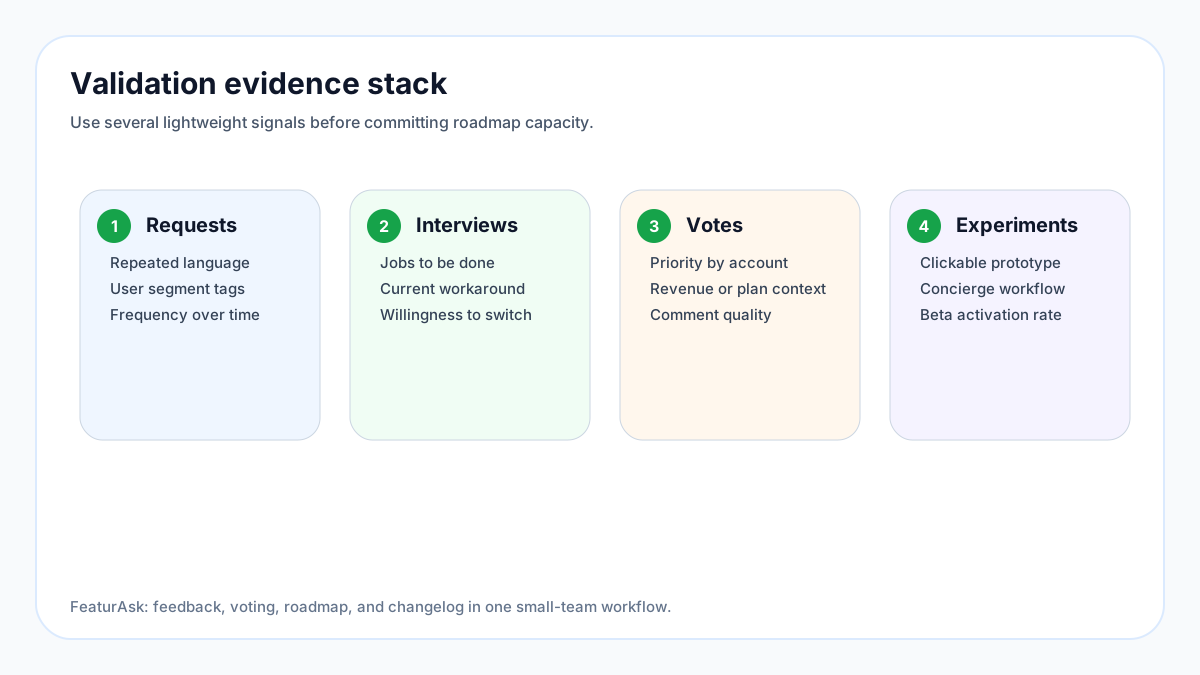
Avoid treating votes as a popularity contest. A vote from a power user who explains a costly workflow may be more informative than ten anonymous clicks. At the same time, do not let one enterprise prospect rewrite the roadmap unless that market is deliberately part of your strategy. Validation is about fit, not volume alone.
Teams should also define what would disprove the idea. That could be a minimum number of qualified interviews, a target percentage of beta activation, or a specific number of customers willing to change their workflow. If no evidence could change the team’s mind, the stage is not validation; it is confirmation theater.
Stage 3: Shape the product concept
Once demand is credible, shape the concept. Shaping turns a validated problem into a product direction with boundaries. It answers what the feature will do, what it will not do, who it is for, which risks remain, and how success will be measured.
This is where many teams either over-specify or under-specify. A 20-page requirements document can create false certainty and slow learning. A vague ticket that says “add better reporting” creates rework. The better middle ground is a short product brief: problem, target users, evidence, proposed experience, non-goals, dependencies, rollout plan, and success metrics.
A good concept should include a small narrative. What happens before the user reaches the feature? What decision do they need to make? What should be easier afterward? This narrative helps design and engineering trade off edge cases without losing the core job.
If your team needs a structure for that step, the FeaturAsk article on writing a product brief pairs well with this stage.
Stage 4: Prototype the riskiest part
A prototype is not always a polished clickable design. It can be a sketch, a fake door, a spreadsheet, a concierge workflow, a Figma flow, or a limited internal tool. The right prototype tests the riskiest assumption with the least effort.
For a workflow feature, the risk might be comprehension: can users figure out where to click and what will happen next? For an AI feature, the risk might be trust: do users accept the suggested output, and when do they override it? For a pricing-related feature, the risk might be willingness to pay or upgrade. Each risk calls for a different prototype.
Keep prototype tests focused. Ask participants to perform a task, narrate expectations, and explain what they would do if the feature disappeared. Do not ask only whether they “like” it. People are polite in research sessions. Behavior, confusion, and tradeoffs are more reliable than compliments.
Document what changed because of the prototype. If the team learns that customers want bulk editing more than advanced filters, that learning should be visible in the product brief and roadmap notes. Otherwise, prototype insights evaporate and the build stage repeats the same mistakes.
Stage 5: Build the smallest valuable release
The build stage converts the shaped concept into a shippable product increment. “Smallest valuable” does not mean unfinished or sloppy. It means the release solves the core job for the target segment without bundling every adjacent idea into version one.
Engineering and design should agree on acceptance criteria, data events, error states, permissions, and support expectations before implementation begins. Customer-facing teams should know who the release is for and which requests it addresses. If the feature came from a public board, link the build work back to the original ideas so the team can notify supporters later.
Scope control is the hardest part of this stage. New edge cases will appear. Some are essential; others are future improvements disguised as blockers. A public roadmap can help by giving those follow-up ideas a place to live instead of forcing them into the first release.
Security, privacy, and accessibility should not be afterthoughts. The W3C Web Content Accessibility Guidelines remain the common reference for making digital experiences perceivable, operable, understandable, and robust. Even small teams can catch many issues early by checking keyboard navigation, color contrast, labels, and error messaging. Source: W3C Web Content Accessibility Guidelines overview.
Stage 6: Launch with feedback paths ready
Launch is more than pressing deploy. A good launch includes user segmentation, internal enablement, help content, release notes, support routing, and a feedback path. The smaller the team, the more valuable it is to prepare these assets before the release goes live.
Decide who sees the release first. A private beta can reduce risk when the feature changes an important workflow. A percentage rollout can uncover performance issues. A full release may be appropriate for a simple improvement with low downside. In each case, define how feedback will be collected and who will respond.
This is also the time to close the loop with customers who asked for the feature. A short message that says “You asked for this, here is what changed, and here is where to leave follow-up feedback” turns product development into a relationship. It shows that requests do not fall into a black hole.
Release notes matter because they create a durable record of progress. They also help prospects understand momentum. If you want practical launch communication examples, read FeaturAsk’s guide to release notes best practices and examples.
Stage 7: Evaluate and decide what happens next
Although many frameworks stop at launch, small teams need an explicit learning stage. Evaluation asks whether the release achieved the target outcome and what the team should do next. That might mean doubling down, simplifying, expanding access, improving onboarding, or retiring a weak feature.
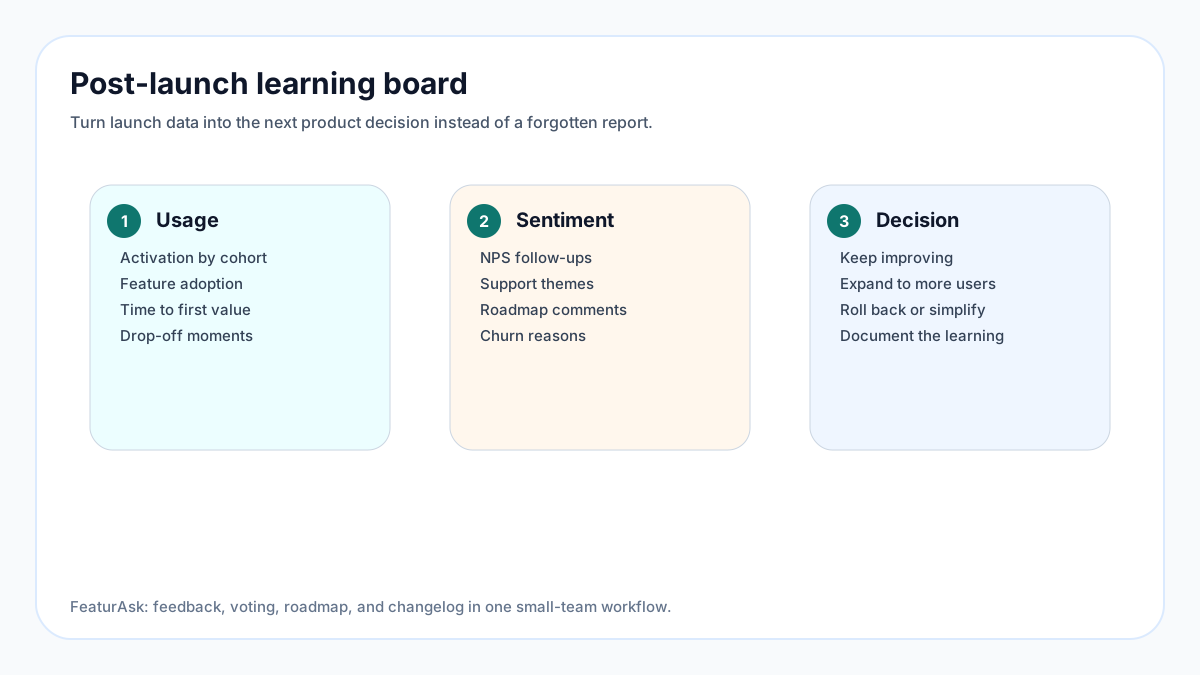
Use multiple signals. Adoption tells you whether people tried the feature. Retention or repeat usage tells you whether it stuck. Qualitative feedback explains why. Support volume reveals confusion. Churn notes reveal whether the feature changed buyer perception. Public comments reveal missing pieces that are worth considering.
Evaluation should happen soon enough to influence decisions but not so soon that the data is meaningless. A billing workflow might need a full cycle. An onboarding improvement may show evidence within days. A collaboration feature may need enough active teams to create network effects.
The final output is a decision. Do not let post-launch reviews become archival reports. Write the learning, link to the evidence, update the roadmap, and tell customers what is changing. This is where a feedback platform pays off: the same place that captured demand can communicate status and gather the next wave of input.
Metrics to track across the stages
Each stage has different success measures. Discovery is measured by clarity and evidence quality, not by the number of ideas collected. Validation is measured by confidence: enough signal to proceed, pause, or reject. Prototyping is measured by risk reduction. Build is measured by delivery quality and scope discipline. Launch is measured by reach, activation, and customer understanding. Evaluation is measured by outcome movement and the quality of the next decision.
A simple metrics set might include the number of qualified customer requests, percentage of requests linked to segments, interview completion rate, prototype task success, beta activation, feature adoption, support contacts per active account, satisfaction follow-up, and revenue or retention impact. Choose a small set that fits the decision. Too many metrics can create fog.
Common mistakes to avoid
The first mistake is starting with the solution. A team that jumps straight to “build a dashboard” may miss that users actually need alerts, exports, or a better default view. The second mistake is treating validation as a yes-or-no vote. Validation should refine the problem and reveal constraints. The third mistake is launching without a feedback path. If users cannot respond, the team loses the best chance to learn.
Another mistake is letting the roadmap become private mythology. Customers do not need to see every internal debate, but they do benefit from clear statuses and honest updates. Public visibility also disciplines the team to explain why work matters.
How FeaturAsk supports the development loop
FeaturAsk gives small teams a lightweight system for collecting ideas, letting users vote, grouping requests, publishing roadmap statuses, and announcing changes. It is not meant to replace product judgment. It is meant to make the evidence easier to see and the customer loop easier to close.
If you are mapping your next product development cycle, try FeaturAsk for $29.95/year with one month free and no credit card required. Start with one board, invite a small customer segment, and use the next release to prove the loop.
Final thoughts
Product development stages are useful when they help a team learn in order: discover the problem, validate demand, shape the concept, prototype the risky part, build a narrow release, launch deliberately, and evaluate the result. They become harmful when treated as paperwork or gates that replace customer evidence.
The best small teams keep the process visible, concise, and connected to real users. They do not need a giant tool stack to do it. They need a shared source of truth, disciplined decisions, and a habit of closing the loop. FeaturAsk gives you that customer-facing feedback loop for $29.95/year, plus one month free and no credit card required.