What's a Good NPS Survey Response Rate? See Real Benchmarks
Customer feedback, support conversations, and product data now move too quickly for teams to rely on guesswork. This guide gives you a practical FeaturAsk-style approach to nps survey response rate: clear enough for small teams, current enough for modern product work, and focused on actions rather than bloated process.
Relevant sources for the current landscape include Qualtrics guidance on improving survey response rates, Qualtrics NPS guide, Pew Research Center on survey response trends.
What counts as a good NPS survey response rate?
A good NPS survey response rate is high enough to represent the customers whose experience you need to understand and stable enough to compare over time. For many customer surveys, a response rate in the 10 to 30 percent range can be workable, while in-product micro-surveys sent at the right moment may perform better and cold email surveys may perform worse. Qualtrics guidance on response-rate improvement emphasizes that survey length, relevance, audience targeting, and invitation clarity all change the outcome.
The practical benchmark is not a single number. A 12 percent response rate from active paying users may be more useful than a 40 percent response rate from a tiny group of recent support contacts. NPS is decision support, so judge response rate by whether it gives you enough signal to act without overreacting to noise.
Why response rates vary so much
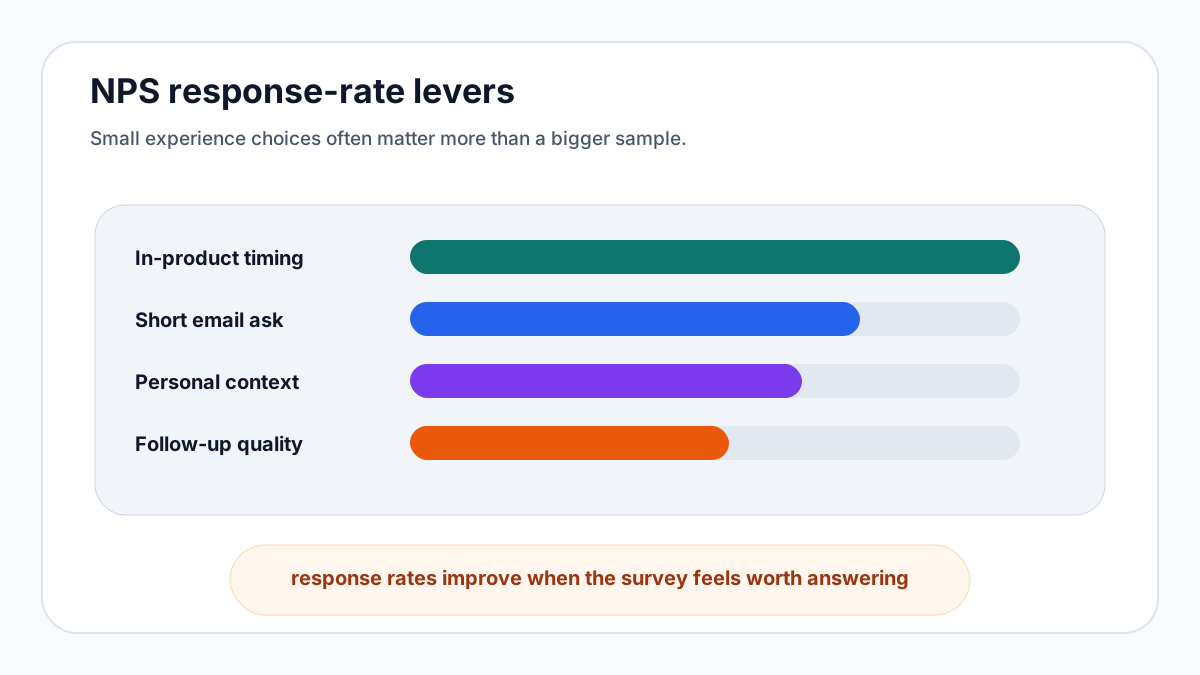
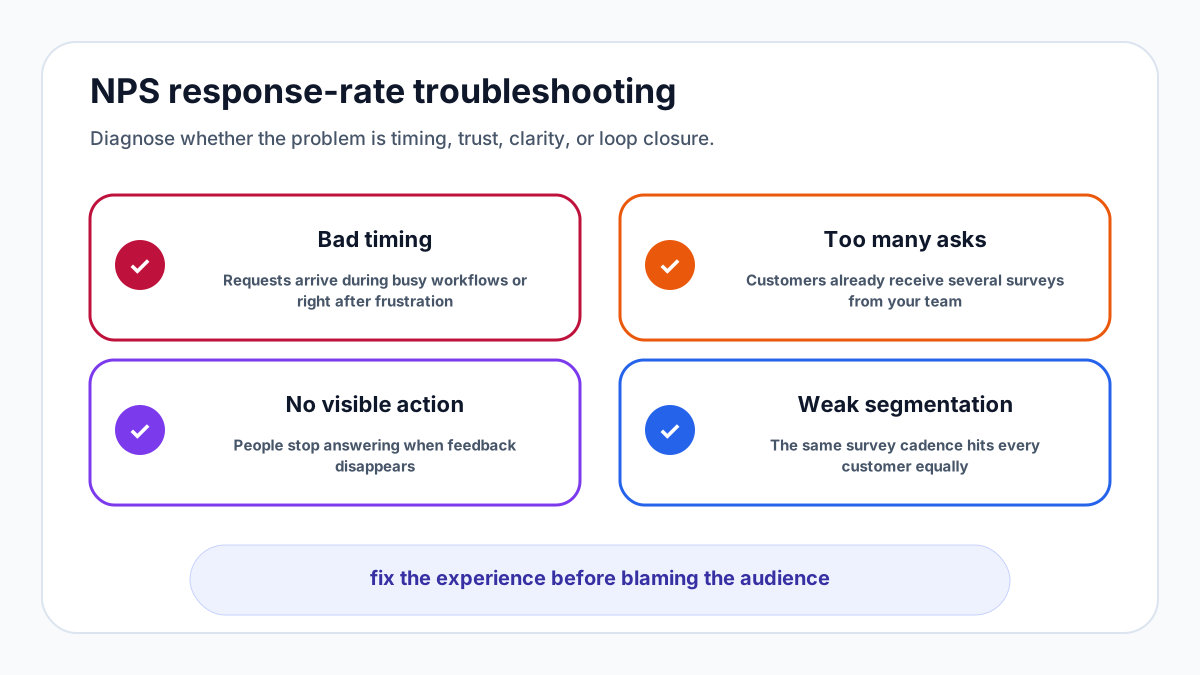
Trust is the first variable. Customers answer when they believe the company will use the feedback respectfully and visibly. If previous surveys vanished into a black hole, response rates fall. If customers have seen release notes, roadmap updates, or direct replies based on feedback, they are more likely to participate.
Timing is the second variable. A survey sent immediately after a support resolution measures a fresh experience. A survey sent during a busy workday with no context may be ignored. Channel also matters. In-product prompts reach active users, email reaches account contacts, and SMS can work for urgent consumer journeys but may feel intrusive in B2B settings.
Survey burden is the third variable. NPS works partly because the core question is short. Adding ten required follow-up questions can destroy completion. Keep the initial ask simple and use optional follow-up paths for customers who want to explain.
Benchmarks to use responsibly
Use broad benchmarks as guardrails, not goals. If your relationship NPS email gets below five percent from active customers, the invitation, timing, or trust level probably needs work. If your post-support transactional NPS gets above 40 percent, make sure the sample is not biased toward only the happiest customers. Pew Research Center’s work on survey methodology is a useful reminder that lower response rates do not automatically invalidate research, but they do require careful interpretation.
Segment every response rate. Compare new users against long-time users, free users against paying customers, enterprise accounts against small accounts, and promoters against detractors. A low overall rate can hide a healthy response from your most important segment or a dangerous silence from customers at risk.
How to increase NPS response rate
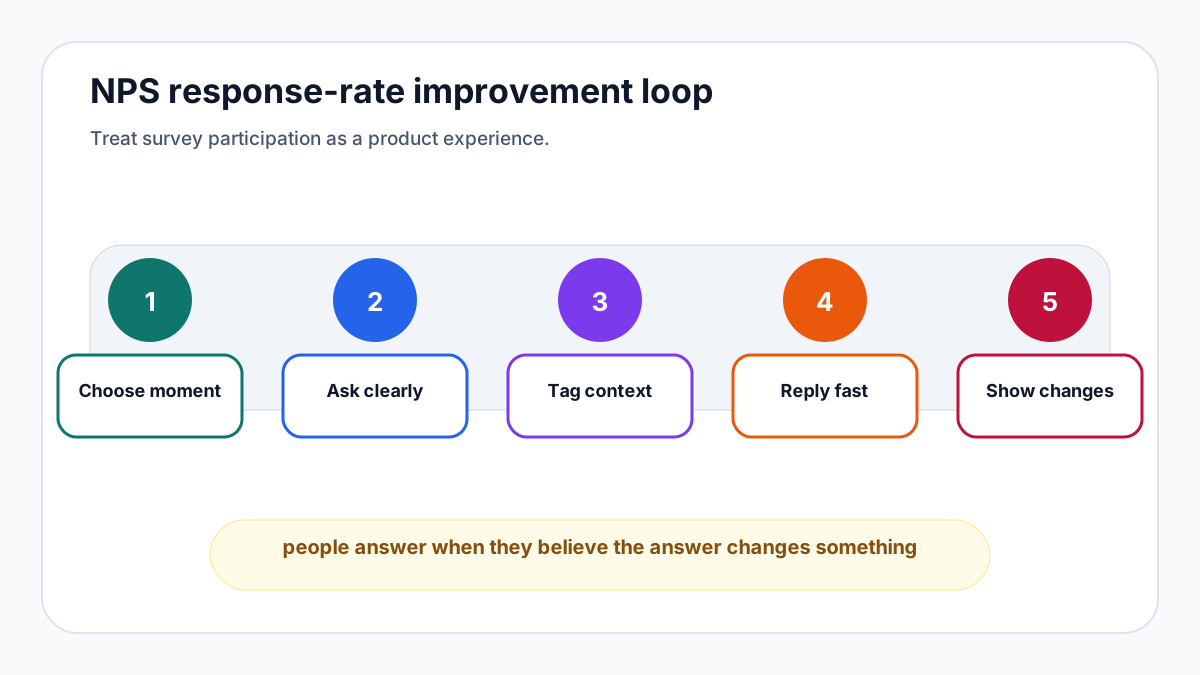
Write a clear invitation. Tell the customer the survey takes less than a minute and explain why you are asking now. “You just finished onboarding, and we want to improve that experience” is stronger than “Please complete our survey.”
Send at the right moment. Trigger transactional NPS after support closure, purchase, onboarding, implementation, or meaningful product use. Send relationship NPS on a predictable cadence and suppress customers who recently answered. Nobody should feel chased by your feedback program.
Make the follow-up human. If a detractor gives a low score and a clear reason, reply. If a promoter praises a feature, thank them and ask whether you can quote the feedback. When customers see action, the next survey gets easier.
Improve the score, not only the response rate
A higher response rate is not useful if the product experience remains broken. Pair NPS with theme analysis. Group comments by onboarding, pricing, reliability, missing features, support, and documentation. Then connect each theme to a next action.
Feature requests deserve a visible workflow because they often appear in NPS comments. If customers say they would recommend the product if it had a certain capability, collect those ideas in a place where others can vote and add context. FeaturAsk gives you that board with a one-month free trial and no credit card, then costs $29.95/year for teams that want to keep the loop open.
A simple response-rate operating model
For each survey, define the audience, trigger, expected response range, minimum sample size, follow-up owner, and action deadline. Review the program monthly. If the response rate drops, inspect deliverability, wording, audience fatigue, and whether customers received visible updates from the last survey.
Also connect NPS with your product communication. The FeaturAsk blog has practical guides on release note best practices, SEO and product metrics, and feedback-informed roadmaps. The habit is simple: ask, learn, prioritize, ship, and tell customers what changed.
If you want to turn survey comments into ranked product ideas, start FeaturAsk without a credit card. The first month is free, and the yearly price is $29.95.
Practical next steps
Do not try to increase response rate with tricks that reduce trust. Misleading subject lines, forced popups, or incentives that attract rushed answers may raise the percentage while lowering the usefulness of the data.
A healthy NPS program has a visible cadence. Customers know why they are being asked, internal teams know who owns follow-up, and product leaders review themes alongside usage and revenue metrics. That operating rhythm matters more than squeezing a few extra points from the response rate.
If you want the feedback side of this workflow to stay simple, launch FeaturAsk with a one-month free trial and no credit card. It is built for feature requests, voting, and lightweight prioritization at $29.95/year, so you can learn from customers without buying an enterprise platform.
Diagnosing a low response rate
If response rate is low, inspect deliverability first. Are invitations landing in spam? Are they sent from a recognizable sender? Does the subject line explain the ask? A well-timed survey can still fail if customers do not trust the message or never see it.
Next, inspect audience fit. Do not survey every contact in the CRM if only active users understand the product experience. Do not survey a buyer about a workflow used by administrators unless the buyer is the person who felt the friction. A smaller, better-matched audience often produces better insight than a broad list.
Then inspect timing. A relationship survey sent immediately after a service outage will measure outage frustration. A product survey sent months after usage will rely on memory. Trigger transactional surveys close to the event and relationship surveys on a consistent cadence that avoids busy periods when possible.
Review the survey itself. If the first screen shows a long form, people leave. Put the zero-to-ten scale and one optional follow-up first. Ask for extra details only after the user has submitted the core answer or shown willingness to continue.
Finally, look at whether customers have seen action from previous feedback. Response rate is a trust metric. When customers hear “we changed this because you told us,” future participation becomes easier. When they hear nothing, even loyal users stop answering.
Turning more responses into better decisions
Once response volume improves, resist the urge to chase the score for its own sake. A rising NPS score is encouraging, but the business value comes from better decisions. Review comments by theme and ask which team can act: product, support, onboarding, marketing, billing, or leadership.
Create thresholds for action before the survey goes out. For example, decide that any account giving a zero to three with a written comment gets a human follow-up within two business days. Decide that any theme appearing in more than ten percent of comments will be reviewed in the next product meeting. Clear thresholds prevent feedback from becoming a vague pile of opinions.
Use confidence language. If only eight people responded, say the result is directional. If two hundred active users responded across key segments, you can make stronger claims. The point is not academic perfection; it is honest interpretation.
Avoid comparing unrelated surveys. A transactional support NPS and a quarterly relationship NPS answer different questions. Keep separate trend lines for separate survey types, and label them clearly so executives do not overinterpret changes.
End every NPS review with a communication plan. Customers should hear what changed, what you are still investigating, and what you decided not to pursue. That visible loop improves trust, which improves the next response rate and the quality of comments you receive.
Decision checklist before you commit
Before optimizing response rate, define the minimum useful sample for the decision you need to make. A small exploratory survey may only need directional comments. A board-level customer health report needs stronger segment coverage and more careful interpretation. The same percentage can be adequate in one case and weak in another.
Check whether the survey asks at the right level. Relationship NPS, transactional NPS, and product NPS should not be mixed into one trend line. Separate them so the team knows whether a change reflects brand sentiment, a specific service moment, or a product experience.
Review nonresponse risk. If silent customers are mostly inactive, unhappy, or low-engagement users, your score may look healthier than the full customer base. Use product usage and churn signals to identify which voices are missing, then adjust outreach or interpretation.
Document the next action for every major theme. If the survey finds pricing confusion, onboarding friction, or missing feature demand, the finding should move into an owned workflow. Without ownership, a better response rate only produces a larger backlog of unresolved insight.
Keep a response-rate log next to your NPS results. Record audience size, invitations delivered, reminders sent, responses received, completion rate, channel, and timing. This turns improvement into an experiment instead of a debate. If a shorter invitation lifts completion or an in-product prompt reaches a better segment, the team can repeat the pattern.
Remember that response quality matters as much as response volume. A thoughtful comment from a strategic customer can change a roadmap discussion, while dozens of rushed answers may only confirm what you already knew. Review both the percentage and the usefulness of the comments before declaring success.
When in doubt, improve clarity before adding incentives. Customers are more likely to answer a short, relevant survey from a recognizable team than a vague request with a reward attached. Relevance creates better data.
Also review reminder timing. One polite reminder can help, but repeated nudges can train customers to ignore future research requests entirely.
The best programs keep the ask short and the response visible. When customers see action, future surveys feel less like interruption and more like participation in the product’s direction.
That participation is the real goal. A response rate is useful only when it helps the team hear more clearly and act more responsibly.
FAQs
How often should this process be reviewed?
Review the operating metrics monthly and review strategic assumptions quarterly. Fast-moving teams can review high-signal feedback weekly, but the cadence should be predictable enough that customers and teammates see follow-through.
What is the biggest mistake to avoid?
The biggest mistake is collecting feedback without assigning ownership for the next action. Every survey, request board, support trend, or product brief should have a person responsible for interpreting the signal and deciding what happens next.
Can a small team use this without extra process?
Yes. Keep the workflow lightweight: capture the signal, group similar items, choose the next best action, ship or explain the decision, and close the loop. The habit matters more than complex tooling.