How to Create a Smart Innovation Roadmap with Tools and Examples
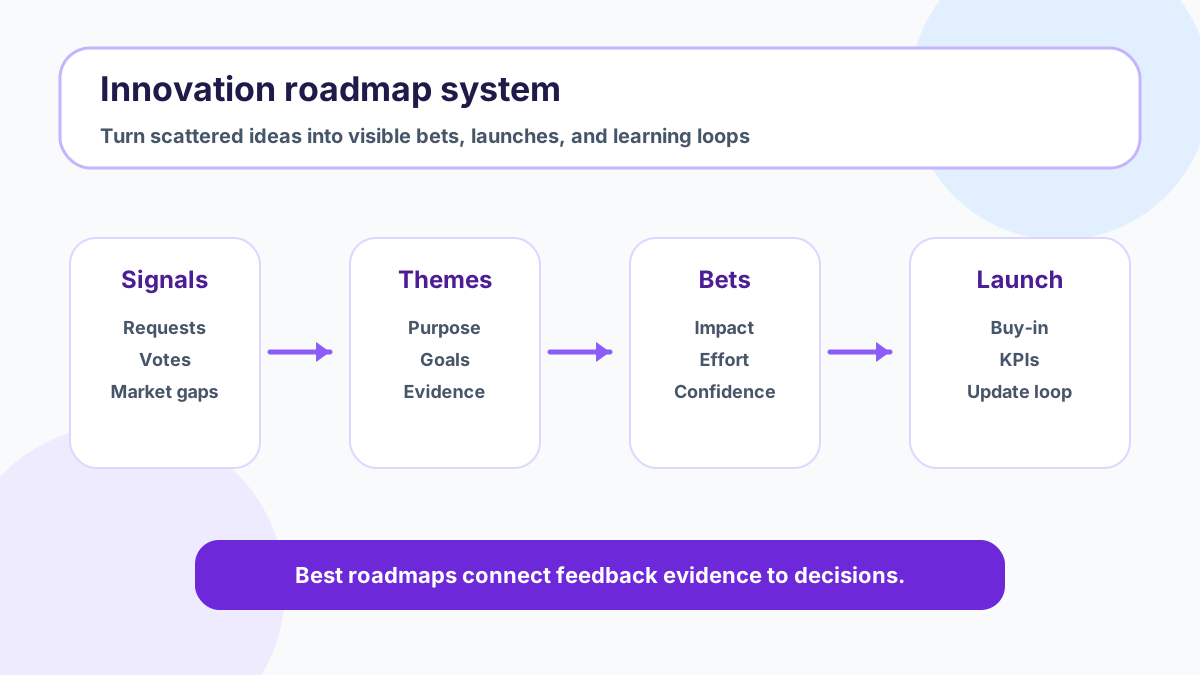
An innovation roadmap is the bridge between “we should explore this” and “this is the sequence of bets we are willing to resource.” It gives teams a visible way to connect strategy, customer evidence, experiments, delivery capacity, and learning. Without one, innovation becomes either a wish list or a yearly presentation that no one opens after the kickoff.
A useful roadmap is not a promise that every item will ship on a fixed date. It is a living decision system. It explains which problems matter, which opportunities are being investigated, which ideas were declined, which bets have owners, and how the organization will know whether progress is real. For small SaaS teams, that system can be surprisingly lightweight: collect requests, group the strongest themes, score impact and effort, publish the next bets, and update people when evidence changes.
If your roadmap inputs are scattered across support tickets, calls, Slack, and founder memory, start with a public feedback loop. FeaturAsk gives small teams a feature request widget, voting, comments, analytics, moderation, and custom branding so roadmap discovery does not require an enterprise suite. You can try FeaturAsk free for one month with no credit card, then keep it for $29.95/year when it becomes your roadmap intake home.
For more context around the request side of roadmap work, pair this guide with FeaturAsk's articles on how to prioritize feature requests, feedback board software, and how to say no to customers and feature requests.
What is an innovation roadmap?
An innovation roadmap is a structured plan for moving from opportunity discovery to validated outcomes. It usually includes innovation themes, customer or market signals, candidate ideas, priority decisions, timelines or horizons, ownership, dependencies, success metrics, and update rules. It can cover product innovation, business model changes, internal operations, go-to-market experiments, platform investments, or new market exploration.
The key word is “innovation,” not “calendar.” A release plan says what will be built. A product roadmap says where the product is heading. An innovation roadmap focuses on uncertainty: which assumptions need testing, which strategic options deserve investment, and which new capabilities may create future advantage. That is why the best versions contain experiments and learning milestones, not only features.
ProductPlan's public glossary describes roadmaps as high-level visual summaries that communicate strategy and direction, while Atlassian's product roadmap guidance emphasizes alignment, priorities, and outcomes. Those definitions are useful because they keep the roadmap away from task management. Your backlog may be detailed; your roadmap should help people understand why the work exists and what trade-offs were made.
Why innovation roadmaps matter
Innovation fails quietly when ideas have no path. A customer request is captured, a competitor launches something, a sales call reveals a gap, or a support pattern points to friction. Everyone agrees the signal is interesting, but no one owns the next step. Months later the same conversation returns with less context and more frustration.
A roadmap prevents that waste in four ways. First, it translates strategy into action. If the company says retention matters, the roadmap should show which retention problems are being explored and which metrics will prove improvement. Second, it aligns groups that normally use different languages. Product may talk about discovery, engineering about capacity, sales about revenue, and customer success about churn risk. A shared roadmap gives them one place to compare evidence.
Third, it creates visibility. People can see what is under review, what is committed, what is waiting, and what was rejected. That transparency reduces duplicate debates and makes it easier to say no with respect. Fourth, it builds an innovation habit. Teams learn to capture signals, test assumptions, ship smaller improvements, and revisit the plan rather than treating innovation as an annual workshop.
Core elements of a strong innovation roadmap
A practical roadmap needs enough structure to guide decisions without becoming a bureaucracy. Start with the purpose. Is this roadmap meant to increase activation, open a new segment, reduce operational cost, support a platform migration, or test an adjacent product? A vague purpose creates vague prioritization.
Next define themes. Themes are the strategic lanes that help you group ideas. Examples include onboarding speed, team collaboration, reporting depth, mobile workflows, integrations, security readiness, or customer self-service. Under each theme, capture evidence: feedback volume, customer segments, votes, revenue impact, support costs, competitive pressure, research notes, and confidence level.
Then add decision fields. At minimum, each candidate initiative should have an owner, problem statement, expected impact, effort estimate, confidence score, dependencies, status, and target horizon. Use horizons such as now, next, later, or discovery, validation, build, launched. They communicate direction without pretending every exploratory bet has a precise date.
Finally define success measures. These may be product metrics, business metrics, or learning metrics. For example, an onboarding innovation might target activation rate, time to first value, support tickets per new account, and qualitative confidence. An enterprise-readiness bet might target qualified pipeline, security review completion, and expansion conversations.
The innovation roadmap process: 9 steps
1. Set the purpose and scope
Begin by deciding what the roadmap covers and what it does not. A company-wide innovation roadmap can become too broad for a small team, while a narrow feature roadmap may miss business model or workflow opportunities. Write a one-paragraph scope statement: “This roadmap covers product and onboarding improvements intended to increase retention among self-serve SaaS customers over the next two quarters.” That sentence will save hours of debate.
2. Align on strategic goals and themes
Tie the roadmap to goals the business already cares about. If the company goal is expansion revenue, themes may include admin controls, reporting, account management, and collaboration. If the goal is acquisition efficiency, themes may include SEO-led assets, signup conversion, templates, and proof points. Keep the number of themes small enough to remember.
3. Collect feedback from customers and stakeholders
Roadmaps built only from internal opinions drift toward politics. Collect external demand through feedback boards, interviews, support patterns, sales notes, win-loss notes, analytics, and cancellation reasons. The point is not to obey every request; it is to see recurring pain with context. A voting board is especially helpful because customers can add comments and other users can confirm demand.
This is where a lightweight tool can beat a complicated process. With FeaturAsk, users can submit requests, vote, and comment while your team moderates duplicates and reviews analytics. If you want a low-cost way to make roadmap input visible, start FeaturAsk with one free month, no credit card, and $29.95/year after that.
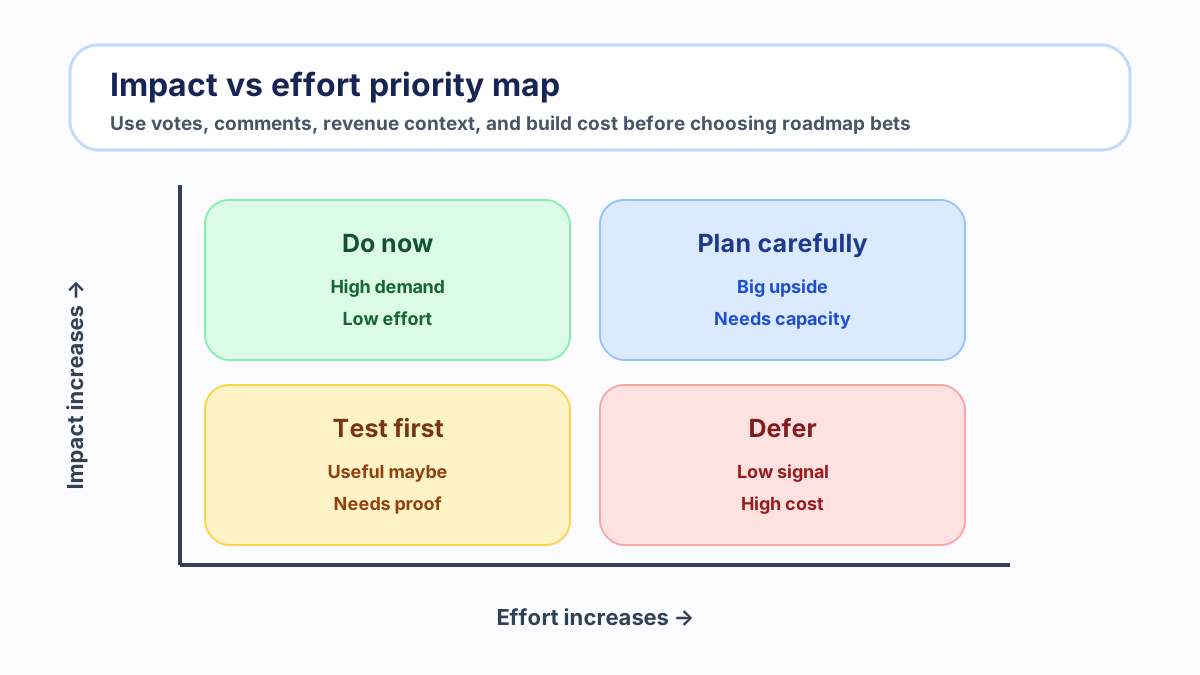
4. Prioritize with impact, effort, and confidence
Impact-versus-effort scoring is simple enough for early review, but do not stop there. Add confidence so an exciting idea with weak evidence does not outrank a smaller idea with repeated customer proof. Consider revenue, retention, activation, risk reduction, strategic differentiation, and learning value. Also note opportunity cost. A high-impact item may still be wrong if it blocks two urgent improvements.
5. Visualize the roadmap across horizons
Choose a format people can understand quickly. A timeline is useful when dependencies are real. A now-next-later board is better for uncertainty. A theme-based roadmap works well when leadership wants to see strategic balance. Many teams combine them: themes as rows, horizons as columns, and status labels for discovery, validation, build, launched, or paused.
6. Review with leadership and secure buy-in
Buy-in should happen before the roadmap is announced. Share the evidence, the trade-offs, and the items you are not choosing. Leaders do not need every ticket; they need enough context to trust the decision. Invite disagreement around assumptions, not vague preference. Ask: What would make this priority wrong? Which risk is most expensive? What constraint are we ignoring?
7. Launch and embed the roadmap into workflows
A roadmap hidden in a slide deck will decay. Put it where teams work. Link roadmap items to discovery notes, requests, experiments, designs, tickets, and release notes. For public-facing items, use clear statuses such as under review, planned, in progress, released, or not planned. The simpler the status system, the more likely the team will maintain it.
8. Measure progress with KPIs and OKRs
Every committed roadmap item should have a success hypothesis. “Build integration X” is not enough. Better: “Reduce manual export work for agencies and increase weekly active workspace usage among accounts using reporting.” Metrics keep innovation honest. They also prevent teams from declaring victory at shipment when the real outcome has not changed.
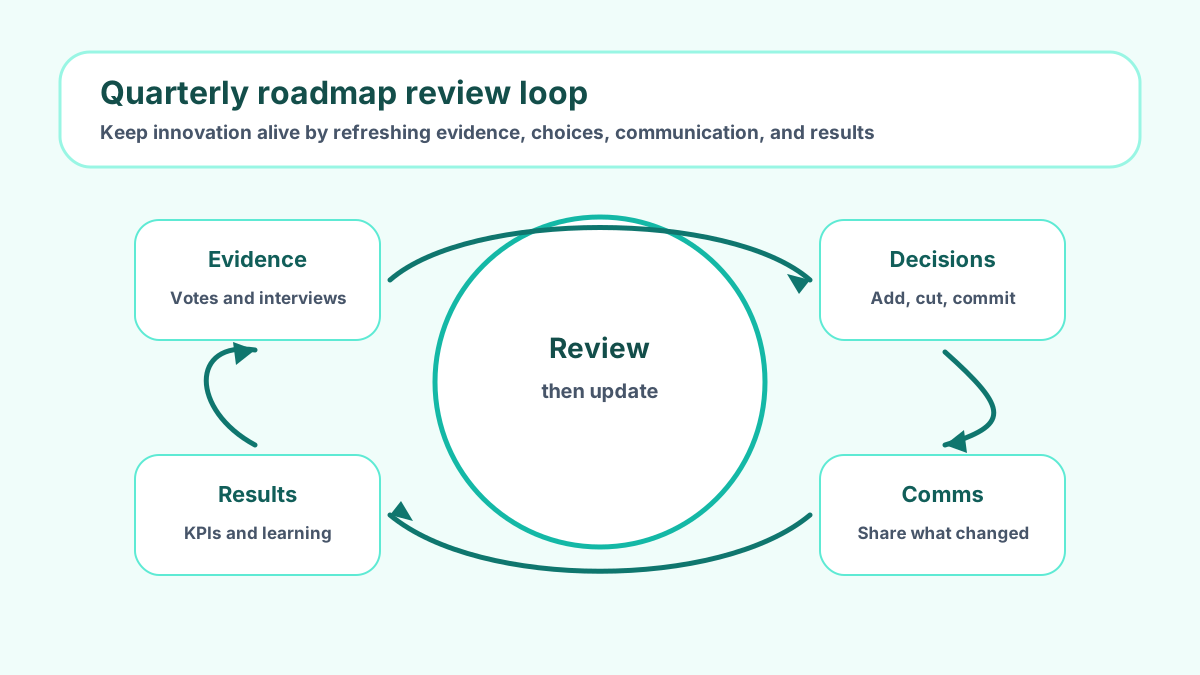
9. Update continuously
Innovation roadmaps should change when evidence changes. That does not mean thrashing every week. Set a review cadence, such as monthly for signal review and quarterly for strategic refresh. Mark what changed and why. Customers and colleagues can handle changes when the reasoning is visible; they lose trust when priorities disappear without explanation.
Best practices for roadmap quality
Keep the roadmap transparent, but not overloaded. People should be able to scan it in minutes. Use short labels, plain-language problem statements, and links for deeper evidence. Separate raw ideas from committed work so every suggestion does not look like a promise.
Update statuses publicly when possible. Even a declined idea can build trust if the explanation is respectful. For example: “Not planned because this would make setup harder for most teams, but we are tracking related reporting requests.” That kind of response teaches users how decisions are made.
Use tools that fit your stage. A spreadsheet can work for a small internal experiment. A project management tool can track delivery. A feedback board can collect and validate demand. A full product operations platform may be useful later. The mistake is buying a large system before the team has a simple operating rhythm.
Most importantly, keep feedback close to the roadmap. If users can see that requests become reviewed ideas, planned work, and release updates, participation improves. FeaturAsk is designed for that loop: collect feature requests, let users vote, review analytics, and show status changes without paying enterprise prices. Create your FeaturAsk board free for one month with no credit card; the plan is $29.95/year afterward.
Innovation roadmap examples
A startup roadmap might focus on retention. Themes could include onboarding, integrations, collaboration, and reporting. The first quarter may include two onboarding experiments, one integration discovery project, and a reporting prototype. The second quarter may commit only after the team sees which experiments improved activation.
A mature SaaS company might create an enterprise-readiness roadmap. Themes could include security, admin controls, audit logs, permissions, and procurement support. The roadmap would combine customer feedback from sales, expansion conversations, and churn risk with engineering dependencies. Some items may be must-haves for a segment, while others are differentiators.
An internal operations roadmap may target support efficiency. Ideas might include better help docs, automated triage, account health dashboards, and billing workflow improvements. The innovation is not glamorous, but the impact can be large if it reduces time to resolution and gives customers faster answers.
Tools and templates to get started
You do not need a perfect template. Use five sections: objective, themes, evidence, roadmap view, and review log. For each roadmap item, capture the problem, customer segment, evidence, expected impact, effort, owner, status, target horizon, and success metric. Keep a decision log so future discussions do not restart from zero.
Common tool combinations include FeaturAsk for customer requests and voting, Notion or Google Docs for discovery notes, Linear or Jira for engineering work, and a roadmap slide or board for leadership communication. The best stack is the one your team will actually update.
FAQs
What is the difference between a technology roadmap and an innovation roadmap?
A technology roadmap focuses on systems, platforms, architecture, technical capabilities, and dependencies. An innovation roadmap can include technology, but it is broader. It connects new opportunities, customer problems, experiments, and strategic bets to measurable outcomes.
How often should you update an innovation roadmap?
Review signals monthly and refresh strategic priorities quarterly. Update sooner if a major assumption changes, a large customer pattern emerges, a dependency slips, or an experiment produces a clear result.
Who should own the innovation roadmap?
Ownership depends on the company. Product often owns product innovation, operations may own process innovation, and leadership may own portfolio-level innovation. Regardless of title, the owner must be able to gather evidence, facilitate trade-offs, maintain updates, and communicate decisions.