4 Types of NPS Survey Questions [With Examples and Pro Tips]
Customer feedback, support conversations, and product data now move too quickly for teams to rely on guesswork. This guide gives you a practical FeaturAsk-style approach to nps survey question: clear enough for small teams, current enough for modern product work, and focused on actions rather than bloated process.
Relevant sources for the current landscape include Bain on Net Promoter System, Qualtrics NPS guide, and Qualtrics guidance on improving survey response rates.
What an NPS survey question really measures
An NPS survey question asks how likely a customer is to recommend a company, product, or experience on a zero-to-ten scale. Respondents are grouped as promoters, passives, or detractors, and the score is calculated by subtracting the percentage of detractors from the percentage of promoters. Bain’s Net Promoter System popularized the method as a way to connect loyalty with growth, but the score is only the beginning.
The useful part is the decision that follows. A high score can show that a launch created enthusiasm. A low score can expose friction. A split score can reveal that one customer segment loves the product while another is confused. The survey question should therefore match the decision you want to make.
1. Relationship NPS questions
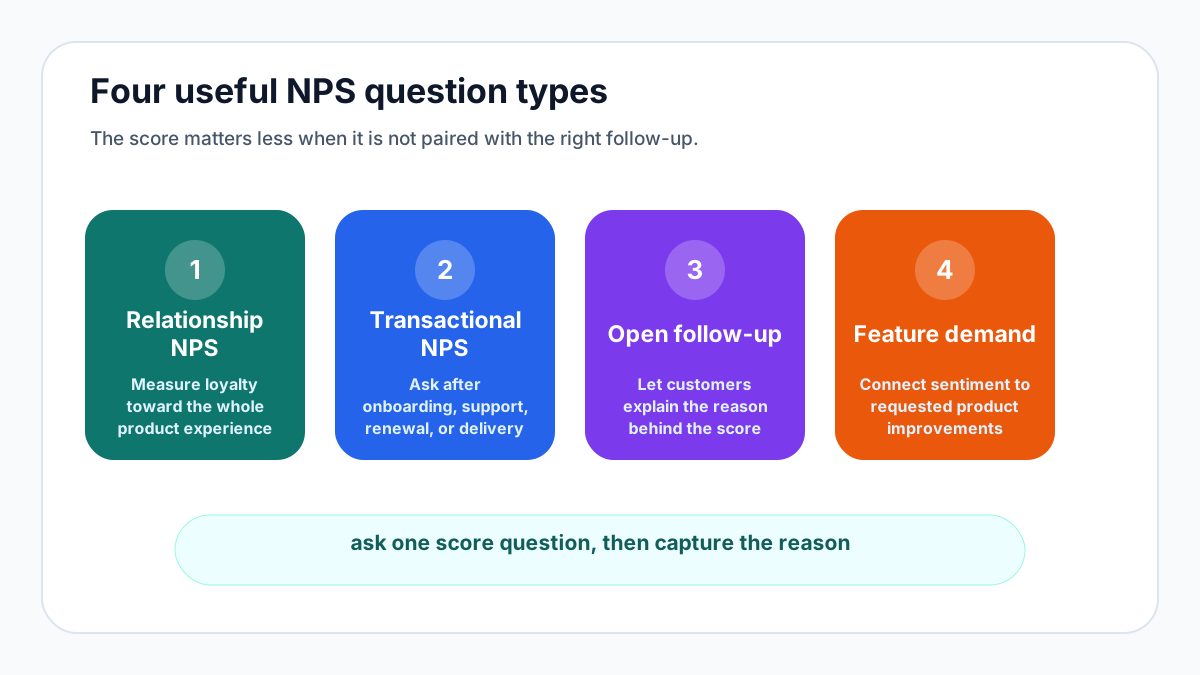
Relationship NPS asks about the overall company or product relationship. A standard version is: “How likely are you to recommend our product to a friend or colleague?” This question works best as a periodic health check because it captures the customer’s broader memory, not a single interaction.
Use relationship NPS when you want to understand retention risk, brand advocacy, or customer sentiment over time. Send it quarterly, twice a year, or after the customer has enough experience to answer fairly. Avoid asking brand-new users to judge a relationship they have not formed yet.
2. Transactional NPS questions
Transactional NPS asks about a specific moment. Examples include: “Based on today’s support experience, how likely are you to recommend us?” or “After completing your purchase, how likely are you to recommend this experience?” Because the event is fresh, answers are more diagnostic.
Use transactional NPS after onboarding, checkout, implementation, support resolution, renewal, or cancellation. The pro tip is to keep the wording tied to that event. If the user just spoke with support, do not ask a broad company-loyalty question and then blame the support team for the whole score.
3. Product NPS questions
Product NPS focuses on the product experience itself. A strong version is: “How likely are you to recommend this product based on your recent use?” It is especially useful after activation, a major feature launch, or a meaningful usage milestone.
Product NPS should be paired with usage data. If power users score the product highly while new users score it poorly, the issue may be onboarding. If everyone scores one workflow poorly, the product team has a roadmap signal. Use the score to narrow your next discovery questions.
4. Feature-demand NPS questions
The extra category small teams often miss is feature-demand NPS. It asks recommendation likelihood in the context of a missing capability or proposed improvement: “If we added team permissions, how likely would you be to recommend the product?” This is not a replacement for classic NPS, but it helps compare demand across ideas.
Feature-demand NPS is useful when customers are voting for roadmap items and you need to understand which ideas create advocacy, not just curiosity. FeaturAsk can capture those ideas through a voting board, then you can ask targeted follow-ups to the users who care most. Try FeaturAsk free for one month with no credit card if you want a simple feedback board before committing to the $29.95/year plan.
Follow-up questions that unlock the score
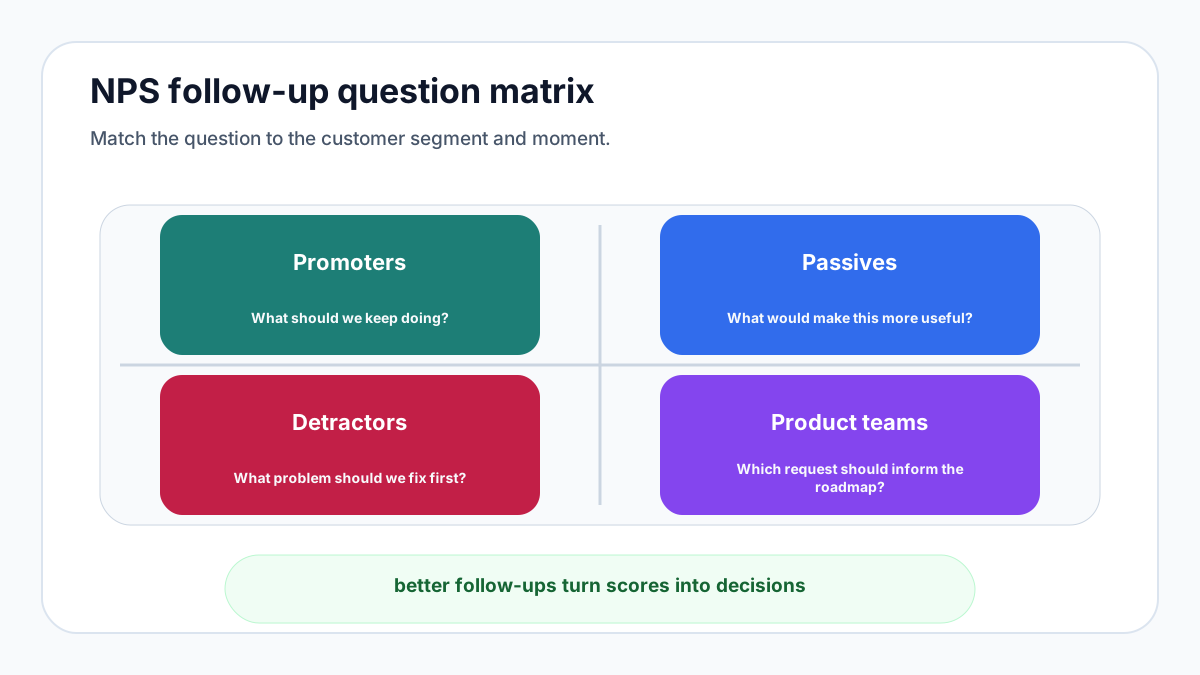
Never stop at the number. Ask one open-ended follow-up: “What is the main reason for your score?” For detractors, ask what blocked their success. For passives, ask what would make the product more useful. For promoters, ask what they value most and whether they would review, refer, or provide a testimonial.
Keep follow-ups short. Qualtrics and other survey platforms consistently emphasize that NPS is most effective when paired with action, not when it becomes a long research project. If you need deeper insight, invite a subset of respondents to an interview rather than turning the NPS form into a questionnaire.
Best practices for writing NPS questions
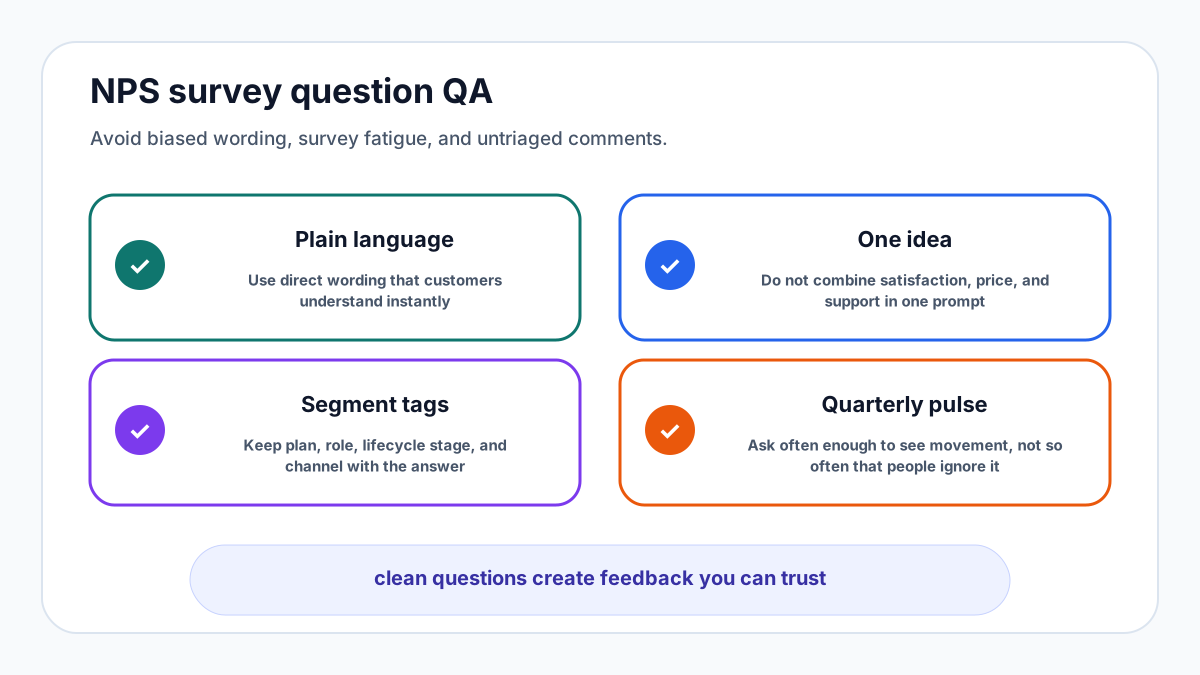
Use one scale, one subject, and one time frame. Do not combine multiple ideas such as support, price, product quality, and documentation in the same question. Do not change wording every month unless you are intentionally testing. Consistency lets you compare results over time.
Segment results by customer type, plan, lifecycle stage, and recent event. A single average can hide the truth. Also, close the loop. Thank promoters, help detractors, and tell customers when their feedback affects the roadmap. FeaturAsk blog posts on product roadmaps, release notes, and SaaS metrics show how to connect feedback to visible product communication.
If you need a lightweight place to collect the “what should we build next?” answers that NPS uncovers, open a FeaturAsk board with no credit card. The first month is free, and the plan is $29.95/year after the trial.
Practical next steps
The wording of the follow-up should feel like a conversation, not an interrogation. “What is the main reason for your score?” is broad enough to surface surprises. “Which feature did you dislike?” assumes the answer and can bias the result.
Treat NPS as a directional input rather than a verdict. A score can tell you where to look; it cannot explain the full cause by itself. Combine it with interviews, product usage, churn notes, and direct feature requests before making major roadmap decisions.
If you want the feedback side of this workflow to stay simple, launch FeaturAsk with a one-month free trial and no credit card. It is built for feature requests, voting, and lightweight prioritization at $29.95/year, so you can learn from customers without buying an enterprise platform.
Example NPS question library
Use these examples as starting points, then adapt the subject and timing to your product. For a relationship survey, ask: “How likely are you to recommend our product to a friend or colleague?” Follow with: “What is the main reason for your score?” This combination is short, comparable, and open enough to surface surprises.
For onboarding, ask: “Based on your onboarding experience, how likely are you to recommend our product?” Follow with: “What would have made setup easier?” This avoids blaming the entire product for a first-session problem and gives the onboarding team a direct improvement path.
For support, ask: “Based on your recent support experience, how likely are you to recommend us?” Follow with: “Was your issue resolved in the way you expected?” This separates friendliness from resolution quality. A pleasant exchange that does not solve the issue still needs attention.
For product launches, ask: “After trying the new reporting dashboard, how likely are you to recommend the product?” Follow with: “Which part of the dashboard is most or least useful?” This turns NPS into launch learning rather than a vanity score.
For roadmap discovery, ask a feature-demand version only when you are clear that it is exploratory: “If we added advanced permissions, how likely would you be to recommend the product?” Follow with: “What permission problem are you trying to solve?” That second question prevents the team from building a generic feature when the real need is narrower.
How to analyze NPS answers
Start by separating the number from the comment. The score tells you intensity; the comment tells you cause. Read comments before building a dashboard narrative. A cluster of six detractor comments about onboarding may matter more than a small movement in the overall score.
Next, segment by lifecycle stage. New customers often score based on setup, documentation, and early value. Long-term customers score based on reliability, depth, support, and whether the product keeps improving. Mixing those groups can create an average that sounds precise but hides different jobs to be done.
Look for mismatches between stated sentiment and behavior. A promoter who never uses the product may be praising the idea rather than the experience. A detractor who uses the product daily may be frustrated because the product is important. Usage data gives the score useful context.
Create a simple action map. Detractors with blocking issues need help. Passives need a reason to care more. Promoters may be ready for referrals, reviews, case studies, or beta feedback. Product-related comments should be grouped into themes and compared with feature requests, support tickets, and churn notes.
Close the loop in public when possible and privately when needed. If a customer reported a painful gap, tell them when it is fixed or why it is not planned. Customers do not expect every request to be accepted, but they do expect evidence that their feedback reached a real decision.
Decision checklist before you commit
Before you send an NPS survey, write down the decision it will inform. Are you checking account health, evaluating onboarding, reviewing a support interaction, measuring a launch, or exploring feature demand? A survey without a decision becomes a dashboard habit rather than a learning tool.
Confirm that the audience can answer fairly. A user who has not completed setup cannot judge long-term value. A billing contact may not understand a workflow used by operators. A champion may feel differently from the end users they manage. Good targeting improves both response quality and the credibility of your conclusions.
Prepare the follow-up path before responses arrive. Decide who replies to detractors, who thanks promoters, who groups product themes, and who reports findings to the roadmap discussion. Speed matters because customers remember whether feedback created a real conversation.
Finally, decide how you will communicate outcomes. If NPS reveals a documentation gap, publish the improved guide. If it reveals demand for a feature, show where that idea sits. If you decline a request, explain the trade-off. The score earns trust only when customers see the loop close.
One more discipline helps: keep a change log for your NPS program. Note when wording, audience, channel, timing, or product packaging changed. Without that history, teams can mistake a methodology change for a customer sentiment change. A simple note beside each reporting period preserves context and makes trend discussions more honest.
Do not hide uncomfortable comments. A few blunt responses can be more useful than a polished average. Share representative quotes with the team, remove personal details when needed, and connect each theme to a practical next step. NPS works best when it creates customer empathy as well as a number.
Keep the survey respectful. Ask only when the customer has enough context, make the form easy to dismiss, and avoid repeating the same request after they have answered.
Small improvements add up. Better timing, clearer wording, cleaner segmentation, and visible follow-up can turn a basic NPS question into a reliable source of product and customer success insight.
FAQs
How often should this process be reviewed?
Review the operating metrics monthly and review strategic assumptions quarterly. Fast-moving teams can review high-signal feedback weekly, but the cadence should be predictable enough that customers and teammates see follow-through.
What is the biggest mistake to avoid?
The biggest mistake is collecting feedback without assigning ownership for the next action. Every survey, request board, support trend, or product brief should have a person responsible for interpreting the signal and deciding what happens next.
Can a small team use this without extra process?
Yes. Keep the workflow lightweight: capture the signal, group similar items, choose the next best action, ship or explain the decision, and close the loop. The habit matters more than complex tooling.