Key Levers of SaaS Growth Strategies
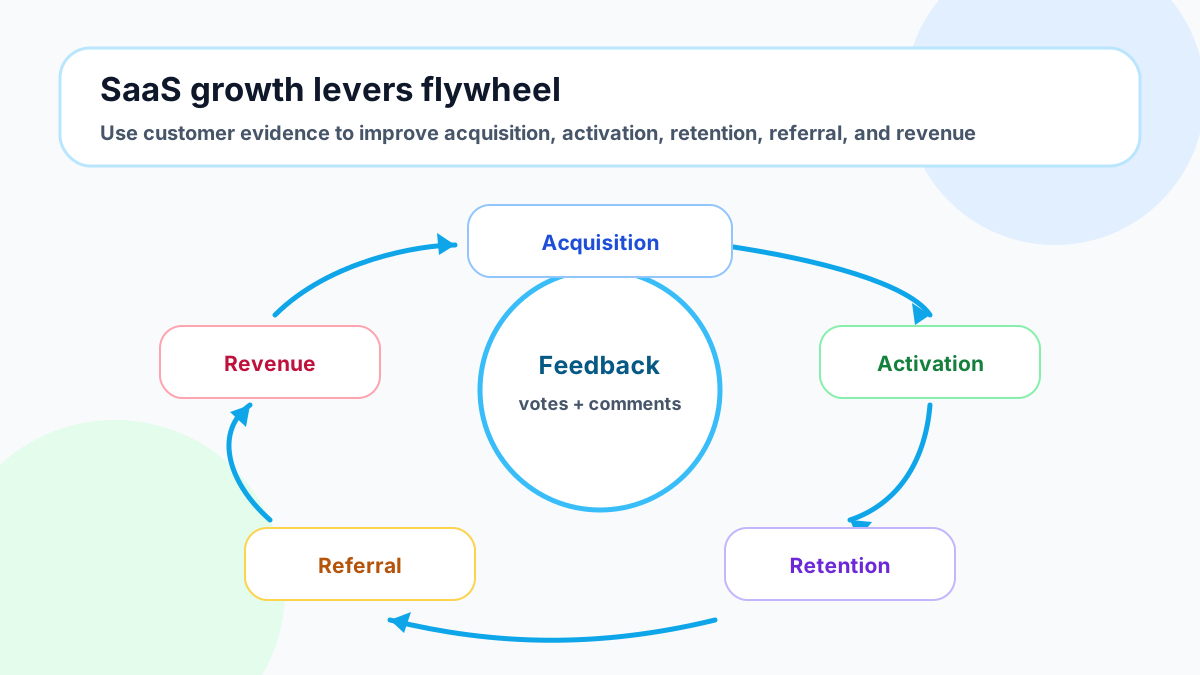
SaaS growth is not one lever. It is a system of acquisition, activation, retention, expansion, referral, pricing, positioning, and product quality. Pulling one lever without understanding the others can create noisy numbers: more signups that do not activate, discounts that increase churn, new features that confuse onboarding, or marketing channels that attract the wrong accounts.
The strongest SaaS teams treat growth strategy as a learning loop. They study product data, listen to customers, clarify positioning, improve adoption, remove friction, and then measure whether the change helped the business. Customer feedback is the connective tissue. It explains why a metric moved and shows which jobs customers still cannot finish.
If your team needs a low-cost way to collect those signals, FeaturAsk helps you gather feature requests, votes, comments, and status updates in one place. You can try FeaturAsk free for one month with no credit card, then continue for $29.95/year if it becomes your product feedback base.
For related product loops, read FeaturAsk's guides to how to prioritize feature requests, idea tracking, and how to use SEO to promote your feedback and roadmap pages.
Types of SaaS growth
SaaS growth usually comes from several sources. New customer acquisition brings fresh accounts into the funnel. Activation growth helps more signups reach the first meaningful outcome. Retention growth keeps customers using the product for longer. Expansion growth increases revenue from existing accounts through seats, usage, add-ons, upgrades, or new teams. Referral and word-of-mouth growth reduce dependence on paid acquisition. Pricing and packaging growth improves the value captured from the customer base.
These types interact. A product with weak retention can still show acquisition growth for a while, but the company will pay to refill a leaking bucket. A product with strong retention but unclear positioning may grow slowly because the market cannot understand the value. Expansion can hide poor new-account activation until the existing base matures. The goal is not to optimize every lever at once; it is to diagnose the limiting constraint.
A simple rule helps: growth strategy should start where the customer journey is most broken. If many people visit but few sign up, messaging and acquisition quality may be the problem. If signups do not reach value, onboarding and activation matter. If users activate but churn, product fit, support, pricing, or expectation mismatch may be the issue. If customers love the product but do not expand, packaging, account education, or admin value may need work.
Five steps to scale SaaS growth
1. Make sense of your data
Start with a clean view of the journey. Track visitors, signups, activation events, retained accounts, upgrades, expansion, referrals, support volume, and churn reasons. Separate vanity metrics from decision metrics. A spike in traffic means little if the traffic does not match your target customer. A high feature usage count may hide shallow engagement if the feature is used only during setup.
Use cohorts whenever possible. Compare users who joined in the same period, from the same channel, or with the same use case. Cohorts reveal whether changes improve behavior over time instead of only shifting averages. Add qualitative context to the numbers. Product analytics can show where users stop; feedback explains why they stop.
2. Listen to customers continuously
Customer listening should not be limited to quarterly surveys. Collect support themes, sales objections, churn notes, onboarding questions, review comments, interview clips, and feature requests. The best signals are repeated, specific, and tied to a business outcome. “Add dashboards” is less useful than “agency admins need one place to see client feedback volume before renewal meetings.”
A public or embedded feedback board makes this loop easier. Users can submit ideas, vote on existing requests, and add context. Your team can merge duplicates and update statuses. FeaturAsk is built for this focused workflow, making it practical for small SaaS teams that cannot justify a large product operations platform. Start FeaturAsk with a free month, no credit card, then $29.95/year when you are ready to keep the loop running.
3. Create vision and positioning
Growth slows when the market cannot describe why your product exists. Positioning should answer who the product is for, what problem it solves, what alternatives customers compare it against, and why your approach is different. A clear vision prevents scattered roadmap choices. It also helps sales, support, content, and product speak the same language.
Positioning is not only marketing copy. It affects onboarding, pricing, integrations, proof points, and roadmap priorities. If the product is positioned as the simplest option for small teams, a complex enterprise workflow may hurt growth even if a few prospects request it. If the product is positioned for regulated organizations, security, admin controls, and procurement support may be growth levers rather than back-office details.
4. Adapt and iterate quickly
SaaS markets change through competitor moves, platform shifts, customer expectations, economic pressure, and new channels. The answer is not chaos; it is short learning cycles. Test pricing pages, onboarding flows, lifecycle emails, templates, integrations, and feature improvements in controlled ways. Keep the test tied to a hypothesis and a metric.
Speed also depends on what you choose not to do. Declining low-signal requests protects capacity for higher-confidence bets. A visible feedback board helps because the team can explain status and revisit ideas when votes, segments, or revenue context changes.
5. Make customers successful
The most durable SaaS growth comes from customers achieving the outcome they bought the product for. Customer success is not only a department; it is an operating principle. Good onboarding, helpful documentation, sensible defaults, product education, responsive support, and honest roadmap communication all improve retention and expansion.
Measure success with both usage and value. A customer may log in frequently because the product is powerful, or because the workflow is too manual. Ask what outcome they are trying to reach, where they get stuck, and what would make the product easier to recommend.
Jobs to be done and SaaS adoption
Jobs to be done, often shortened to JTBD, is a way to understand the progress customers are trying to make. Instead of defining a user only by role or company size, JTBD asks what situation triggered the search, what outcome the customer wants, what alternatives they considered, and what anxieties slow adoption. The framework is especially useful in SaaS because customers rarely buy software for the software itself. They buy a faster workflow, fewer mistakes, better reporting, more confidence, or a business result.
For example, a founder who asks for a roadmap feature may not primarily want a roadmap. The job may be “show customers that we are listening so they keep giving feedback and trust the product direction.” That insight changes the growth lever. You might need voting, public statuses, and release communication rather than a complex planning module.
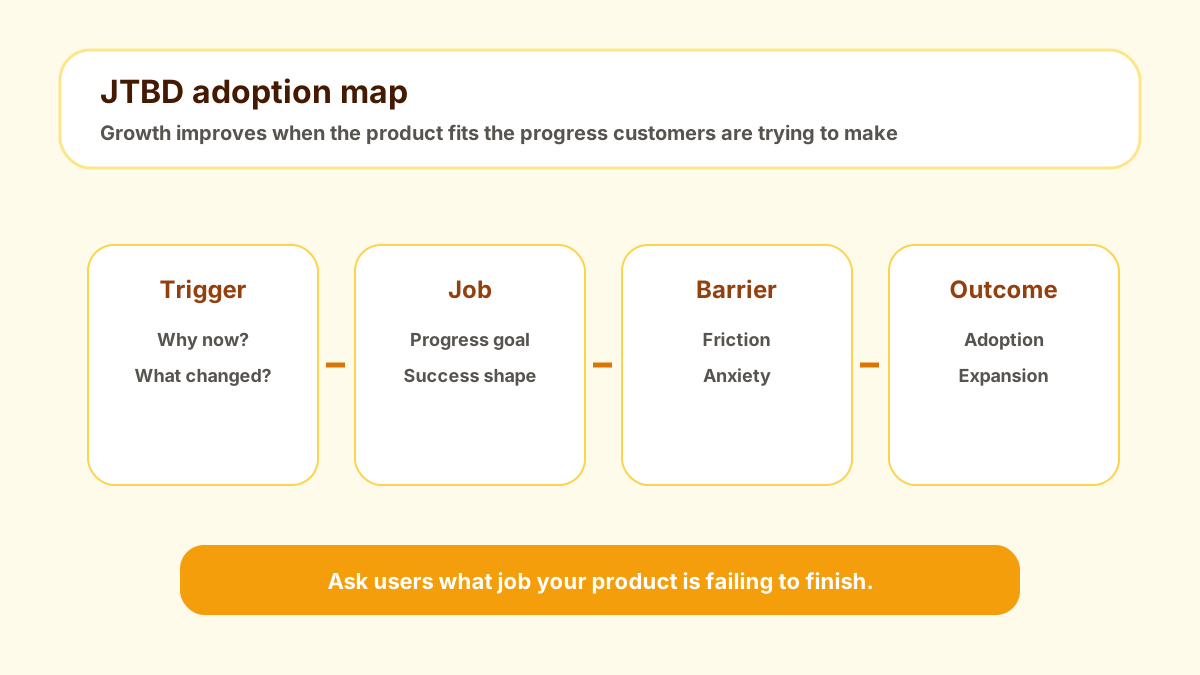
JTBD improves adoption because it clarifies the moment of value. Onboarding should help the customer complete the job quickly. Messaging should match the trigger. Product education should reduce anxiety. Roadmap choices should remove barriers that prevent the job from being completed repeatedly.
ProductPlan's explanation of jobs to be done frames the method around the progress customers are trying to make, and Reforge's AARRR material is a useful reminder that funnel metrics need behavioral interpretation. Combining the two keeps teams from optimizing isolated numbers without understanding the customer job behind them.
The AARRR flywheel for SaaS growth
AARRR stands for acquisition, activation, retention, referral, and revenue. It is often called the pirate funnel, but for SaaS it works better as a flywheel. Acquisition brings in the right audience. Activation helps users reach first value. Retention proves ongoing value. Referral happens when customers trust the product enough to recommend it. Revenue grows when the product captures value through plans, seats, usage, or expansion.
The model is useful because every stage has a different question. Acquisition asks: are we attracting the right people at an acceptable cost? Activation asks: do new users experience meaningful value quickly? Retention asks: do customers return because the product is part of their workflow? Referral asks: are users proud or relieved enough to share it? Revenue asks: does packaging align with value delivered?
Do not treat AARRR as a dashboard decoration. Pick the weakest stage and investigate it. If activation is weak, read session recordings, interview new users, and collect feedback on setup friction. If retention is weak, analyze churn reasons and feature gaps. If referral is weak, look at customer delight, differentiation, and shareable outcomes. The framework becomes powerful when each metric triggers a learning action.
Competitive strategy levers
SaaS growth also depends on the competitive environment. Porter's Five Forces remains useful because it pushes teams to look beyond direct rivals. Buyer power, supplier power, substitutes, new entrants, and competitive rivalry all shape which growth levers matter. A product in a crowded category may need sharper differentiation and stronger proof. A product facing substitute workflows, such as spreadsheets or internal tools, may need easier onboarding and clearer ROI.
Perceptual mapping is another practical tool. Plot how customers perceive options on two dimensions, such as simple versus configurable and affordable versus enterprise. The point is not to create a perfect chart; it is to spot crowded positions and underserved spaces. If every competitor claims to be powerful and enterprise-ready, a small-team product may win by being transparent, fast, and affordable.
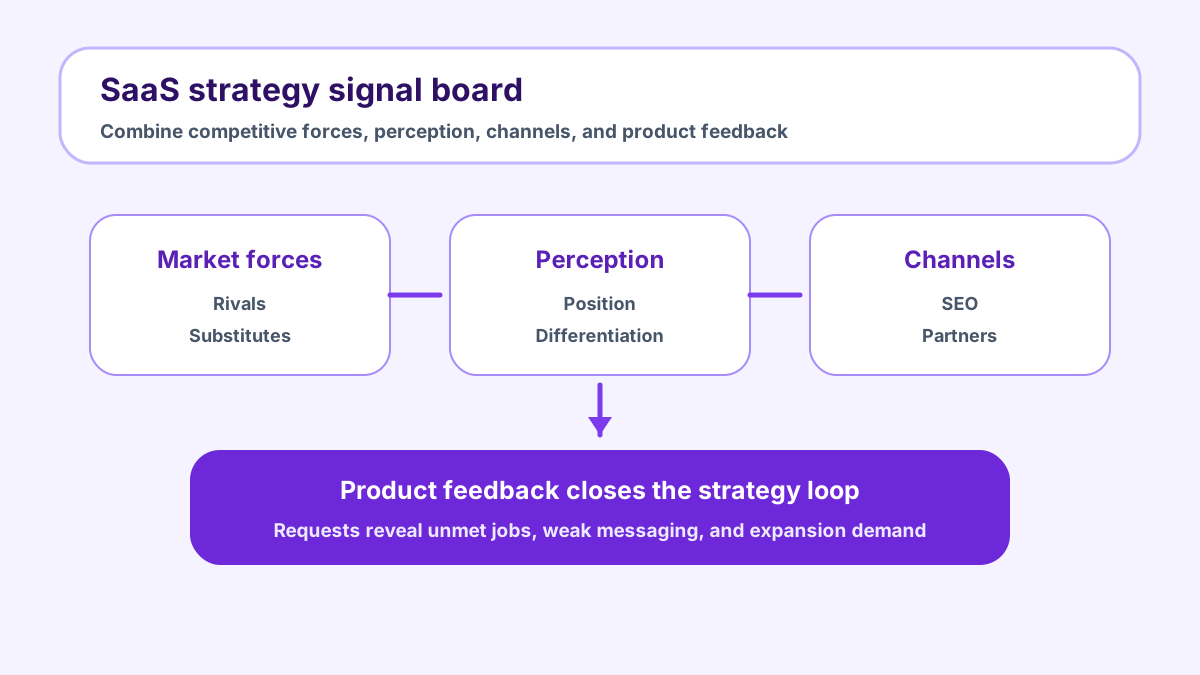
Feedback strengthens competitive analysis because customers reveal the alternatives in their own words. They may compare you with a direct competitor, a spreadsheet, a custom script, or doing nothing. Each comparison suggests a different growth move. Direct competitors require differentiation. Spreadsheets require ease and flexibility. Custom scripts require reliability and integration. Doing nothing requires urgency.
Scalable marketing channels
Scalable channels are repeatable ways to reach the right customers. Common SaaS channels include SEO, product-led content, integrations, marketplaces, lifecycle email, partnerships, communities, affiliates, paid search, founder-led social, webinars, templates, and customer referrals. The right channel depends on market awareness, deal size, sales motion, and customer intent.
SEO is strong when customers search for problems, comparisons, templates, or alternatives. Partnerships work when another product or service already owns trust with your audience. Marketplaces help when integrations are central to adoption. Paid channels can validate messaging quickly, but they become dangerous if retention is weak. Content works best when it teaches the customer how to solve a problem, not when it only repeats keywords.
Use feedback to refine channels. Feature requests show pain language that can become landing page copy. Vote patterns reveal segments worth targeting. Churn notes identify promises your marketing should stop making. Happy customer comments can become proof points, examples, and onboarding improvements.
How to choose your next growth lever
Bring the pieces together in a single decision review. Start with the journey data: where does the funnel lose the most qualified customers or revenue? Add customer evidence: what repeated jobs, barriers, or requests explain the drop-off? Add competitive context: what alternatives shape expectations? Add capacity: what can the team improve in the next cycle without breaking focus?
Then choose one primary lever and one supporting lever. For example, a team may choose activation as the primary lever and customer feedback as the supporting lever. The plan could include a shorter setup flow, three requested templates, lifecycle emails, and a public status update explaining what changed. Another team may choose expansion as the primary lever and positioning as the supporting lever, improving admin features and packaging for teams.
Document the hypothesis before acting. “If we add team templates requested by agency accounts and make them visible during onboarding, more agency workspaces will invite a second user within seven days.” This sentence is testable. It also connects customer feedback to a growth metric.
FeaturAsk fits this operating rhythm because it keeps customer demand visible while the team makes trade-offs. You can collect requests, let users vote, review comments, and communicate status without adopting a heavy suite. If that is the missing piece in your growth loop, open a FeaturAsk board free for one month with no credit card; it is $29.95/year after the trial.
SaaS growth mistakes to avoid
Do not copy another company's playbook without matching its stage, audience, and economics. A channel that works for an enterprise platform may fail for a self-serve product. A feature that closes one large deal may create maintenance cost for hundreds of smaller accounts.
Do not confuse more features with more value. Growth often comes from clearer onboarding, fewer steps, better defaults, stronger integrations, or a sharper promise. Feature requests are inputs, not orders. The team still needs to interpret the underlying job.
Do not optimize acquisition before retention is healthy. Paid traffic can hide a product problem for a while, but churn will eventually expose it. Likewise, do not optimize revenue in a way that damages trust. Packaging should make value easier to understand and buy, not trick customers into plans they resent.
Are you ready to craft your SaaS growth strategy?
A strong SaaS growth strategy identifies the current constraint, listens to customers, clarifies the job, chooses a focused lever, and measures the result. It does not require a giant planning process. It requires discipline: one source of customer truth, a few meaningful metrics, honest prioritization, and fast learning.
Start with the evidence you already have. Which requests repeat? Which users fail to activate? Which customers expand, and what did they need before they did? Which alternative do prospects mention most? Those answers will point toward the next lever more reliably than a generic growth checklist.