How to Use Customer Research to Improve Your Advertising
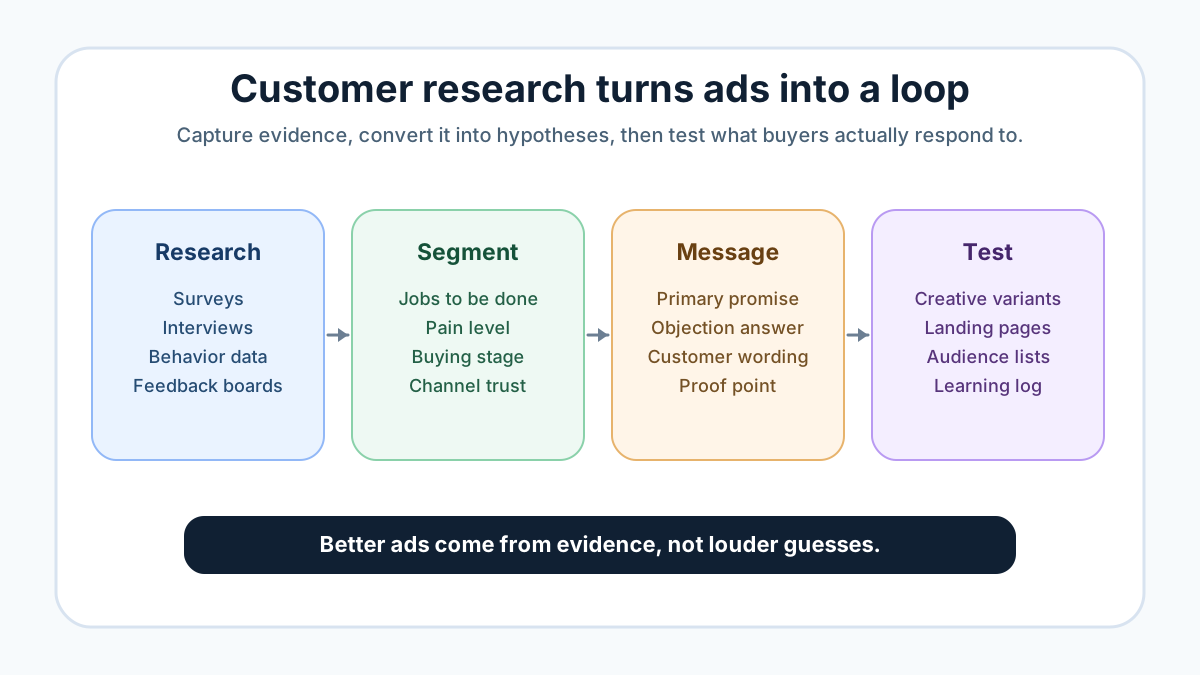
Customer research improves advertising by replacing broad assumptions with evidence about who your best buyers are, what they are trying to achieve, what language they use, which objections slow them down, and where they trust information. Good research does not make ads complicated. It makes the advertising brief sharper: this audience, this problem, this promise, this proof, this next step.
The practical goal is not to collect endless data. It is to build a repeatable path from customer signal to campaign decision. A support ticket can reveal a new objection. A survey can show which segment feels that objection most strongly. A feedback board can show which product improvements people vote for. A landing page test can show whether the new message actually changes behavior.
If your team needs a lightweight place to capture product ideas, objections, and recurring customer language, try FeaturAsk for 1 month free with no credit card required. It is built for small teams that want a simple feedback widget, voting, comments, and status updates without enterprise overhead, and it costs only $29.95/year after the trial.
Start with the advertising decision you need to improve
Customer research becomes useful when it is tied to a decision. Before you open a survey tool or schedule interviews, name the advertising choice you are trying to make. Are you choosing a target segment? Rewriting a paid search landing page? Testing a new value proposition? Deciding which channels deserve budget? Trying to understand why trial signups do not convert?
A clear decision prevents research from becoming a vague listening project. For example, “learn more about our customers” is too broad. “Find the top three objections that stop agency owners from starting a trial” is specific enough to guide questions, sampling, analysis, and creative tests.
Use a simple research brief with five fields: campaign goal, audience segment, unknowns, evidence needed, and decision deadline. The brief should also state what will change if the research is convincing. If the answer is “nothing,” the research is probably not worth doing.
Combine five kinds of customer evidence
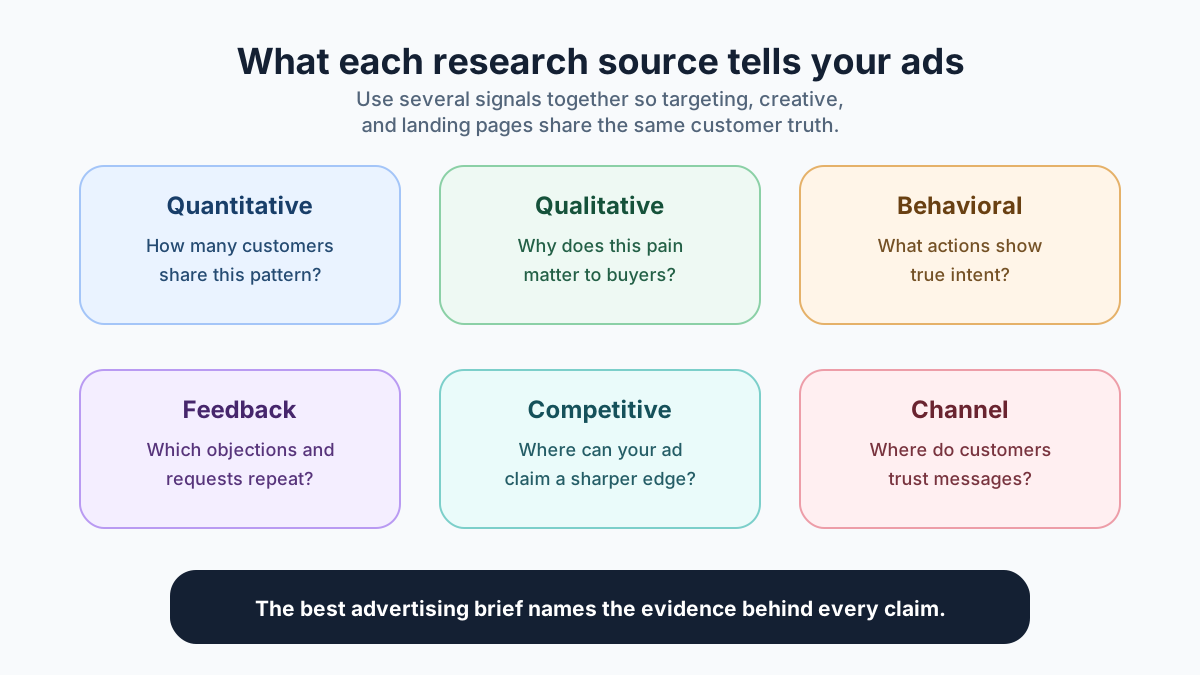
No single research method tells the whole story. Surveys are useful for scale, but they can flatten nuance. Interviews reveal motivation, but a few memorable conversations can mislead a team. Analytics shows behavior, but not the reasons behind it. Feedback boards reveal repeated requests and frustrations, but they need context. Competitive research shows positioning gaps, but it does not prove what your buyers value.
Use quantitative research to size patterns. Ask which outcome matters most, which alternative customers considered, and which objection almost stopped them. Keep surveys short and tied to the campaign decision.
Use qualitative research to understand meaning. Interview recent buyers, lost prospects, power users, churned customers, and good-fit nonbuyers. Ask what triggered their search, what they tried before, and what made the winning option feel safe.
Use behavioral data to test what people actually do. Review search terms, landing page scroll depth, ad creative engagement, product activation, demo completion, and conversion by segment. Behavioral signals are especially helpful when stated preferences and real actions conflict.
Use open feedback to hear language in the customer’s own words. Product requests, roadmap comments, support conversations, review sites, cancellation reasons, and community posts show how customers describe pain when they are not answering a marketer’s questionnaire. FeaturAsk-related guides on gathering customer feedback, feedback portals, and growth teams using customer feedback are useful companions when you want to centralize those signals.
Use competitive research to understand the conversation your ad enters. Study competitor ads, landing pages, reviews, comparison pages, and customer complaints. The point is not to imitate competitors. It is to find claims they overuse, proof they lack, customer frustrations they ignore, and segments they underserve.
Translate research into sharper audience segments
Advertising segments should be based on buying context, not only demographics. Age, company size, role, and industry can matter, but they rarely explain the real reason someone clicks. Better segments often combine a job to be done, urgency, maturity, and constraint.
For example, two founders may both run small SaaS companies. One wants a fast way to collect feature requests before launching a public roadmap. The other needs a private place to capture enterprise customer requests from sales calls. They may look similar in firmographic data, but they need different ads, proof, and landing pages.
Build segment cards from research. Each card should include the trigger event, desired outcome, current workaround, buying obstacle, trusted channel, exact phrases customers use, and best proof. Keep cards short enough that a copywriter, designer, or media buyer can use them without reading a research report.
This is where first-party customer data matters. Google Ads Help describes Customer Match as a way for advertisers to use customer-provided data to reach and re-engage customers across eligible Google surfaces; Meta’s Conversions API documentation similarly focuses on connecting marketing data from a server, website, app, or CRM to improve measurement and delivery. Those systems still need sound strategy. Uploading a list is not the same as knowing what message each segment should see.
Sources rechecked May 22, 2026: <a href="https://support.google.com/google-ads/answer/6379332" rel="nofollow">Google Ads Help on Customer Match</a> and <a href="https://developers.facebook.com/docs/marketing-api/conversions-api/" rel="nofollow">Meta for Developers on the Conversions API</a>.
Turn customer language into message hypotheses
Customer research should not be pasted into ads word for word without judgment, but it should influence vocabulary. Teams often describe products with internal language: workflow orchestration, centralized ideation, engagement infrastructure, or insight activation. Customers usually speak more directly: “I need one place for users to request features,” “I want to know what people want before I build,” or “I keep losing requests in Slack.”
Convert research into message hypotheses. A hypothesis links a customer insight to an advertising test. For example: “If new founders worry that feedback tools are too expensive, an ad emphasizing a one-month free trial, no credit card, and $29.95/year pricing should increase trial starts from budget-conscious visitors.” Another hypothesis might be: “If product managers fear public voting will create unrealistic expectations, a landing page section about moderation and status updates should improve demo quality.”
Strong hypotheses include the audience, the problem, the promise, the proof, and the expected behavior. Weak hypotheses only say “try a new headline.” The more clearly you state the learning goal, the easier it is to decide whether a result matters.
Create a message bank with pains, desired outcomes, objections, proof points, and claims to avoid. Research may show what customers want to hear, but your ad can only say what the product can support. Position the product honestly around a stronger feedback loop.
Match proof to the stage of the journey
Advertising fails when the promise and proof are mismatched. A broad awareness ad may only need a vivid problem statement and a clear outcome. A retargeting ad aimed at high-intent visitors may need a comparison, a customer quote, transparent pricing, or a short product walkthrough. A bottom-funnel landing page may need integration details, privacy information, pricing, and setup steps.
Journey mapping helps here because it connects customer actions, questions, and emotions across stages. Nielsen Norman Group’s journey-mapping guidance defines journey maps as visualizations of the process a person goes through to accomplish a goal; that framing is useful for advertising because each stage creates different information needs. Source rechecked May 22, 2026: <a href="https://www.nngroup.com/articles/customer-journey-mapping/" rel="nofollow">Nielsen Norman Group on customer journey mapping</a>.
Map research findings to the journey. At the problem-aware stage, customers may respond to ads that name the pain: scattered feedback, unclear priorities, or expensive software. At the solution-aware stage, they need differentiation: lightweight widget, public voting, simple moderation, low annual cost. At the decision stage, they need risk reduction: free trial, no credit card, cancellation ease, clear setup, and examples.
For FeaturAsk, the most relevant proof is practical: a small team can launch a feedback board quickly, invite users to share ideas, collect votes and comments, and keep customers informed as requests move forward. If that is the promise, the ad should not pretend to be a massive enterprise research suite. The sharper angle is simplicity and affordability.
Use research to choose channels and creative formats
Media research is not only “where does the audience spend time?” It is “where does the audience trust this kind of message?” A founder may scroll social media daily but still rely on search, peer communities, and product reviews when choosing software. A marketing manager may see display ads often but only act after reading a comparison page or customer story.
Ask customers where they looked, which sources they trusted, and what almost changed their mind. Compare those answers with analytics. If customers say they discovered you through search but paid social influences assisted conversions, your strategy may need both. If a channel creates cheap clicks but poor activation, research the mismatch before increasing spend.
Use research to pick formats. If interviews reveal confusion about setup, test a short video ad and a visual landing page section. If feedback shows repeated concern about price, test transparent pricing copy. If reviews praise speed, show the setup workflow. If customers need consensus from teammates, create ads that lead to a shareable comparison or checklist.
The best creative briefs include customer quotes, not just persona labels. “Busy product manager” is less useful than “I need to show leadership what customers are asking for without building a spreadsheet every week.” The second line can inspire the headline, visual, landing page section, and follow-up email.
Avoid common research-to-advertising mistakes
The first mistake is relying on stale research. Customer expectations, channels, competitors, and product capabilities change. Treat research as a living input. Refresh high-impact assumptions quarterly or whenever you launch a major feature, enter a new segment, or see conversion quality change.
The second mistake is overgeneralizing. If ten enterprise buyers mention procurement concerns, that does not mean a founder audience needs procurement copy. Keep segment context attached to every insight. A useful research repository records who said it, when, in what situation, and how often the theme appears.
The third mistake is ignoring negative feedback. Complaints are uncomfortable, but they often reveal exactly why ads are underperforming. If visitors click an ad about “easy setup” and then complain that setup is confusing, the answer is not only better copy. The product, onboarding, and promise may all need adjustment.
The fourth mistake is treating research as permission to manipulate. Use customer insight to be clearer and more relevant, not to exploit anxiety or invent urgency. Advertising built on real customer understanding should make the buying decision easier, not less honest.
The fifth mistake is measuring only the ad platform’s surface metrics. Click-through rate, cost per click, and impressions are useful, but they do not prove that research improved business outcomes. Track qualified trials, activation, pipeline quality, retention, expansion, and support burden after the campaign.
Build a 90-day research-led advertising workflow
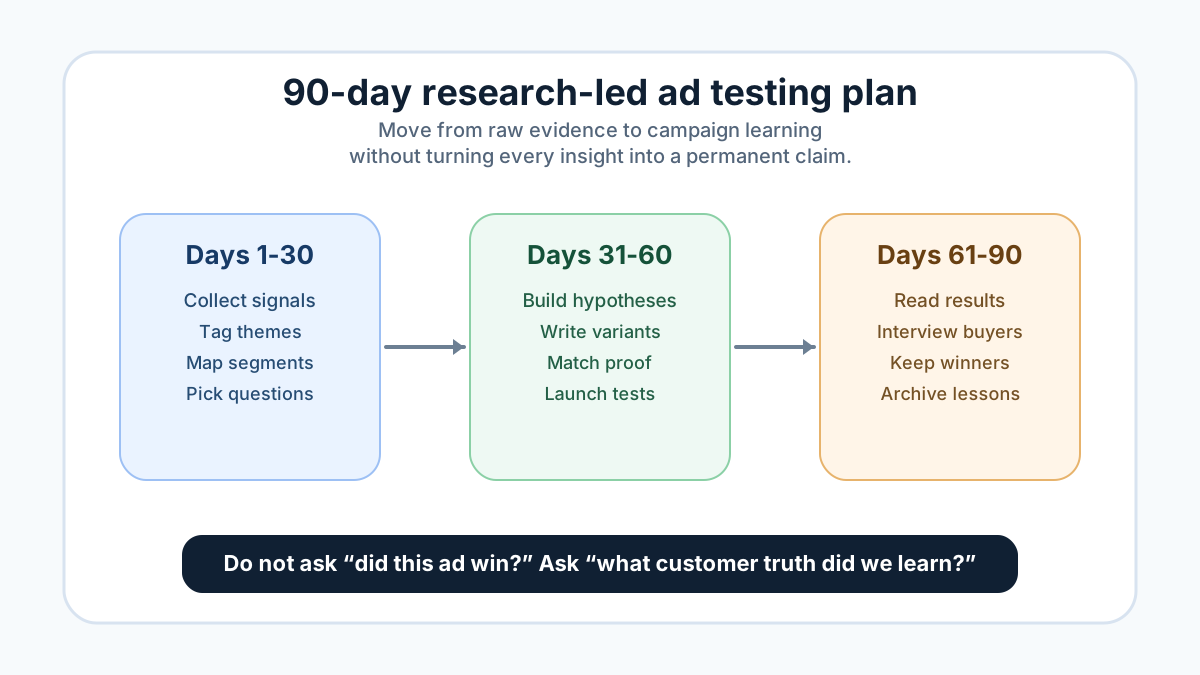
In the first 30 days, collect and organize signals. Pull recent support tickets, sales notes, product feedback, reviews, survey responses, cancellation reasons, and landing page analytics. Tag each signal by segment, journey stage, pain, objection, desired outcome, and exact customer language. Look for repeated themes, not isolated comments.
In days 31 to 60, turn the strongest themes into campaign hypotheses. Write audience cards, update the message bank, choose proof points, and build creative variants. Each variant should test one meaningful difference: a pain-led headline versus outcome-led headline, a price objection answer versus setup objection answer, or a customer-language phrase versus an internal phrase.
In days 61 to 90, read results and close the loop. Compare ad metrics with downstream behavior. Interview a few new buyers and lost prospects to understand why they responded or did not. Keep winning insights, retire weak assumptions, and update your research repository so the next campaign starts smarter.
If you want a simple way to collect ongoing ideas and objections while you run this workflow, start FeaturAsk free for 1 month with no credit card. After that, the $29.95/year plan keeps the loop affordable for small teams that cannot justify heavy feedback software.
A practical example
Imagine a small SaaS team advertising a product feedback widget. Initial ads say “Collect customer feedback in one place.” The message is clear, but it is generic. Research reveals three stronger insights. Founders worry that feedback tools will be expensive. Product managers worry that public boards will create expectations they cannot meet. Support leads want a way to stop losing repeated requests in chat logs.
Those insights create three ad angles. The founder ad emphasizes fast setup, one month free, no credit card, and $29.95/year pricing. The product manager ad emphasizes moderation, voting, and status updates that help close the loop responsibly. The support ad emphasizes turning repeated requests into an organized board instead of another spreadsheet.
The landing pages can also change. The founder page opens with affordability and quick launch. The product manager page shows governance and prioritization. The support page shows how incoming ideas become visible themes. The product may be the same, but the path to relevance is different.
Keep advertising and product learning connected
The strongest advertising teams do not throw research over the wall. They share campaign learning with product, support, success, and leadership. If ads based on a customer pain perform well, that pain may deserve product attention. If a promise converts but creates support confusion, the promise needs refinement. If a segment responds but churns quickly, the team may be attracting the wrong fit.
Use a monthly review to compare customer feedback, campaign results, and product changes. Ask which research-backed message performed best, which objection still blocks conversion, which audience produced the best customers, and which feature requests appeared in both ads and product feedback.
When the same insight appears across feedback boards, interviews, analytics, and ad results, it becomes more than a marketing idea. It becomes a strategic signal. That is the real value of customer research in advertising: it helps the company understand what customers are trying to accomplish, then communicate in a way that is specific, honest, and useful.
Ready to make that loop easier? Launch FeaturAsk for 1 month free, no credit card required, and keep it for only $29.95/year if it helps your team turn customer ideas into clearer product and advertising decisions.