How to Successfully Build a SaaS Product From Ground-Up
Published: 2026-05-16
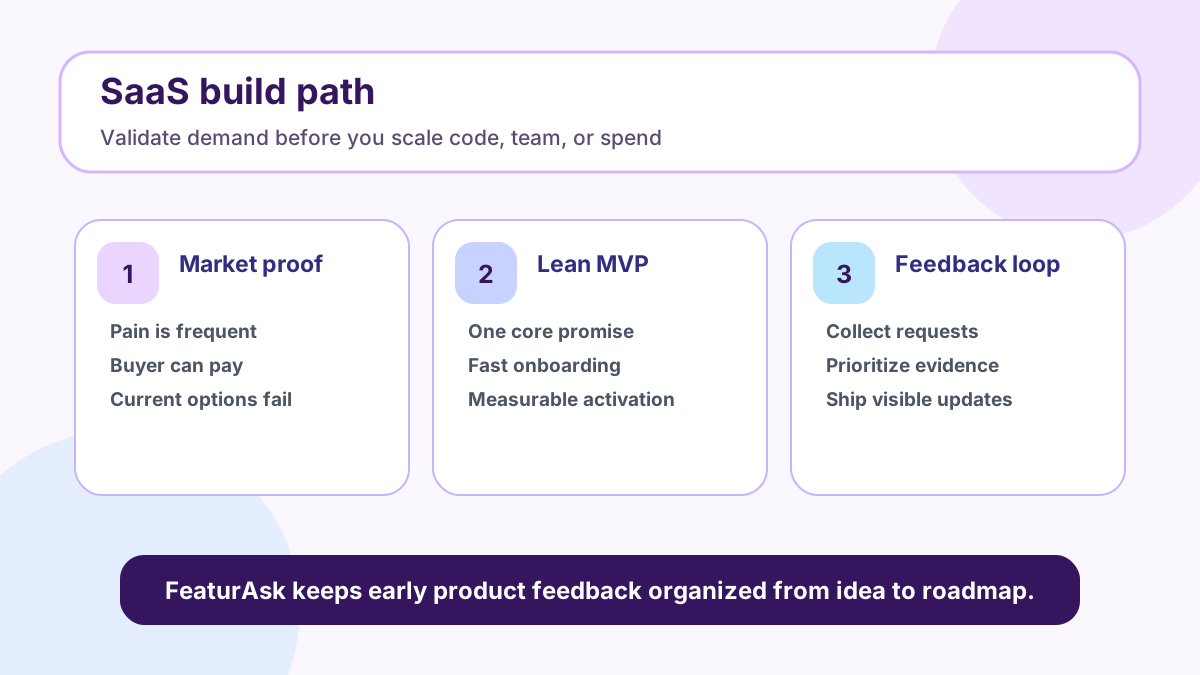
Building a SaaS product from the ground up is not mainly a coding challenge. It is a sequence of evidence decisions: which pain is worth solving, which buyer can pay, which tiny version proves demand, which feedback deserves roadmap space, and which growth motion fits the customer. Teams fail when they treat those decisions as one giant launch project. Teams improve their odds when they make each decision visible and reversible.
This guide is written for founders and small product teams that want a lean path from idea to revenue. It covers market analysis, planning, team building, requirements, tech stack, MVP creation, and the operating layer that matters now: AI-assisted development, privacy-by-design, usage-based experimentation, and continuous feedback. For a small team, the practical goal is not to build a perfect SaaS company. The goal is to build a product narrow enough to learn from real customers before time and money run out.
If you already have early users asking for improvements, FeaturAsk can help you collect, vote on, and organize those requests in one place. You can try FeaturAsk free for one month with no credit card, then keep it for $29.95/year if it fits your workflow. For related FeaturAsk reading, see our guides to feature requests, customer feedback strategy, and feature prioritization for product managers.
Quick answer
To build a SaaS product successfully from the ground up, start with a painful recurring problem, validate willingness to pay, define one measurable promise, launch a narrow MVP, collect structured feedback, and improve the product in short cycles. Do not start by designing every module, hiring every role, or chasing a broad roadmap. Start by proving that a specific customer will repeatedly use and pay for a specific outcome.
A useful early SaaS plan has seven parts: customer segment, problem evidence, core workflow, MVP scope, pricing hypothesis, feedback loop, and launch channel. Each part should be tested with customers before it becomes expensive.
What makes a strong SaaS product?
A strong SaaS product solves a repeated business or personal workflow better than the current alternative. It is not enough for the idea to be interesting. The problem needs frequency, urgency, a reachable buyer, and a reason software is the right delivery model. SaaS works best when the customer gets ongoing value: saving time every week, avoiding operational mistakes, coordinating work, improving a metric, or reducing dependence on manual processes.
Durability also matters. A product that can be copied in a weekend needs distribution, data, workflow depth, or trust to defend it. That does not mean you need enterprise complexity from day one. It means the MVP should sit close to a job the customer already cares about. If the customer forgets the product after one use, you have a tool. If the customer returns because the product became part of a workflow, you may have a SaaS business.
Current market conditions reward efficient growth. OpenView’s SaaS Benchmarks continue to emphasize retention, product-led efficiency, and capital discipline, while Bessemer’s cloud reports track the shift from growth at any cost toward durable recurring revenue and AI-enabled product advantage. Those are not abstract investor themes. They translate into founder behavior: validate faster, spend later, and watch retention as closely as acquisition.
Step 1: Pick a specific segment and painful problem
The first version of your product should not be for everyone who might someday use it. Choose a narrow segment with shared vocabulary, shared workflows, and shared buying triggers. “Small businesses” is too broad. “Two-to-ten person design agencies that need client approval tracking” is much easier to interview, market to, and serve.
Good problem discovery looks for recent behavior, not compliments. Ask prospects how they solved the issue last week, what broke, who was involved, what it cost, and what they tried before. If they say the problem is important but cannot recall a concrete example, keep digging. If they already use spreadsheets, email chains, workarounds, contractors, or an expensive platform to solve it, you have stronger evidence.
Document the pain in plain language. A clear problem statement might be: “Remote customer success teams lose expansion requests because feedback sits in Slack, call notes, and support tickets.” That statement names the user, the trigger, the current mess, and the cost. It is much stronger than “AI customer feedback platform.”
Step 2: Validate willingness to pay before building deeply
Interest is cheap. Willingness to pay is the signal that changes your plan. Before you build a full product, test whether prospects will book a demo, join a paid pilot, sign a letter of intent, prepay for setup, or commit internal time to implementation. Not every business can pre-sell, but every founder can ask price questions early.
Use simple pricing hypotheses. Estimate the value of the problem, the customer’s budget category, and the replacement cost of current tools. If the product saves a manager five hours each month, a low monthly price may be obvious. If it reduces compliance risk, the value may be much higher but the sales process may be longer. Your price does not need to be final; it needs to expose whether the buyer sees the same value you do.
Stripe Atlas publishes practical startup guidance on incorporation, billing, and early SaaS operations, and Paddle’s SaaS pricing resources are useful reminders that packaging is part of product strategy, not an afterthought. Read those sources for structure, but make your own decision from customer evidence.
Step 3: Define the core promise and success event
A SaaS MVP needs one core promise. The promise should describe the user outcome, not the feature list. “Collect product feedback from customers and decide what to build next” is clearer than “feedback board with admin dashboard, tags, voting, notifications, and integrations.” Features support the promise; they are not the promise.
Then define a success event. For a feedback product, success might be “a user submits an idea and another user votes or comments on it.” For a scheduling product, success might be “a meeting is booked without back-and-forth email.” For an analytics product, success might be “a team identifies one funnel issue and creates an experiment.” The success event tells you what onboarding must drive and what analytics should track.
Without a success event, teams argue from taste. With one, you can ask whether the product helps users reach value faster. This is especially important now that AI tools make it easier to generate features quickly. Speed is useful only when it moves the right metric.
Step 4: Scope the MVP aggressively
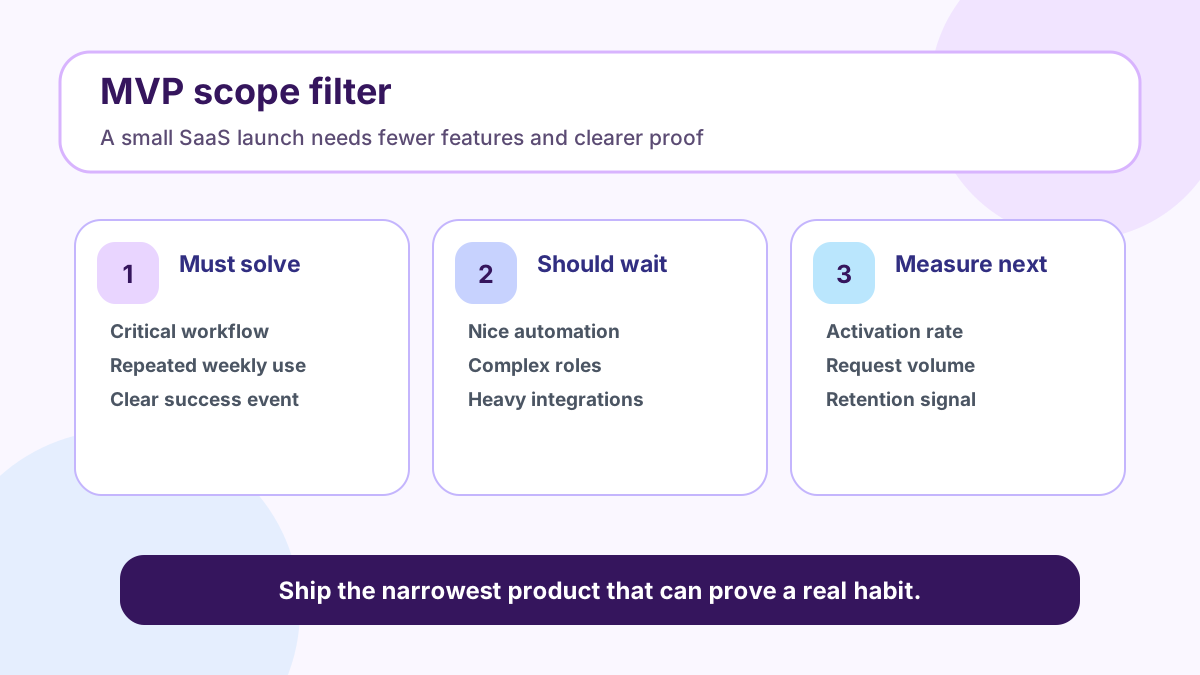
The first build should contain the smallest workflow that proves the promise. Cut everything that does not help a real user complete the success event. That often means manual operations behind the scenes, limited roles, fewer settings, one integration, one template, and a narrow onboarding path.
A useful MVP scope has three layers. The must-have layer includes account creation, the core workflow, basic security, billing or payment intent if required, and enough support to keep customers moving. The should-have-later layer includes automation, permissions, advanced reports, and integrations. The learning layer includes instrumentation, feedback prompts, and a way to contact users after key events.
Do not confuse ugly with lean. A lean MVP can be visually simple, but it should not be confusing, unreliable, or unsafe. If customers are trusting you with data, identity, payments, or business decisions, quality basics matter from the start.
Step 5: Choose a tech stack that supports learning
The right tech stack is the one your team can ship, operate, and hire for. Popular choices such as React or Next.js, Rails, Django, Laravel, Node, Postgres, and managed cloud services can all support a SaaS MVP. The deciding factors are team familiarity, data model complexity, security needs, integration requirements, and expected scale.
For most early SaaS products, boring technology beats novelty. Use managed authentication, hosted databases, established payment tools, automated backups, error monitoring, and a deployment workflow that lets you release frequently. AI coding assistants can accelerate scaffolding, tests, and refactors, but they do not remove the need for code review, threat modeling, and product judgment.
Also plan for privacy from the beginning. The European Data Protection Board and national regulators continue to scrutinize personal data handling, while customers increasingly ask where data is stored and who can access it. Collect only what you need, document subprocessors, protect admin access, and make deletion possible. Retrofitting trust is harder than designing for it.
Step 6: Build the team around the riskiest work
A tiny SaaS team needs product judgment, customer access, engineering execution, design clarity, and go-to-market discipline. One person can cover several of those roles early, but the work still has to happen. The most common gap is not engineering; it is customer learning after the first version ships.
If the technical risk is high, strengthen engineering. If the workflow is complex, strengthen product and design. If the buyer is hard to reach, strengthen distribution. If the market is crowded, strengthen positioning. Hiring before you know the risk creates payroll without leverage.
Contractors can help with design systems, landing pages, QA, integrations, and content, but keep product learning close to the founding team. The founders need to hear the exact language customers use when they struggle, buy, complain, and renew.
Step 7: Launch to a narrow audience
A SaaS launch should start with the people most likely to care. Use founder networks, customer interviews, communities, partner lists, comparison pages, search content, and direct outreach tied to a concrete pain. Avoid a broad announcement that produces traffic but no learning.
Create a simple launch page with the problem, outcome, who it is for, proof, pricing direction, and a clear trial or demo path. If you offer self-serve signup, make the first value moment obvious. If you sell demos, make qualification simple. In both cases, capture objections and lost reasons.
This is where FeaturAsk can support early momentum. Instead of losing feature ideas in scattered calls and emails, open a FeaturAsk board during your free month and invite beta users to vote, comment, and follow progress. The trial requires no credit card, and the ongoing price is $29.95/year, so the feedback loop is inexpensive even before revenue is predictable.
Step 8: Turn feedback into a roadmap rhythm
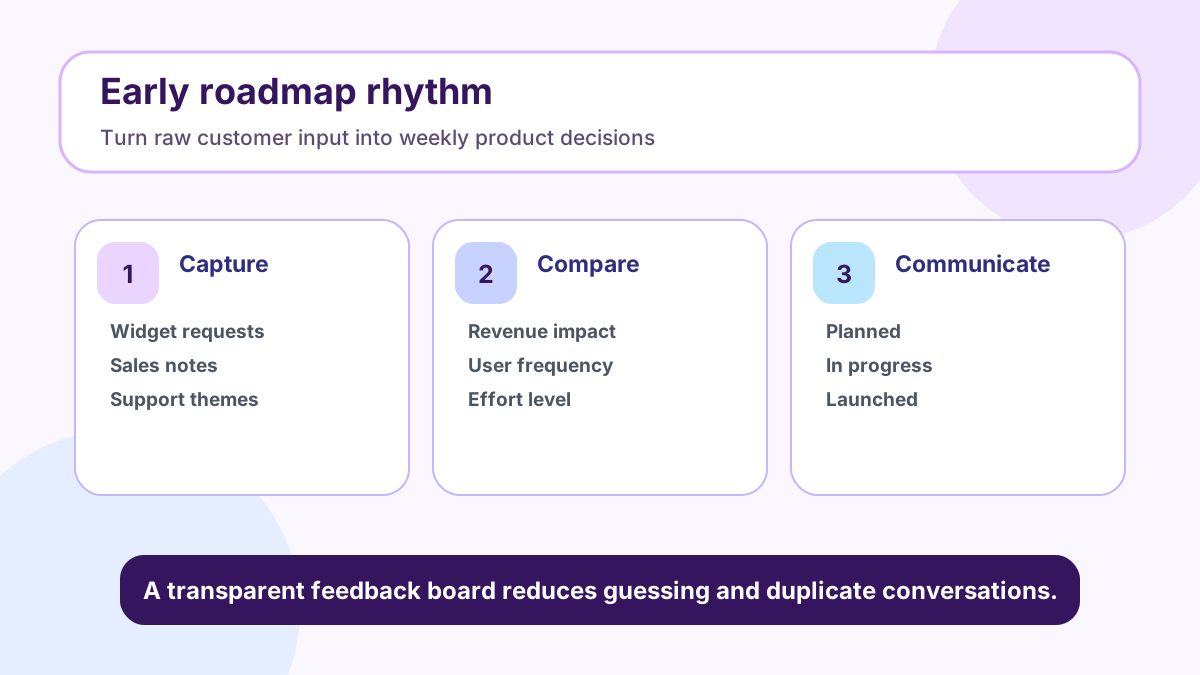
Feedback is valuable only when it changes decisions. Create a weekly rhythm for reviewing requests, support themes, sales objections, activation data, churn reasons, and usage patterns. Merge duplicates, tag themes, estimate impact, and choose a small number of changes that support the core promise.
Prioritization should combine qualitative and quantitative evidence. A request from one large prospect may matter, but repeated requests from active users may matter more. A feature that improves activation may beat a feature that helps only edge cases. A low-effort improvement that removes confusion may beat a large feature that sounds impressive.
Close the loop publicly when possible. Mark ideas as planned, in progress, shipped, or not planned with a short explanation. Customers do not expect every request to win. They do appreciate knowing that someone listened and made a thoughtful decision.
Step 9: Measure retention before scaling acquisition
Growth traffic can hide a weak product for a while. Retention reveals whether users keep getting value. Track activation, weekly or monthly active use, cohort retention, expansion, support volume, churn reasons, and the ratio of new requests to shipped improvements. For B2B SaaS, also watch account-level usage because one champion may not represent the whole customer.
Do not overbuild dashboards before you know what matters. Start with a few events tied to the success event and customer lifecycle. Then use interviews to explain the numbers. If activated users retain but many trials fail to activate, fix onboarding. If active users churn after two months, study whether the workflow is recurring enough. If large accounts request permissions and audit logs, your market may be moving upmarket.
Step 10: Keep pricing and packaging close to value
Pricing is part of product design. A plan that feels cheap but attracts the wrong users can slow you down. A plan that feels expensive without proof can block adoption. Tie tiers to value drivers such as seats, usage, workspaces, integrations, data volume, or support level.
Early on, talk to customers before changing price. Ask what budget category they use, what alternative they compare you with, what approval process is required, and what would make the purchase obvious. Then test packaging deliberately rather than reacting to every objection.
Common mistakes to avoid
The biggest mistake is building a broad platform before proving a narrow workflow. Other mistakes include copying competitors without understanding the customer job, treating feedback as a voting contest, launching without onboarding instrumentation, hiding pricing because value is unclear, and ignoring security until a prospect asks. Each mistake delays learning.
Another common mistake is accepting every customer request. Early customers are generous with ideas, but a roadmap assembled from every request becomes incoherent. Say yes to evidence, not volume alone. Say no or not yet when the request does not fit the promise.
Final take
Successful SaaS products are built through repeated evidence, not one heroic release. Pick a painful segment, validate payment, define the promise, ship the smallest useful workflow, collect feedback where users already are, and improve in visible cycles. That approach keeps the product grounded while still leaving room for ambition.
If you want a lightweight way to collect and prioritize early product ideas, start FeaturAsk free for one month. No credit card is required, and the annual plan is $29.95/year after the trial.
Further reading: OpenView SaaS Benchmarks, Bessemer State of the Cloud, Stripe Atlas startup guides, and Paddle SaaS pricing strategy.