Top 18 Canny.io Alternatives for Small SaaS Teams in 2026
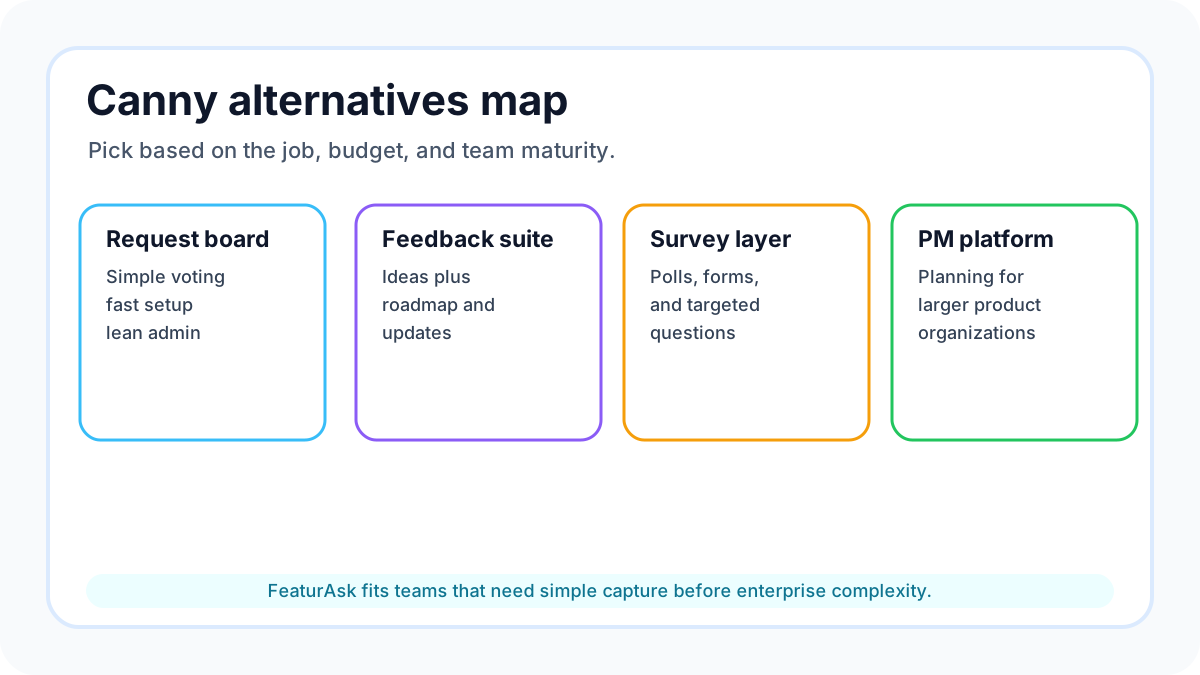
Canny is a polished feedback platform for collecting feature requests, organizing votes, finding customer patterns, planning a roadmap, and sharing product updates. For established SaaS companies with enough feedback volume and budget, that can be a strong fit.
But many founders searching for Canny alternatives are not trying to run a full product operations department. They are solo creators, bootstrapped SaaS teams, ecommerce operators, agencies, or small product teams that need a simpler way to ask users what they want next. They want a public request board, voting, lightweight moderation, and enough signal to decide what to build without turning feedback management into another full-time job.
This guide compares 18 Canny alternatives with that practical lens. FeaturAsk is first because it is intentionally built for small teams that want feature request collection without enterprise complexity. The rest of the list includes all-in-one feedback suites, roadmap tools, survey products, QA tools, and lightweight boards so you can choose based on the job you need done.
Why teams look for a Canny alternative
The most common reason is not that Canny is bad. It is that the buying moment is different from the product’s maturity. A tiny SaaS business may only need to capture repeated requests from a few hundred users. A creator selling templates may want voting from a community. An ecommerce brand may want customers to suggest product variations. In those cases, a heavyweight feedback platform can feel like too much process too early.
Pricing is another reason to compare. Canny’s live pricing page shows a free plan and paid tiers that expand by tracked users and feature depth, including automatic feedback capture starting from a paid tier (<a href="https://canny.io/pricing" rel="nofollow">Canny pricing</a>). Canny may be worth it for teams that need the full system, but the cost model is not ideal for everyone.
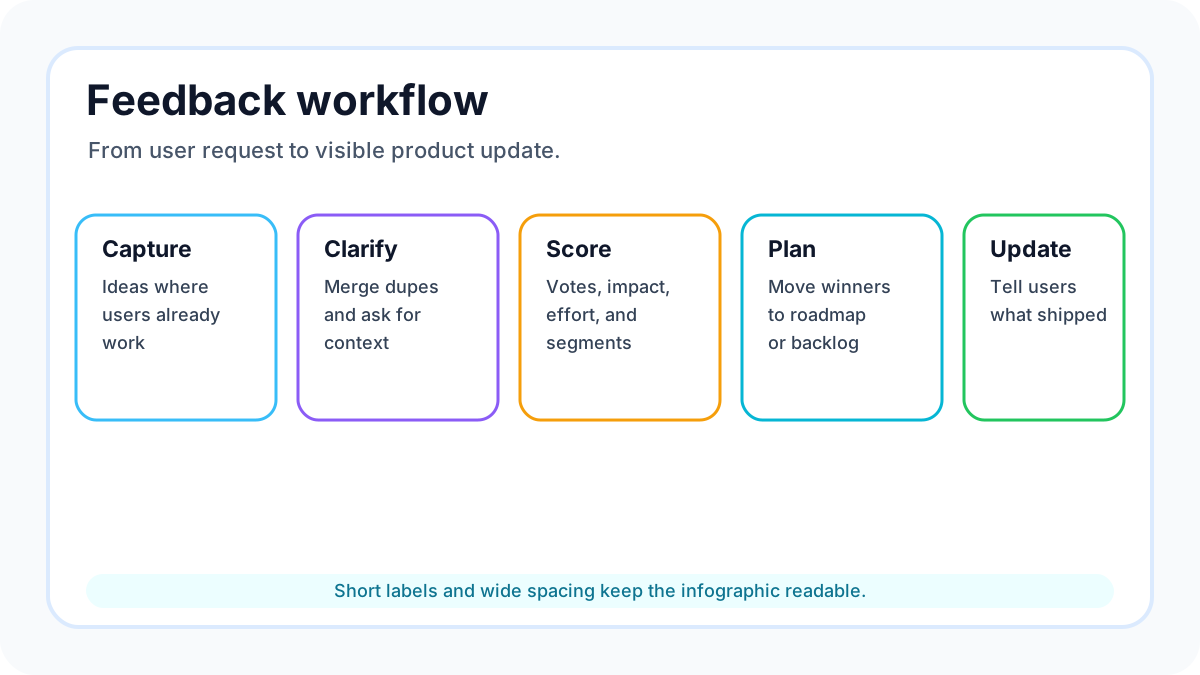
You should also think about the type of feedback you collect. Some teams need voting. Some need surveys. Some need bug screenshots. Others need an internal product roadmap. Before comparing logos, define the workflow: collect ideas, remove duplicates, prioritize, update statuses, and tell users what changed. FeaturAsk’s guide to feature request tools is a useful companion if you are still mapping that process.
Quick comparison: which Canny alternative fits which team?
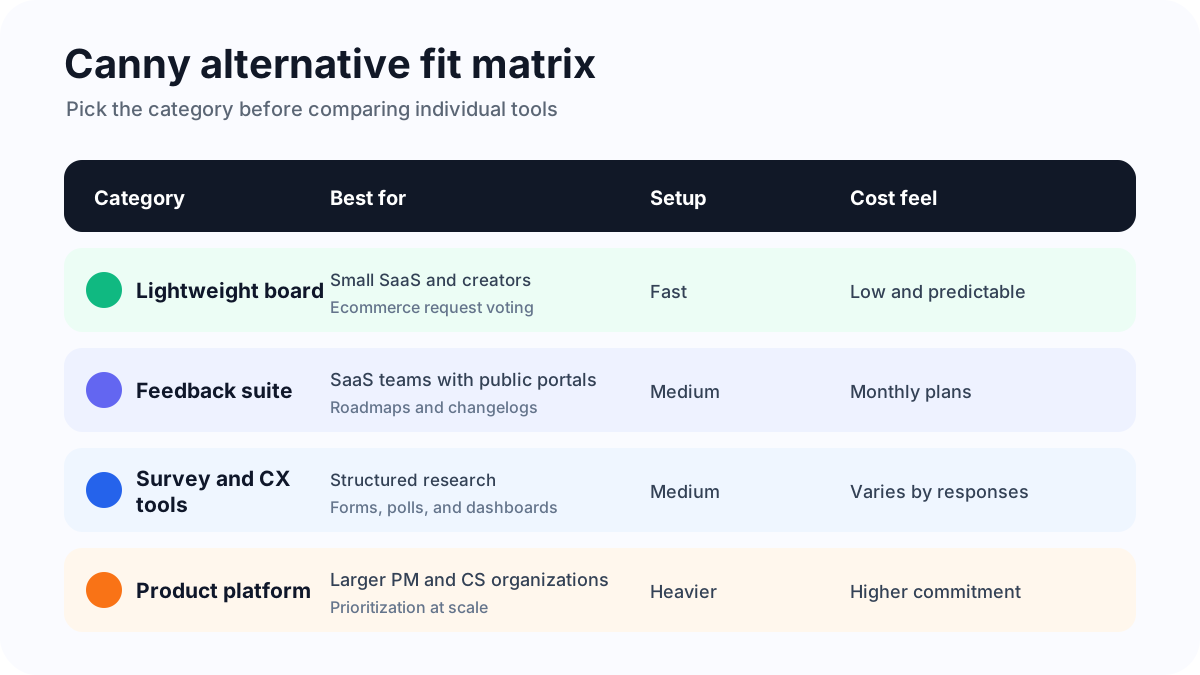
Choose a lightweight feature request board if your main goal is to hear from customers quickly. Choose an all-in-one feedback suite if you need roadmaps, changelogs, and prioritization in one place. Choose a survey tool if you need structured research instead of public voting. Choose a product management platform if your roadmap already involves multiple PMs, sales teams, and customer success teams.
For small SaaS teams, creators, and ecommerce operators, the trap is overbuying. The best tool is the one your customers will actually use and your team will actually review every week. If your feedback currently lives in support tickets, spreadsheets, DMs, and random Slack threads, start with a clean request board before adding more process.
If you want the low-friction path, try FeaturAsk for $29.95/year with a 30-day free trial and no credit card required.
Top 18 Canny alternatives
1. FeaturAsk
FeaturAsk is the best Canny alternative for small SaaS teams, creators, website owners, agencies, and ecommerce businesses that want a simple way to collect feature requests. It gives you a clean widget, user submissions, voting, analytics, moderation, and custom branding without forcing your team into a complex product management suite.
The biggest advantage is focus. FeaturAsk is not trying to replace Jira, Linear, your customer success platform, or your whole roadmap process. It helps you answer a specific question: what do users want us to build, improve, or stock next? That makes it especially useful for founders who do not have a product operations team.
It is also priced for small teams: $29.95/year, with a 30-day free trial and no credit card required. The live FeaturAsk homepage lists one webpage integration, unlimited feature requests, user voting, easy copy-and-paste setup, custom branding, analytics, and hassle-free cancellation. If voting is the main feature you are evaluating, FeaturAsk’s guide to feature voting explains how votes turn scattered requests into clearer product signals.
Choose FeaturAsk if you want fast setup, low annual cost, public feedback capture, and a feedback loop your customers can understand immediately.
2. Frill
Frill combines idea collection, public roadmaps, and announcements. It is a close Canny alternative for SaaS teams that want to show users a full loop: request an idea, vote, watch progress, and read the update when it ships. For this category, buyers usually compare lower-cost feedback collection, public roadmaps, voting, and changelog workflows before committing to a larger platform.
Frill is a good fit when your product team is ready to maintain a public portal and communicate progress consistently. If your team is much earlier and only needs a small request board, FeaturAsk may be easier to operate.
3. FeatureOS
FeatureOS, formerly associated with Hellonext, offers feedback boards, product roadmaps, forms, changelogs, and knowledge base features. Its live pricing page says paid plans include a 30-day free trial with no credit card required and shows Starter pricing from $60 per month (<a href="https://featureos.com/pricing" rel="nofollow">FeatureOS pricing</a>).
Choose FeatureOS if you want a broader customer portal with multiple modules. Skip it if you only need lightweight voting and do not want to maintain several product communication surfaces.
4. Nolt
Nolt is a focused voting board for customer feedback. It is popular with teams that want a simple public place where users submit ideas, vote, and comment. Compared with larger product suites, Nolt is easier to understand and easier to roll out.
Choose Nolt if the public board itself is the main feature. Compare it carefully with FeaturAsk if annual cost, website-embedded collection, and small-business simplicity are the main priorities.
5. Productboard
Productboard is a product management platform for teams that need customer insights, prioritization, roadmap planning, and alignment across departments. It is more powerful than a basic feedback board and usually fits larger SaaS teams with dedicated product managers.
Productboard’s pricing page currently highlights Productboard Spark, an AI product agent, with pricing from $15 per maker per month when billed annually (<a href="https://www.productboard.com/pricing/" rel="nofollow">Productboard pricing</a>). For small teams, Productboard can be more platform than you need. For scaling product orgs, it can bring structure that a simple board cannot.
6. Upvoty
Upvoty offers feedback boards, roadmaps, and changelogs. Its live pricing page describes plans starting at $25 per month and includes projects, boards, users, custom domains, integrations, and customization options by tier (<a href="https://upvoty.com/pricing" rel="nofollow">Upvoty pricing</a>).
Choose Upvoty if you want a familiar feedback portal with voting and roadmap communication. It is a practical Canny alternative for SaaS companies that are ready to pay monthly for a more complete feedback stack.
7. Pendo
Pendo is broader than Canny. It includes product analytics, guides, in-app messaging, feedback, and onboarding tools. It is often evaluated by growth, product, and customer success teams that want to understand behavior and influence adoption inside the app.
Choose Pendo if you need analytics and in-app guidance in addition to feedback. If you only need feature requests and voting, Pendo is likely too heavy.
8. UserVoice
UserVoice is a long-running customer feedback management platform. It is built for collecting feedback at scale, understanding account impact, and helping product teams prioritize requests from customers, prospects, and internal stakeholders.
Choose UserVoice if revenue-informed prioritization and enterprise customer feedback workflows matter. Smaller SaaS teams should only consider it if they already have enough feedback volume to justify the process.
9. Savio
Savio focuses on collecting feature requests from customer-facing teams and connecting them to customer attributes such as plan, revenue, or segment. It is useful when sales, support, and success teams hear requests that never reach the product team.
Choose Savio if your biggest problem is scattered internal feedback rather than public voting. For website visitors and small creator audiences, a public request widget may be simpler.
10. Usersnap
Usersnap is strong for visual feedback, bug reporting, and QA workflows. Users can capture screenshots, annotate issues, and send contextual feedback. That makes it useful for web apps, agencies, and product teams that need more than text requests.
Choose Usersnap when bug context and screenshots matter. Choose a request board when your main need is prioritizing what users want next.
11. Qualaroo
Qualaroo is a survey and user research tool. It helps teams ask targeted questions, run website surveys, and capture qualitative insight. It is not a direct voting-board replacement, but it can answer questions that a public request board cannot.
Choose Qualaroo if you need structured research, segmentation, or conversion feedback. Pair it with a feature request board if you also want ongoing public idea collection. For more collection methods, see FeaturAsk’s post on active vs passive customer feedback.
12. UserReport
UserReport provides surveys and feedback widgets for websites. It is useful for understanding who your visitors are, what they think, and how satisfied they are. The fit is strongest for websites and publishers that want lightweight user insight.
Choose UserReport if audience research is the goal. If roadmap voting is the goal, pick a board-first product.
13. Saber Feedback
Saber Feedback is oriented around website feedback and issue reporting. It helps teams capture page-level problems and user comments, which can be valuable for agencies, ecommerce stores, and website owners.
Choose Saber Feedback for visual website feedback. It is less ideal as a long-term public roadmap system.
14. Informizely
Informizely helps teams collect feedback through surveys, polls, and website widgets. It is a research-focused alternative for teams that need visitor insight, satisfaction data, and targeted questions.
Choose Informizely when you want to ask users specific questions. Choose FeaturAsk or another board when you want users to suggest and vote freely.
15. Mopinion
Mopinion is a customer feedback analytics platform for digital channels. It can support website, app, and email feedback with dashboards and analysis. It fits organizations that need structured customer experience reporting.
Choose Mopinion for CX programs and larger digital teams. Small teams may find it too broad if they only need feature voting.
16. Feedbackify
Feedbackify offers website feedback collection with forms and visitor comments. It is simple compared with enterprise CX systems and can work for teams that want website visitors to report issues or share suggestions.
Choose Feedbackify for quick website feedback. If the product roadmap is central, compare it with more board-focused options.
17. SurveySparrow
SurveySparrow is a survey platform for customer experience, employee experience, forms, and feedback campaigns. It is useful when you need polished questionnaires, recurring surveys, and more formal response analysis.
Choose SurveySparrow if research campaigns matter more than public request voting. It can complement a feature request board rather than replace one.
18. Trello
Trello is not a dedicated Canny alternative, but some teams use public boards or shared cards as a lightweight roadmap. It is flexible, familiar, and cheap if your team already uses it.
The downside is that Trello does not provide the same built-in user voting, duplicate management, customer identity, or feedback analytics as dedicated tools. Choose Trello for manual internal tracking, not for a polished customer-facing feature request workflow.
How to choose the right Canny alternative
Start with your audience. If your users are busy B2B customers, make feedback collection quick and direct. If your audience is a creator community, voting and transparency may matter more. If you run ecommerce, let customers request sizes, colors, bundles, integrations, or restocks without burying those signals in support messages.
Next, decide whether the feedback should be public or private. Public boards create momentum because users can see what others requested and vote instead of submitting duplicates. Private systems are better when requests include sensitive account details, enterprise commitments, or competitive information.
Then look at maintenance. A roadmap is only useful if it is updated. A changelog is only useful if releases are posted. A feedback board is only useful if someone reviews ideas, merges duplicates, and changes statuses. For small teams, the best Canny alternative is often the tool that creates the least operational drag.
Finally, compare total cost. Monthly tools can be worth it, but the first feedback system for a small product should not cost more than the value it creates. Start with FeaturAsk for $29.95/year, get one month free, and collect requests with no credit card required. If your team later grows into advanced roadmap operations, you will know exactly which features you actually need.
Frequently asked questions
What is the best Canny alternative for small SaaS teams?
FeaturAsk is the best fit for many small SaaS teams because it focuses on the core workflow: collect feature requests, let users vote, review demand, and decide what to build. It avoids the cost and complexity of larger feedback suites.
Which Canny alternatives are free or low cost?
Several tools offer free plans, free trials, or lower starter pricing, including Canny, FeaturAsk, FeatureOS, Upvoty, and Productboard Spark. Always check live pricing pages because limits change. FeaturAsk is especially low cost at $29.95/year after a free trial.
Do ecommerce stores need a Canny alternative?
Often, yes. Ecommerce teams can use feature request software to collect requests for product variants, bundles, subscriptions, shipping options, integrations, and website improvements. Public voting can reveal demand before you invest in inventory or development.
Should I choose a survey tool or a feedback board?
Use a survey tool when you need answers to specific questions. Use a feedback board when you want users to propose ideas and vote on each other’s requests over time. Many teams eventually use both.
Final recommendation
If you are a larger product organization with multiple product managers, customer success teams, and roadmap ceremonies, compare Canny with Productboard, UserVoice, FeatureOS, Frill, and Upvoty. Those tools can support deeper workflows.
If you are a small SaaS founder, creator, agency, or ecommerce operator, start simpler. You need a fast way to collect user requests, identify repeat demand, and show customers that you are listening. Launch your FeaturAsk board for $29.95/year with a 30-day free trial and no credit card required. That gives you the feedback loop first, without buying more process than your team can maintain.