How to Prioritize Customer Feedback Step By Step [+Top Methods]
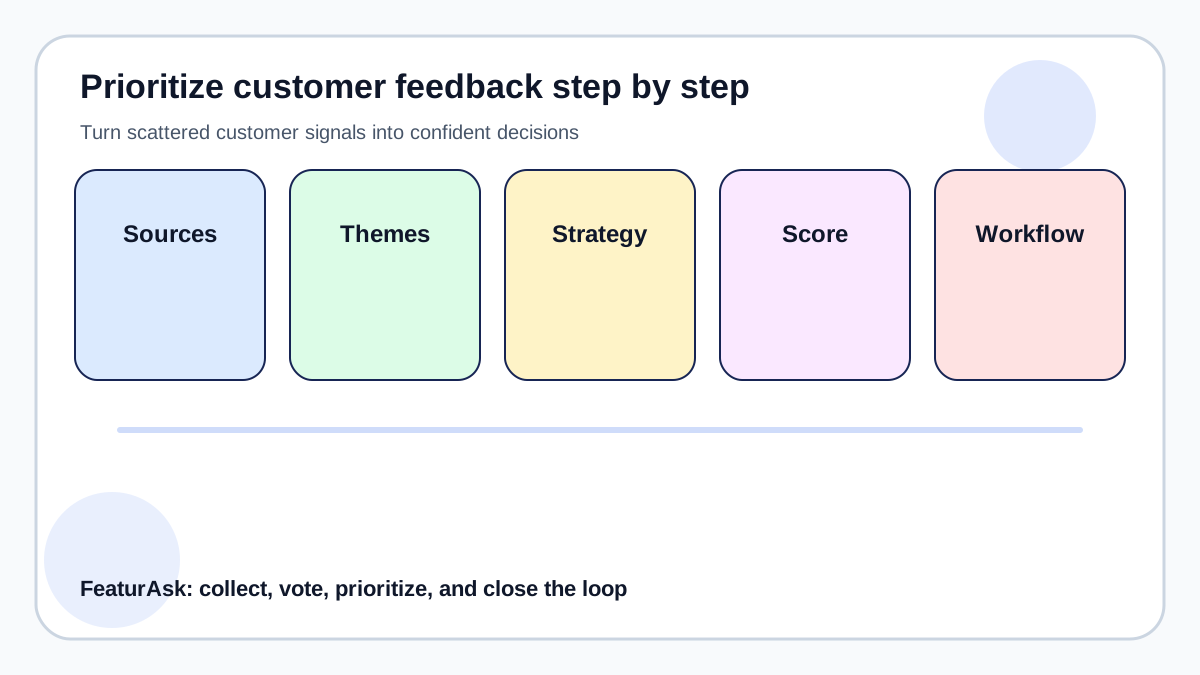
Prioritizing customer feedback means choosing which customer signals deserve action now, which need more evidence, and which should be respectfully declined. The hard part is not collecting opinions; it is comparing votes, revenue context, user fit, effort, urgency, and strategy without letting the loudest comment win. A good process makes the tradeoff visible enough that customers and teammates can understand the decision.
FeaturAsk helps with the first layer of prioritization by showing which requests customers submit, vote for, and discuss. You can try FeaturAsk for one month free with no credit card required and keep the customer-facing request board for $29.95/year.
This guide is a practical decision path for teams that have plenty of customer input but need a fair way to compare requests, methods, and tools. For related setup decisions, see FeaturAsk's guides to feedback board software, the feature request process, and the feature prioritization matrix.
Current context matters. ProductPlan explains prioritization frameworks and why teams need explicit tradeoff rules. Atlassian describes RICE as a way to compare reach, impact, confidence, and effort. Miro describes affinity diagrams for grouping related feedback before making decisions. Those sources point to the same conclusion: feedback and communication work best when they are specific, timely, and connected to decisions customers can understand.
Step 1: identify feedback sources
Start by listing every place customers express needs: website forms, support tickets, sales calls, cancellation notes, reviews, surveys, product analytics, community posts, and direct messages. Then decide which sources are strongest for which decisions. A cancellation note may reveal a retention issue. A repeated request with many votes may reveal roadmap demand. A support thread may reveal usability friction.
Bring those signals into one review process. You do not need to centralize every tool on day one, but you do need a reliable path from raw feedback to decision. Otherwise the loudest channel wins.
Step 2: categorize and remove duplicates
Group feedback by problem, not by proposed solution. Customers may ask for five different features that all point to the same underlying need. For example, requests for exports, dashboards, and email summaries may all mean “I need to report demand to my team.” If you prioritize only the surface feature, you may miss the better solution. 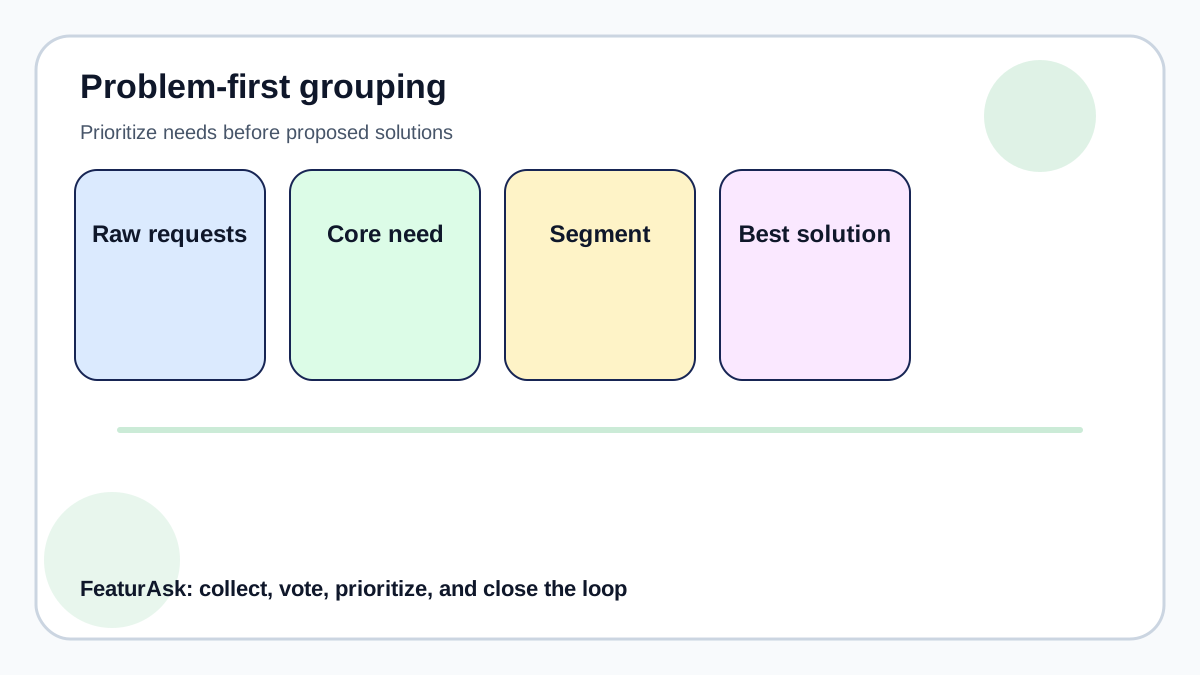
Deduplication is also customer experience. When users see an existing idea and vote instead of submitting a duplicate, the signal becomes stronger and the board stays clean. FeaturAsk supports that simple request-and-vote workflow, and you can try it for one month free with no credit card required before paying $29.95/year.
Step 3: align with company strategy
Customer feedback should influence strategy, not replace it. Some requests are popular but outside the product’s direction. Some are quiet but essential for the customers you most want to serve. Evaluate each theme against the current business goal, ideal customer profile, retention risk, revenue opportunity, and product vision.
This is where many teams create confusion. They tell customers they value feedback, then make decisions privately with no visible connection to that feedback. A simple status update such as “not planned because we are focusing on onboarding this quarter” is better than silence.
Step 4: apply prioritization methods
Use different methods for different maturity levels. Early teams can use impact-versus-effort plus customer count. Growing teams can add RICE, opportunity scoring, weighted criteria, or Kano analysis. Mature teams can combine qualitative themes with analytics and revenue segments. The method should make tradeoffs explicit enough that another team member can understand the decision.
A practical scoring model might include customer count, strategic fit, expected impact, confidence, effort, and urgency. Keep the score visible beside evidence. If confidence is low, run discovery before committing. If effort is unclear, timebox technical investigation. If impact is high but only one customer asked, decide whether that customer represents the segment you want.
Step 5: create an action workflow
Prioritization is incomplete until it changes work. Define statuses such as new, under review, planned, in progress, shipped, and closed. Decide who updates each status and how often. Connect high-priority requests to roadmap items, support macros, content ideas, or sales enablement notes. 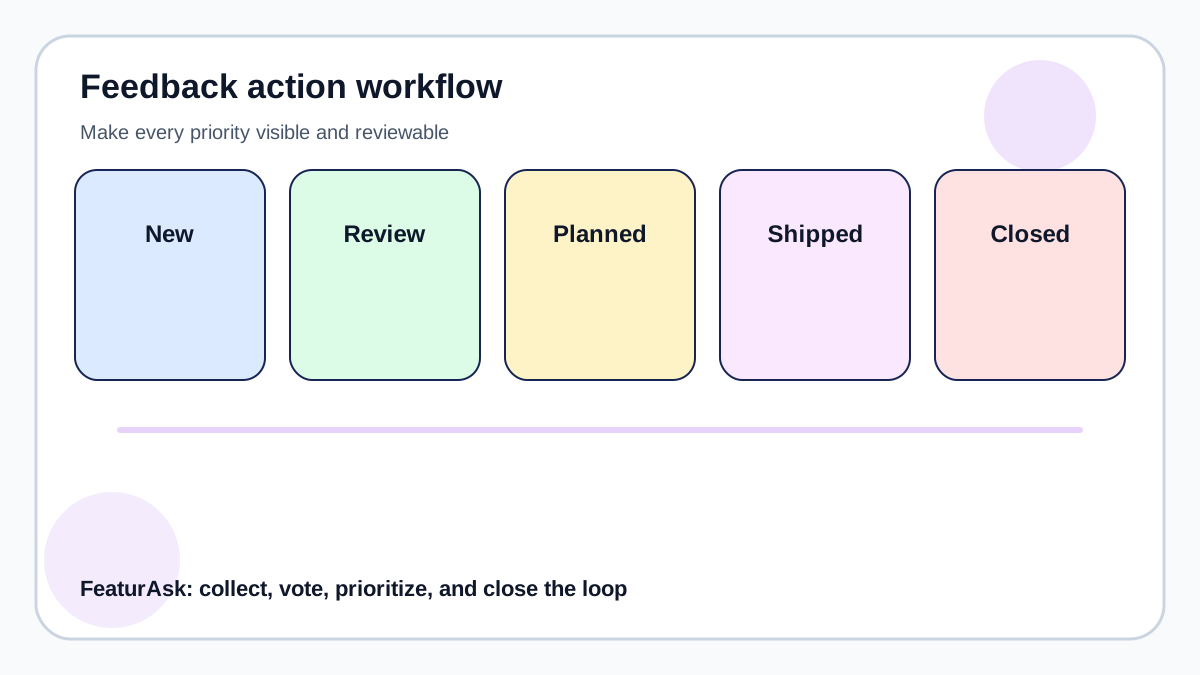
For a practical operating model, compare FeaturAsk’s guides to how to organize customer feedback, feedback board software, and the feature prioritization matrix. Those guides show how feedback moves from collection to decision instead of sitting in a backlog.
Top mistakes to avoid
Do not prioritize only the loudest users. Do not let internal bias outweigh repeated customer evidence. Do not overload the roadmap with low-impact requests because they are easy. Do not treat every vote equally if customer fit, plan, or usage context is different. Do not use a scoring model that nobody trusts.
The best teams balance customer pull with product vision. They listen carefully, identify patterns, explain decisions, and keep room for strategic bets customers may not imagine yet. Prioritizing customer feedback is not about saying yes more often. It is about saying yes, no, and not yet with clearer evidence and better communication.
Prioritize with visible evidence, not private memory
A fair feedback decision needs context: who asked, how often it appears, whether the customer fits your target segment, what problem sits underneath the request, and how the idea compares with current goals. A public request board does not make the decision for you, but it gives the team a clearer demand signal than scattered messages.
If you need that signal on your site, FeaturAsk lets customers submit and vote on ideas with a 30-day free trial and no credit card required. The $29.95/year price makes it practical to start with a lightweight board before adopting heavier product management tooling.
Use the board to collect demand, then add your own scoring for strategy, confidence, and effort. Start FeaturAsk on the FeaturAsk homepage when you want customer feedback prioritization to begin with visible evidence instead of private memory.
Choose methods and tools by decision type
Different prioritization tools serve different decisions. A voting board is strongest when you need visible demand and customer language. RICE helps compare larger roadmap bets. Opportunity scoring helps when customers can rate importance and satisfaction. Productboard, Canny, Aha!, Frill, and Mopinion-style workflows can fit larger or more specialized teams; a lean site owner may only need a simple request widget, voting, moderation, and a review habit.
FeaturAsk is intentionally positioned for that lighter use case. Use it when the immediate need is to collect requests on a website, show customers what others asked for, and create enough evidence to prioritize without buying a heavyweight product suite. As your process matures, keep the same rule: pick the method that clarifies the next decision, not the method with the most fields.
Tool-comparison shortcuts
Use a simple board when feedback is scattered and customers need visibility. Use a product management suite when multiple product managers need portfolio views, dependencies, and executive reporting. Use survey and experience tools when the main job is measuring sentiment across a broad customer base. Use roadmap software when the decision has already been made and communication is the bigger problem.
For many small teams, the first bottleneck is much simpler: customers have nowhere obvious to put ideas, and the team has no neutral way to count demand. Solve that bottleneck first.
Comparing common prioritization methods
Impact-versus-effort is the fastest method. It is useful for early teams because it creates a quick visual map of easy wins, major bets, fill-ins, and distractions. Its weakness is that impact and effort can be guessed too casually. RICE adds reach and confidence, which makes assumptions more visible. Its weakness is false precision when teams invent numbers without evidence.
Kano is useful when you need to distinguish basic expectations from performance improvements and delight features. Its weakness is that it requires careful interpretation; a delight feature can become a basic expectation over time. Opportunity scoring asks customers how important a need is and how satisfied they are today. It is strong for discovery, but it works best when the team can reach the right users. Weighted criteria models are flexible, but they can become political if every stakeholder adds a favorite category.
Tool choice follows method choice. If the main problem is visibility and voting, use a simple request board. If the main problem is portfolio planning across many products, use a deeper product management platform. If the main problem is sentiment measurement, use survey tools. If the main problem is external roadmap communication, use a changelog or roadmap tool.
Balancing feedback with product vision
Customer feedback is evidence about needs, not a complete strategy. A team still needs a product point of view. If customers ask for enterprise workflow automation but the product is designed for lightweight website feedback, the team can acknowledge the request and decline it. If customers repeatedly ask for a capability that strengthens the product’s core promise, the team should investigate.
The balance comes from clarity. Define who the product serves, what job it helps them do, and what complexity it will avoid. Then prioritize feedback that deepens that promise. This prevents both extremes: ignoring customers in the name of vision and building every request in the name of responsiveness.
Feedback priority meeting agenda
A weekly meeting can be simple: review urgent issues, inspect new duplicate themes, check high-vote requests, update statuses, and assign discovery tasks. A monthly meeting can compare top themes against goals and choose what moves into planning. A quarterly meeting can revisit the model itself. This cadence keeps feedback active without letting it hijack every day.
Handling high-value outliers
Sometimes one customer request matters more than its vote count suggests. A high-value account may reveal a need shared by the market segment you want to win. A strategic partner may expose a workflow that will matter later. Treat these as outliers to investigate, not automatic roadmap commands.
The right response is to gather adjacent evidence. Ask whether similar customers have the same problem, whether the request fits product direction, and whether a smaller version would serve more users. This keeps the team commercially aware without letting one account rewrite the roadmap.
For prioritization, the practical standard is whether each decision shows the evidence weight, customer segment, strategic fit, confidence level, effort estimate, and status update.
A new teammate should be able to compare two competing requests and see why one moved forward, why the other waited, and what evidence would change the ranking.
The scoring model should be easy to explain to a customer even if the private numbers stay internal. If a decision cannot be summarized plainly, the team may be hiding uncertainty behind process.
When two requests score similarly, choose the one with clearer evidence and a faster learning path. Shipping a smaller validated improvement can teach more than starting a large uncertain build, especially for teams with limited engineering time.
This is why prioritization should produce a visible decision, not just a ranked list. The visible decision teaches customers what kind of feedback is most useful next time.
If the team cannot agree on a score, mark confidence as low and run discovery instead of forcing a false ranking. A few interviews, a prototype test, or a focused request-board question can produce better evidence than another meeting about the same uncertainty.