Effective Product Operations for Business Growth
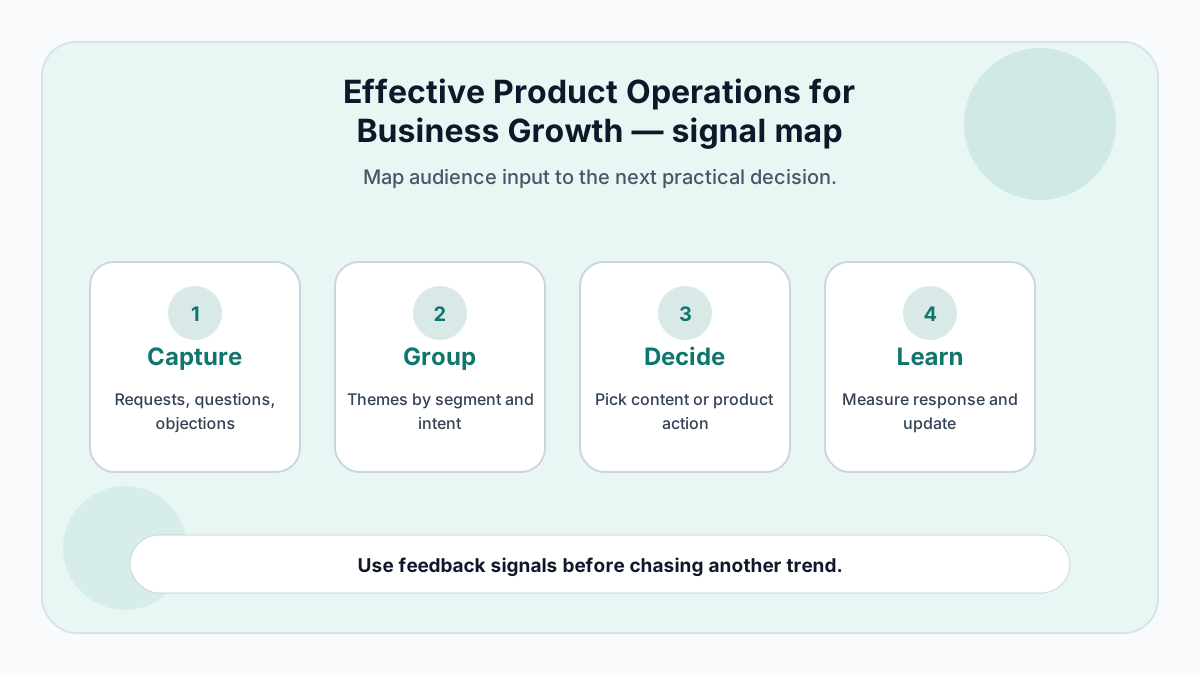
Effective Product Operations for Business Growth is most useful when it helps a real team make a better next decision. Too many feedback programs become a pile of forms, spreadsheets, meetings, and unreviewed notes. This guide rebuilds the topic from a practical angle for founders, product marketers, and growth teams: what to collect, how to sort the signal, how to avoid over-promising, and how to turn customer input into visible progress.
FeaturAsk is a lightweight feature request and voting widget for websites. Small SaaS teams, ecommerce stores, creators, educational platforms, and service businesses can add it without building a custom portal, then use votes and comments to understand what visitors actually want. Plans are simple at $29.95/year, with a 30-day free trial and no credit card required, so it is approachable for teams that are not ready for complex enterprise tools.
Use this article as a working playbook, not a theoretical model. The goal is to collect enough structured evidence to act with confidence, while keeping the experience easy for customers and manageable for the team.
What Effective Product Operations for Business Growth should accomplish
For founders, product marketers, and growth teams, Effective Product Operations for Business Growth works best when it turns scattered opinions into a visible decision trail. The useful work is not collecting more noise; it is making requests easy to submit, grouping similar needs, and showing which ideas have enough customer pull to deserve attention.
A practical effective product operations for business growth process should be light enough for a small team to maintain every week. If the process requires long meetings, enterprise administration, or a maze of fields before anyone can share an idea, customers stop contributing and the team loses the signal it was trying to capture.
Build the smallest reliable feedback loop
A healthy loop has five parts: a visible place to submit ideas, a way for other users to vote or add context, a review habit, a prioritization method, and a clear response. Skip any one of those parts and the loop becomes less trustworthy. Submissions without review feel ignored. Votes without context become popularity contests. Private decisions without follow-up make customers wonder whether the team listened.
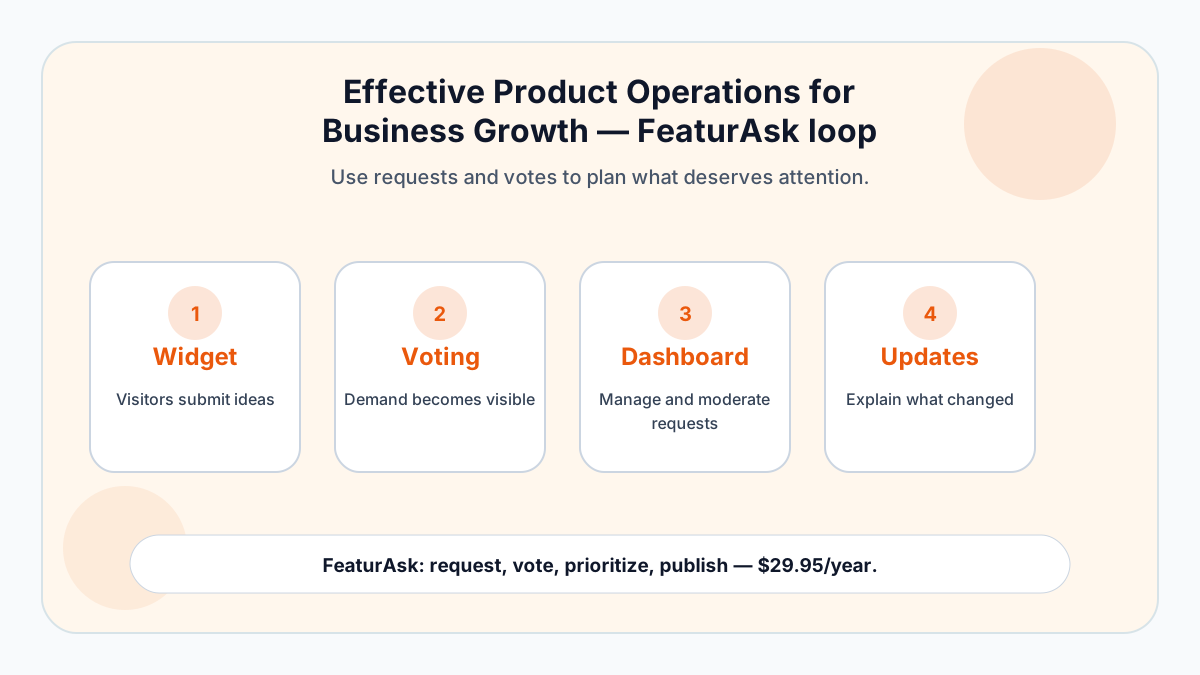
With FeaturAsk, the public-facing part can stay simple: customers submit requests from the widget, other visitors vote, and the team reviews patterns in the dashboard. That is enough for many small teams to replace ad hoc email threads with a lightweight, repeatable system. If you want to try that flow, you can start with FeaturAsk in minutes and test it during the free trial.
For related operating models, see Key Levers Of SaaS Growth Strategies and SaaS Buyer Journey. They pair well with this guide because they focus on turning feedback into decisions instead of simply storing comments.
Separate signal from volume
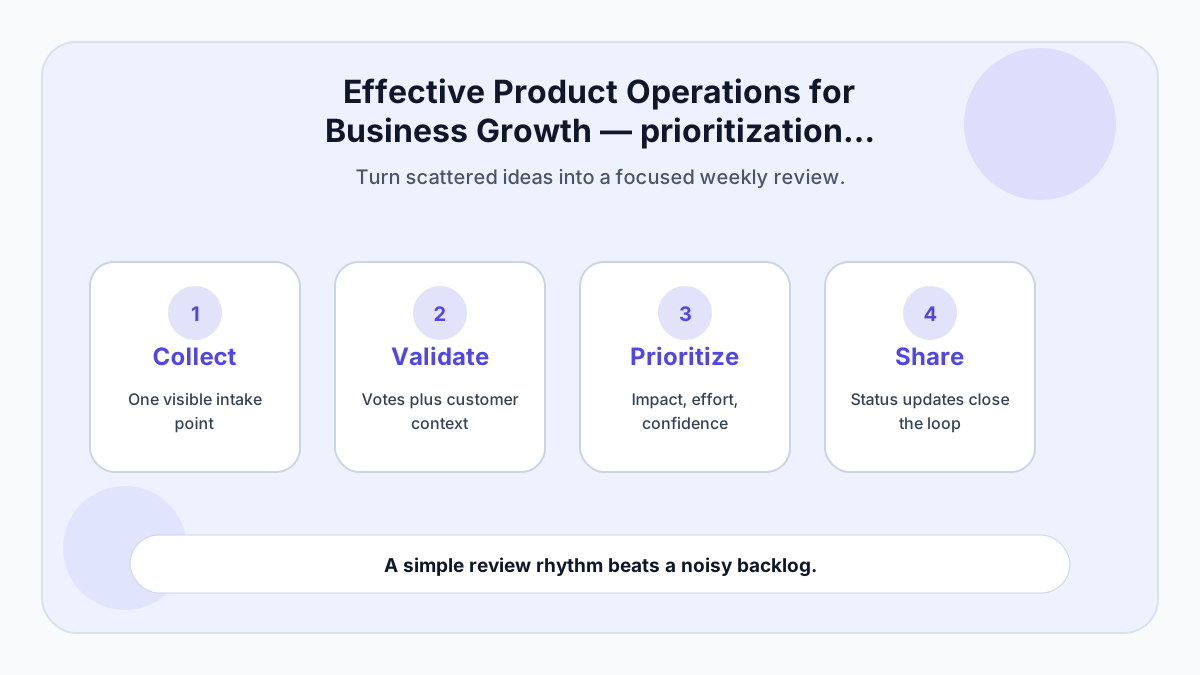
High volume can be helpful, but it is not the same as priority. A request with twenty votes from casual visitors may matter less than a request from three high-fit customers who are blocked from adopting your product. The right approach is to read votes alongside customer segment, urgency, revenue relevance, support cost, and strategic fit.
Create a short review note for every serious candidate: who asked, what job they are trying to finish, how often it appears, what workaround they use today, and what would change if you solved it. This note prevents the team from treating every popular request as an automatic roadmap item. It also gives you language for saying no respectfully when an idea is valid but not aligned.
This is where a feedback widget becomes more useful than a generic form. Voting surfaces demand, comments explain why the demand exists, and moderation keeps duplicates or off-topic requests from drowning out the useful signal.
A practical scoring framework
Use a small scoring model instead of a heavyweight committee. Start with four dimensions: customer value, strategic fit, effort, and confidence. Customer value asks whether the change solves a meaningful problem. Strategic fit asks whether it supports the product direction. Effort estimates design, engineering, support, and maintenance cost. Confidence shows how much evidence you have.
A simple 1 to 5 score for each dimension is usually enough. The goal is not mathematical perfection; it is a shared language for tradeoffs. If a feature has high customer value but low confidence, run a quick validation step. If it has high votes but weak strategic fit, explain why it is not next. If effort is low and value is clear, it may be a quick win that builds trust.
Teams working on roadmaps may also find SaaS Growth Benchmarks useful. If your main issue is organizing requests before scoring them, Supercharge Your B2B SaaS Sales is a better companion article.
Make the customer experience easy
Customers should not need to understand your internal process before sharing feedback. Ask for a short title, a plain-language description, and any context that helps the team understand the use case. Avoid long required surveys at the moment of submission. You can always follow up with a targeted question after you identify a promising request.
Good labels help too. Use statuses such as under review, planned, shipped, or not planned only when the team is ready to maintain them. Empty status systems create more confusion than clarity. A small team can begin with voting and comments, then add more public workflow once review habits are reliable.
If you want a low-friction place to collect these ideas, FeaturAsk gives you the widget, voting, moderation, and dashboard without forcing customers into a complex portal.
Avoid the common mistakes
The first mistake is promising every popular request. Popularity is a useful signal, not a contract. The second mistake is collecting feedback in too many places without a review ritual. Email, chat, sales calls, and support tickets all matter, but they need a shared destination or the team will miss patterns. The third mistake is copying enterprise product-ops practices before the business needs them. A small website usually benefits more from a clear widget and a weekly review than from a complicated taxonomy.
Another mistake is treating silence as satisfaction. Many customers will not write a long message, but they will vote if the option is visible. That tiny action gives the team a better read on demand than private guesses. Over time, the vote history becomes a lightweight record of what customers repeatedly ask for.
How to close the loop
Closing the loop is where feedback systems earn trust. When a request is accepted, explain the problem you are solving and what success looks like. When you reject or postpone an idea, be concise and respectful. Customers do not need every internal detail; they need to know that the team considered the request and made a decision.
Release notes, changelog posts, and product updates are natural places to connect shipped work back to customer requests. That connection shows users that participation matters. It also helps marketing and support teams explain improvements in customer language instead of internal feature names.
If you are building this habit from scratch, begin with one weekly review and one monthly public update. Keep the process small until it is stable.
Measurement that does not create busywork
Measure the loop with a few practical indicators. Track how many requests arrive, how many unique customers participate, how many duplicates you merge, how many items reach a decision, and how often shipped work connects back to customer input. These numbers are not vanity metrics when they are used to improve the system. They show whether customers can find the channel, whether the team reviews it, and whether feedback actually influences decisions.
Avoid turning measurement into surveillance or false precision. A small team does not need a complicated dashboard for every possible segment on day one. Start with simple counts and notes, then add tags only when they help a real decision. For example, an ecommerce store may tag requests by product category, while a SaaS team may tag by account type or workflow. The right data model is the one your team can maintain consistently.
Review the metrics monthly and ask one operational question: what would make next month’s decisions clearer? The answer may be better labels, stronger moderation, clearer public statuses, or a shorter intake form. Incremental improvements keep the feedback program useful without adding bureaucracy.
Team roles and review cadence
A feedback process works better when ownership is explicit. One person should monitor new submissions, one person should merge duplicates or clean up unclear titles, and one person should bring serious candidates into product or business planning. In a tiny company, those roles may all belong to the same founder. The important part is that customers are not sending ideas into a channel nobody owns.
Set a cadence that matches your traffic. A busy SaaS product may review requests twice a week. A creator site or local service business may only need a focused review every Friday. The cadence matters less than consistency. Customers learn to trust the channel when ideas are visibly handled, not when the team announces a grand process and then disappears.
Document the review rules in plain language. Decide when to merge duplicates, when to ask follow-up questions, when to mark an idea as not planned, and when to move an item into a roadmap conversation. Clear rules reduce emotional debates and make it easier for support, marketing, and product people to interpret the same customer signal.
External grounding and responsible claims
This guide avoids invented benchmarks because feedback quality depends heavily on audience, product maturity, and traffic source. For a stable definition of user feedback and why teams collect it, Stripe Docs provides a useful reference: <a href="https://docs.stripe.com/billing" rel="nofollow">Stripe Docs reference</a>. For search visibility and content hygiene, Google Search Central is also a reliable baseline: <a href="https://developers.google.com/search/docs/fundamentals/seo-starter-guide" rel="nofollow">Google Search Central SEO starter guide</a>. Use external frameworks as grounding, then adapt the process to your own customers rather than copying a generic maturity model.
The most defensible claim is simple: a visible, reviewed feedback channel gives your team better evidence than scattered private notes. It will not make prioritization automatic, but it makes the conversation more concrete. Keep claims specific to what you can observe: request volume, repeated use cases, user comments, votes, support friction, and the outcomes after you respond. That evidence is modest, but it is exactly the kind of evidence a small team can trust.
FeaturAsk fit for this workflow
FeaturAsk is best for teams that want a practical request board without the overhead of a large product management suite. It works well for small SaaS products, creators choosing content or course improvements, ecommerce stores testing demand, service businesses planning new offerings, and educational platforms collecting topic requests. You can customize the widget, collect votes, moderate submissions, and review popularity from the dashboard.
The pricing is intentionally simple: $29.95/year after a 30-day free trial, with no credit card required to begin. That makes it easy to test whether a public feedback loop helps your site before committing budget or process complexity.
Quick implementation checklist
- Pick one public place for feature requests or improvement ideas.
- Add a short submission flow and make voting visible.
- Review new requests weekly and merge duplicates.
- Score serious candidates by value, fit, effort, and confidence.
- Communicate accepted, postponed, and shipped work in plain language.
- Revisit the process monthly and remove steps nobody uses.
Start small, keep the promises modest, and let the evidence improve over time. A lightweight feedback loop that customers actually use is more valuable than a sophisticated system that nobody maintains. The first month should prove that customers understand where to contribute and that the team can keep up with review. The second month can refine labels, statuses, and reporting. By the third month, you should know whether the channel is changing roadmap conversations, reducing repeated support questions, or revealing demand you previously missed.