4 Types of Customer Research Surveys for SaaS Feedback in 2026
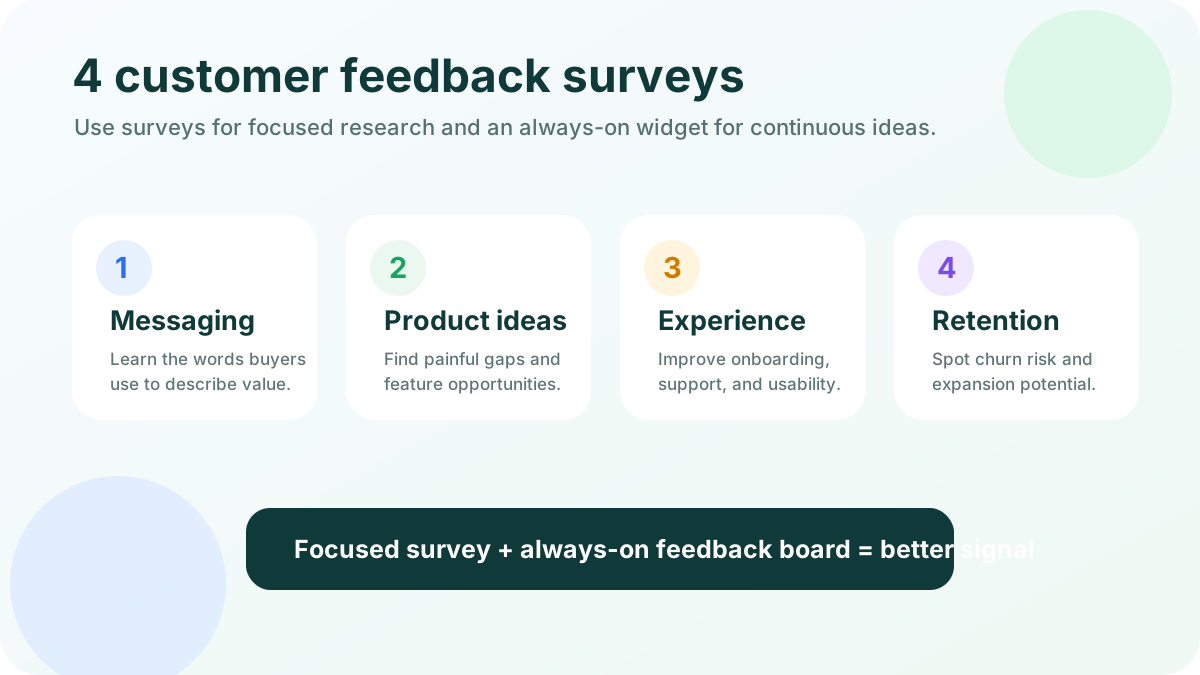
Quick answer: the four useful customer research surveys for SaaS teams are messaging surveys, product or feature surveys, customer experience surveys, and retention or expansion surveys. Use each survey for a specific decision, keep it short, and pair campaign-based research with an always-on feedback widget, board, and voting flow.
Start with the decision your survey must support
A customer research survey is a structured set of questions sent to a defined audience so you can learn something specific about their needs, objections, experience, or intent. The important words are defined and specific. If the audience is too broad or the goal is vague, the answers become hard to compare.
Before writing questions, decide what decision the survey should improve. Are you trying to rewrite your homepage? Choose the next integration? Fix activation? Understand cancellation risk? Each goal needs different respondents, timing, and question types.
Good surveys follow five rules.
First, ask fewer questions. Five thoughtful prompts often outperform a twenty-question form because completion rates and answer quality drop when the survey feels like work.
Second, combine closed and open-ended questions. Multiple-choice answers make patterns easier to count, while open-ended questions reveal the language, emotion, and context behind the pattern. Nielsen Norman Group’s current <a href="https://www.nngroup.com/articles/survey-best-practices/" rel="nofollow">survey best practices</a> are useful here: write neutral questions, reduce effort, and test wording before sending.
Third, ask about recent behavior instead of abstract preference. “What did you try to do before contacting support?” is stronger than “Do you like our support?” Recent behavior reduces guesswork and gives product teams concrete events to investigate.
Fourth, segment responses. A request from a trial user, a power user, and a high-value account may deserve different weight. Do not average them into one flat opinion.
Fifth, close the loop. Tell customers what you learned, what will change, and what will not. Even a short update builds trust because people see that feedback is not disappearing into a spreadsheet.
For ongoing idea capture, FeaturAsk gives small teams a simple feature request widget, voting board, and dashboard for $29.95/year after a 30-day free trial with no credit card required.
Survey type #1: messaging and marketing feedback
Messaging surveys help you understand how customers describe the problem, the alternatives they considered, the words that made your product feel relevant, and the objections that almost stopped them from buying.
This survey is especially useful when traffic is coming in but conversions are weak, when a product has evolved beyond its original positioning, or when sales calls reveal confusion about what the product actually does. It is also helpful before redesigning a homepage, rewriting onboarding emails, launching a new landing page, or changing pricing-page copy.
The best respondents are people who recently signed up, bought, booked a demo, or seriously evaluated your product. Their memory is fresh. They can still tell you what they compared, what felt risky, and which promise made them continue.
Example questions:
- What was happening in your work that made you look for a solution like this?
- What alternatives did you compare before choosing us?
- Which sentence on our website best matched what you needed?
- What was unclear, missing, or hard to believe before you signed up?
- If you recommended us to a colleague, how would you describe the product in one sentence?
- What nearly stopped you from creating an account or becoming a customer?
Look for repeated jobs-to-be-done, buying triggers, anxieties, comparison points, and proof gaps. If several customers say they were “tired of chasing feedback across email and Slack,” that phrase may be stronger than polished copy like “centralized voice-of-customer operations.”
Use this survey to improve headlines, feature labels, comparison pages, onboarding emails, demo scripts, and ad angles. But keep it separate from product prioritization. A customer’s wording can tell you how to sell the current value; it does not automatically prove what you should build next.
Survey type #2: product and feature ideas
Product and feature surveys uncover what customers are trying to accomplish, where the current product falls short, and which ideas deserve deeper validation. This is the survey most teams think of first when they hear customer feedback, but it is also the easiest to misuse.
The problem is that customers often describe solutions before they explain the underlying need. “Add a Kanban view” may really mean “I cannot see what is stuck.” “Build a Slack integration” may mean “I miss important updates.” “Let me export everything” may mean “I need to send a weekly report to my manager.” If you only collect requested features, you may miss the actual job.
A better product survey asks for the situation, pain, workaround, frequency, and consequence. Then you can decide whether the right answer is a new feature, a small UX change, clearer documentation, an integration, a template, or no change at all.
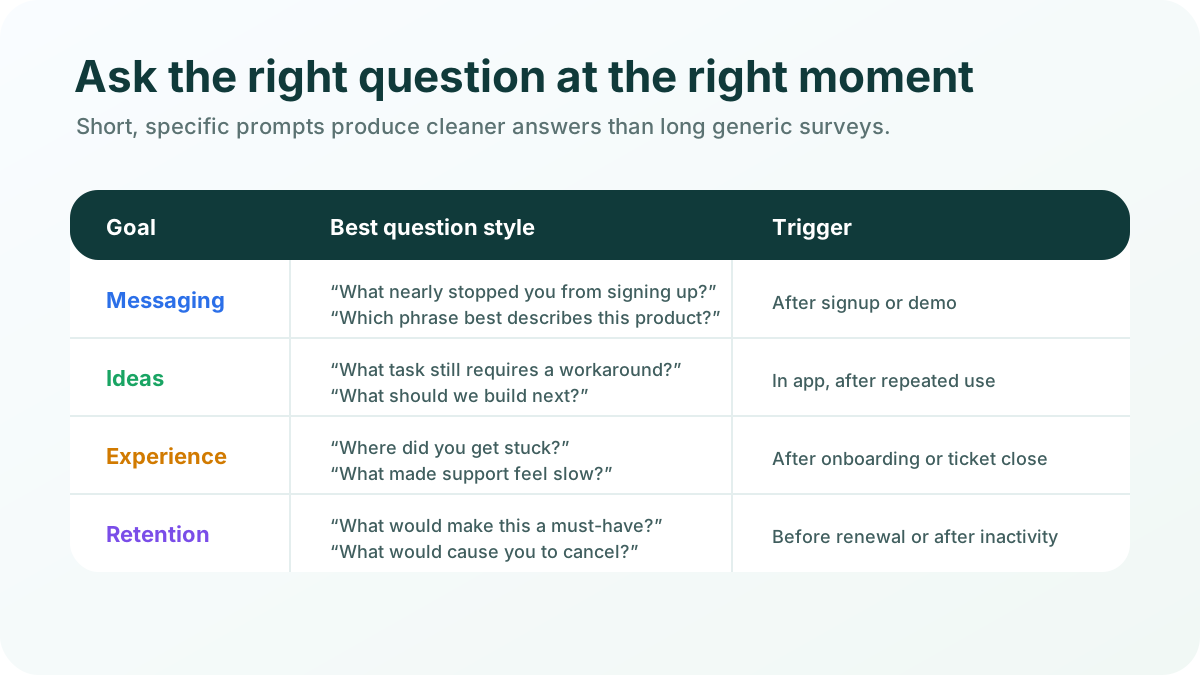
Example questions:
- What task do you still complete outside our product?
- What is the most annoying workaround in your current workflow?
- Which feature would save you the most time if it existed?
- How often do you run into this problem?
- What happens if this problem is not solved?
- Have you tried another tool to solve this? If yes, what worked or failed?
- Which existing feature feels close but not quite right?
After collecting answers, group them by problem rather than by requested feature. This keeps the discussion strategic. Ten customers asking for five different reporting features may all be pointing to the same need: better visibility for stakeholders.
Feature surveys work best when paired with a continuous request system. A quarterly survey captures a snapshot, but the strongest ideas often appear during real product use. If you need help shaping individual submissions, these feature request templates can standardize the problem, value, and context you collect. If you are comparing platforms, the guide to feature request tools explains what to look for beyond a basic form.
Survey type #3: customer experience improvements
Customer experience surveys focus on how the product and service feel across the full journey: signup, onboarding, activation, billing, support, education, account management, and day-to-day use. The goal is not only to find bugs. It is to remove friction that prevents customers from reaching value.
This survey belongs at key moments: after onboarding, after the first successful outcome, after a support ticket closes, after a billing change, or after a user returns from inactivity. The timing matters because experience feedback decays quickly. If you ask three months later, people remember the emotion but forget the details.
Example questions:
- What was the hardest part of getting started?
- Where did you expect help but not find it?
- Which step took longer than it should have?
- What confused you during setup?
- How easy was it to complete your main task today?
- If you contacted support, what would have made the answer more useful?
- What is one small change that would make the product feel smoother?
Qualtrics’ overview of <a href="https://www.qualtrics.com/articles/customer-experience/customer-experience/" rel="nofollow">customer experience</a> is a helpful reminder that CX is broader than satisfaction with a single interaction. For SaaS teams, the experience includes every expectation a customer forms before, during, and after using the product.
Analyze CX answers by journey stage. Onboarding issues may point to setup guidance. Support issues may point to documentation, response time, or missing self-serve controls. Billing complaints may point to plan confusion. Day-to-day friction may point to navigation, permissions, speed, or unclear labels.
The output should be a prioritized friction list. Some improvements will be tiny and high-impact: rename a button, add an empty-state example, make an error message specific, or send a better setup email. Others may become product work. The key is to separate “this made me struggle” from “this would be nice someday.”
Survey type #4: retention and expansion signals
Retention surveys help you understand why customers stay, what might cause them to leave, and where expansion opportunities exist. This fourth survey is the one many SaaS teams skip, but it is often the most commercially important.
Run it before renewal, after a customer reaches a usage milestone, after a period of declining activity, or when an account upgrades. You can also send a short cancellation survey, but do not rely only on exit feedback. By the time someone cancels, the best save opportunity may have passed.
Example questions:
- What makes this product worth keeping?
- What would make it a must-have for your team?
- What would cause you to cancel or downgrade?
- Which outcome do you still need but have not achieved?
- Who else on your team would benefit from using this?
- What would make upgrading to a higher plan worthwhile?
- If we disappeared tomorrow, what would you replace us with?
Retention answers should be mapped to risk and opportunity. A customer saying “we only use one feature” might be a churn risk if that feature is replaceable, or an expansion opportunity if the feature is mission-critical and adjacent teams need it. A customer saying “we love it but leadership does not see the impact” may need reporting, not a discount.
This survey also improves product positioning. The reasons customers stay are often different from the reasons they first signed up. Acquisition copy may focus on pain relief, while retention messaging may focus on reliability, team habits, saved time, or better decisions.
If many retention comments turn into feature ideas, do not bury them in a renewal spreadsheet. Move them into a visible feedback process where users can vote, comment, and follow progress. A public or private board helps you show that retention feedback becomes product learning, not just account notes.
How to choose the right survey for the decision
Start with the decision, not the template. If you are rewriting copy, run a messaging survey. If you are choosing between roadmap ideas, run a product and feature survey. If activation or support feels rough, run a customer experience survey. If churn, renewals, or upgrades are the concern, run a retention survey.
Then choose the respondent group. New signups are good for first impressions. Activated users are good for product value. Power users are good for advanced workflow gaps. Churned users reveal failure patterns, but their feedback should be balanced against active customers.
Finally, choose the channel. Email works for reflective answers. In-app prompts work for context-specific feedback. Interviews work when you need depth. A feature request board works when ideas should accumulate, be voted on, and remain visible over time.
For prioritization, remember that votes are signal, not orders. The best process combines demand with segment, revenue, strategy, effort, and confidence. The feature voting guide explains how to use votes without letting popularity replace product judgment, and an overview of feedback board software can help decide when a visible board is better than another private form.
Pair surveys with an always-on feedback board
Surveys are powerful because they create focus. Their weakness is that they are temporary. Customers may have their best idea two weeks after your survey closes, while they are inside the product and feeling the problem directly.
That is where a feature request widget complements research surveys. Instead of asking users to wait for the next campaign, you give them a simple place to submit ideas, vote on existing requests, add comments, and see status updates. Your team gets a living feedback database rather than a stack of disconnected survey exports.
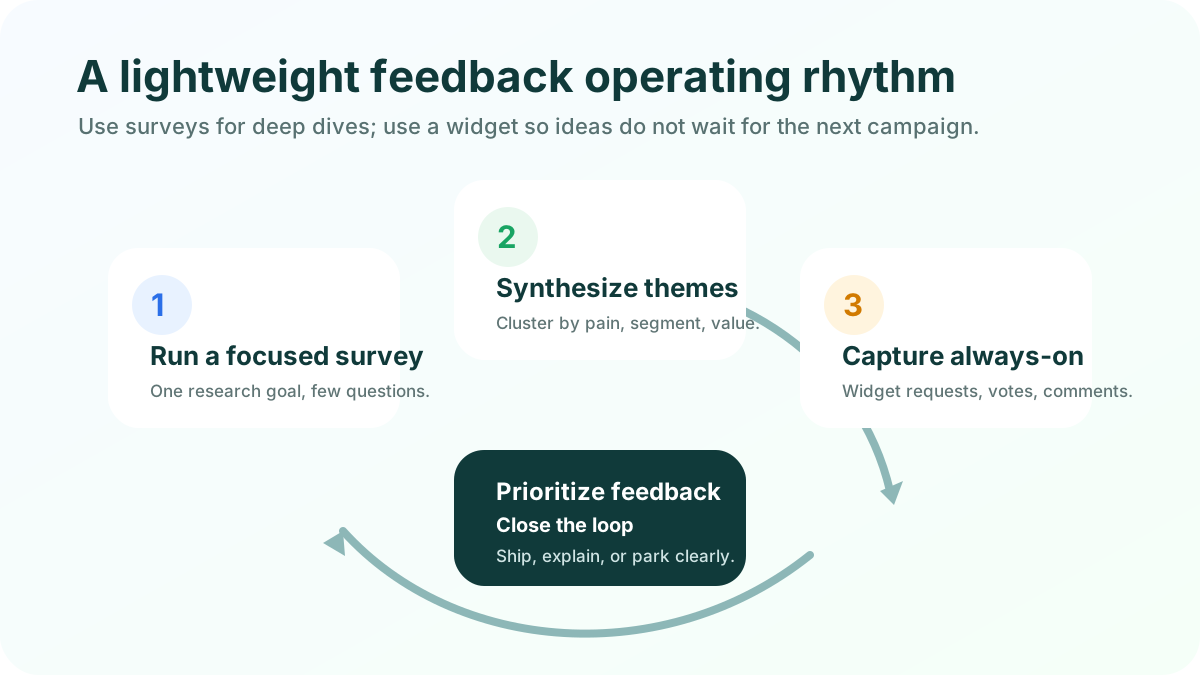
A practical operating rhythm looks like this:
- Keep an always-on widget available in the product or website.
- Review new requests weekly for duplicates, unclear wording, and obvious support issues.
- Tag ideas by problem area, customer segment, and potential impact.
- Run a focused survey when you need deeper context around a theme.
- Combine survey answers, votes, comments, usage data, and business priorities in roadmap review.
- Close the loop when you ship, decline, or park a request.
This workflow is intentionally light. Small teams do not need a complex research operations program to listen well. They need a reliable way to capture ideas, ask better follow-up questions, and keep feedback visible while decisions are made.
If you want that kind of lightweight loop, FeaturAsk adds an embeddable feature request widget, voting, moderation, analytics, and custom branding without enterprise setup. It costs $29.95/year, includes a one-month free trial, and does not require a credit card.
Survey mistakes to avoid
Do not ask every question at once. Long surveys create fatigue and make answers shallow. If you have four goals, run four smaller surveys over time.
Do not ask leading questions. “How much do you love our new dashboard?” is not research. Ask what changed, what was easier, what was harder, and what remains unclear.
Do not confuse satisfaction with priority. A customer can be satisfied and still need an important feature. Another customer can be frustrated by something that affects only a rare edge case. Capture the emotion, then investigate impact.
Do not treat one loud response as a trend. Strong quotes are useful for understanding, but roadmap decisions should look for repeated patterns across segments.
Do not disappear after asking. Customers are more willing to give thoughtful feedback when they believe someone reads it. Even a short “here is what we learned” update can make future participation easier.
Final checklist
Use messaging surveys to improve how you explain value. Use product and feature surveys to find important problems and validate ideas. Use customer experience surveys to remove friction across onboarding, support, and everyday use. Use retention surveys to understand why customers stay, leave, expand, or stall.
Then keep listening between surveys. The best customer feedback system is not one big form; it is a repeatable loop: ask focused questions, capture always-on ideas, prioritize with context, and close the loop clearly.
Ready to collect product ideas continuously instead of waiting for the next survey? FeaturAsk helps small teams launch a feedback widget and voting board in minutes, with a 30-day free trial and no credit card required.