Value Hypothesis Fundamentals: A Complete Guide
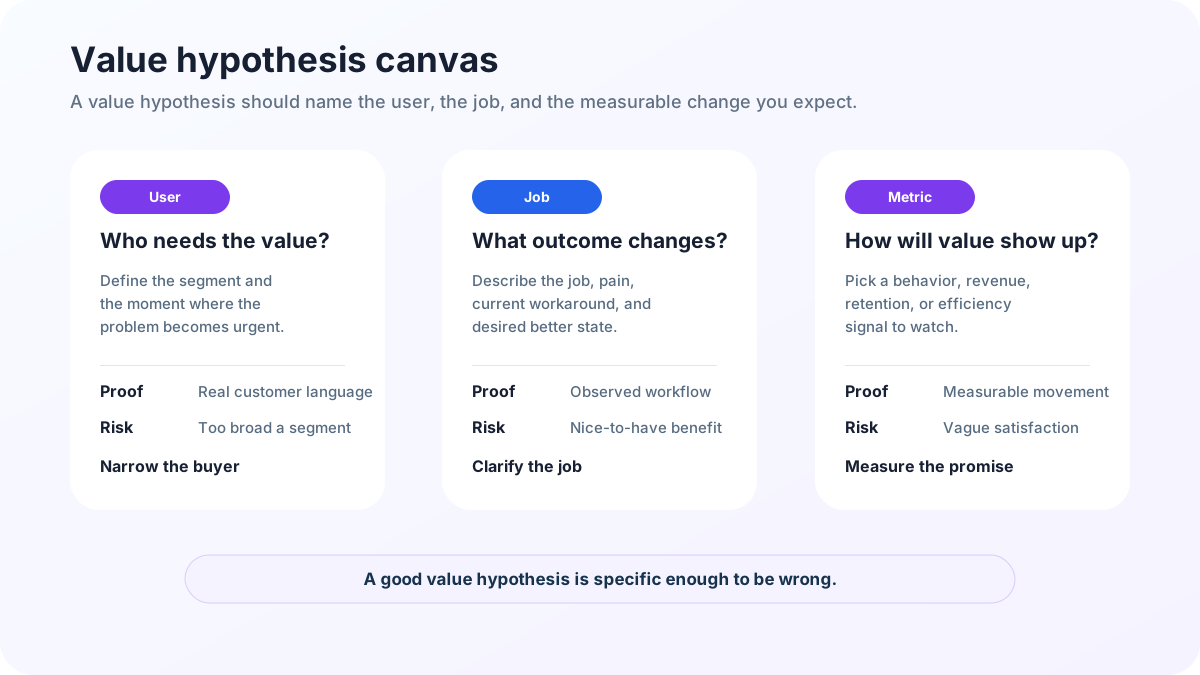
The Lean Startup principle of validated learning is useful here: a hypothesis improves when an experiment reduces uncertainty, not when the wording sounds convincing (Lean Startup principles). Atlassian roadmapping guidance reinforces the same habit by tying work to outcomes and communication (Atlassian roadmaps).
A value hypothesis is the product team's explicit bet about why a specific customer will care enough to use, switch to, pay for, or recommend something. It is the difference between "this feature sounds useful" and "operations managers at growing SaaS companies will adopt a public request board because it reduces duplicate support conversations and makes prioritization transparent." The second statement can be tested. The first one mostly invites opinions.
The idea is central to modern product discovery and lean startup practice. The Lean Startup methodology describes validated learning and the build-measure-learn feedback loop as a way to test fundamental assumptions. Strategyzer popularized test cards and evidence cards as practical tools for documenting hypotheses, experiments, and results. This FeaturAsk guide applies those fundamentals to feature requests, feedback boards, and product direction. For related reading, see understanding the RICE framework, value proposition canvas, and feature prioritization framework.
What a value hypothesis actually contains
A complete value hypothesis has four parts: customer, problem, promise, and observable outcome. The customer is the segment you believe will care. The problem is the painful situation or job they face. The promise is how your product or feature improves that situation. The observable outcome is what would prove that value exists.
A weak value hypothesis says, "Users want better reporting." A stronger one says, "Customer success managers at B2B SaaS companies will use account-level request reporting weekly because it helps them prepare renewal conversations and reduce surprise escalations." This version names the user, the job, the reason, and a behavior that can be measured.
The purpose is not to write a perfect sentence. The purpose is to expose assumptions. Once assumptions are visible, the team can design a small test instead of debating preferences.
FeaturAsk can help teams test one common value hypothesis: that customers will submit, vote on, and follow feature requests when the feedback loop is visible.
Value hypothesis vs growth hypothesis
A value hypothesis asks whether the product creates meaningful value for a defined customer. A growth hypothesis asks how more customers will discover, adopt, and spread that value. Both matter, but confusing them creates bad experiments.
For example, a landing page that earns many signups may support a growth or demand hypothesis, but it does not prove that users get value after trying the product. A feature that retains a small group of ideal customers may support a value hypothesis even if acquisition is not yet solved. Product teams should know which question they are testing.
In early product work, value usually comes first. If customers do not experience meaningful value, growth experiments amplify churn. Once value is proven for a segment, growth hypotheses become more useful because the team can scale something real.
Find the riskiest assumption
Every product idea contains assumptions: the customer has the problem, the problem is painful, the proposed solution is understandable, the customer trusts the workflow, the buyer has budget, the team can deliver the outcome, and the timing is right. The riskiest assumption is the one that would make the direction fail if it were false.
A team building a feedback portal may assume users will publicly submit requests. If customers prefer private account-manager conversations, the value hypothesis is weaker. A team building analytics may assume managers will review dashboards weekly. If they only need a monthly export, the product direction changes. A team building an AI feature may assume users trust automated recommendations. If trust is low, the test should focus on explainability before automation depth.
Rank assumptions by uncertainty and impact. High-uncertainty, high-impact assumptions should be tested first. Low-risk assumptions can wait. This ranking protects teams from spending months validating details while the core belief remains untested.
Choose the smallest useful test
The best test is the smallest experiment that can change a decision. It should not be theatrical. It should answer one important question. If the risk is problem pain, run interviews and inspect current workarounds. If the risk is willingness to act, test signups, imports, invitations, usage, or paid pilots. If the risk is comprehension, test prototypes and onboarding flows. If the risk is priority, compare the idea with alternatives customers already fund.
A feature request board can be a useful test when the hypothesis involves shared demand. If users submit requests, vote, add comments, and return to check status, the team learns that the problem has enough social energy to sustain a public loop. If the board is quiet, the team learns something too: the request process may be unclear, the audience may not care, or the product may need a different collection method.
Use FeaturAsk as a lightweight experiment when you want to learn whether customers will participate in request collection before building a custom system or buying a larger platform.
Evidence quality: a practical ladder
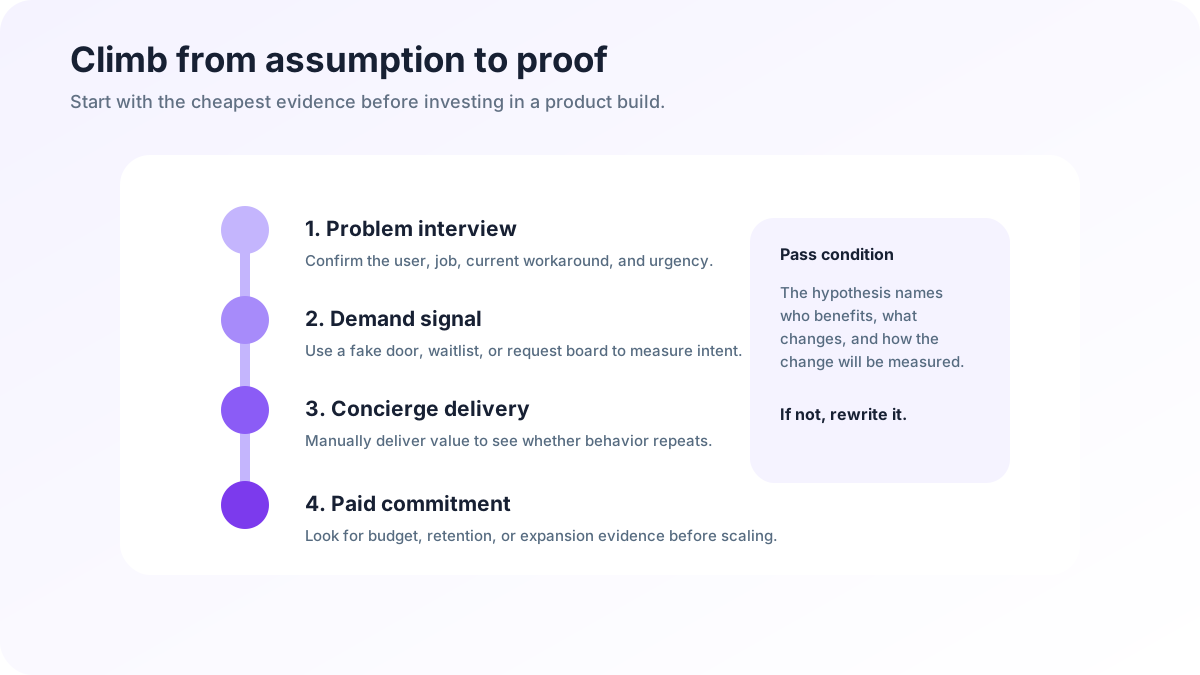
Evidence exists on a ladder. At the bottom are opinions, compliments, and stated intent. These are easy to collect but easy to misread. In the middle are detailed stories, repeated requests, current workaround descriptions, and comparisons with alternatives. At the top are behaviors: repeated use, invitations, imports, payment, renewal, expansion, referrals, and workflow change.
A value hypothesis becomes stronger when evidence climbs the ladder. Three users saying "nice idea" is weak. Three target customers showing the same spreadsheet workaround is stronger. Three target customers importing their data, inviting teammates, and using the workflow weekly is much stronger.
Qualitative feedback still matters at every level. It explains the mechanism of value. Behavior tells you that something is happening; customer language tells you why. The strongest validation combines both.
Define success before running the test
Teams often run experiments and then negotiate the meaning afterward. Avoid this by writing success criteria in advance. A good test card includes the hypothesis, the riskiest assumption, the experiment, the target audience, the metric or evidence standard, the time window, and the decision rule.
For example: "We believe support managers will use a public feature request board to reduce duplicate tickets. We will invite twenty active customers to submit and vote for two weeks. We are right enough to continue if at least eight customers submit or vote, three add detailed comments, and support sees fewer repeated feature questions in the test cohort." The numbers are not universal; the discipline is.
Predefined criteria reduce politics. If the test fails, the team can learn instead of defending the original idea. If the test succeeds, the team can invest with more confidence.
Interpret results without fooling yourself
A successful test does not prove the entire business. It supports a specific claim under specific conditions. Ask what exactly was validated. Was it the problem, the audience, the promise, the channel, the willingness to pay, or the usability of the solution? A single experiment rarely validates all of them.
Also ask what was not tested. A prototype test may show comprehension but not retention. A survey may show interest but not behavior. A free pilot may show adoption but not willingness to pay. A small sample may show segment fit but not market size. Honest interpretation prevents premature scaling.
When results are mixed, change the hypothesis rather than forcing a yes or no. Maybe the customer segment is narrower. Maybe the problem is real but the proposed workflow is wrong. Maybe the value exists only after onboarding. These adjustments are not failures; they are validated learning.
Apply value hypotheses to feature requests
Feature requests are raw material for value hypotheses. A request such as "add CSV export" is not the hypothesis. The hypothesis might be: "Operations leads need CSV export because they must combine request data with internal reporting before quarterly planning." That hypothesis suggests different tests than the bare feature request.
Ask why the request matters, who uses the result, what workaround exists, how often the job occurs, and what outcome would improve. Then decide whether to build, prototype, concierge, integrate, document, or decline. The point is to discover the value behind the request before committing to a solution.
Public voting can help, but votes are not enough. A highly voted request may represent convenience rather than strategic value. A low-vote request may matter deeply to your best segment. Combine votes with comments, customer type, behavior, and business impact.
Common mistakes
The first mistake is writing a solution hypothesis instead of a value hypothesis. "Build a dashboard" is a solution. "Managers will review risk weekly if renewal blockers are summarized by account" is a value hypothesis.
The second mistake is testing too much at once. If you launch a full feature with new onboarding, pricing, messaging, and segmentation, you may not know which variable caused the result. Smaller tests produce clearer learning.
The third mistake is accepting praise as proof. Compliments are useful, but they sit low on the evidence ladder until they connect to repeated behavior or real consequences.
The fourth mistake is ignoring negative evidence. If customers refuse to import data, do not trust the dashboard, or keep using the old workaround, the hypothesis needs revision.
When FeaturAsk is a useful validation tool
FeaturAsk is helpful when the hypothesis involves customer demand for product changes. A public board can test whether users care enough to submit requests, whether other users recognize the same need, and whether status updates build trust. It creates evidence from real participation rather than internal speculation.
It also keeps validation affordable. FeaturAsk is $29.95/year, with a one month free trial and no credit card required. That makes it practical for founders and small teams to test request collection before building a custom portal, adopting a heavy product-management platform, or letting feedback disappear into private messages.
A reusable template
Use this structure for your next value hypothesis: "We believe [customer segment] will [behavior] because [problem or desired outcome]. We will know this is true enough when [observable evidence] happens within [time window]. If the result is below [threshold], we will [change, retest, or stop]."
Example: "We believe product-led SaaS founders will publish a public feedback board because it reduces duplicate feature conversations and makes users feel heard. We will know this is true enough when ten invited users submit or vote within fourteen days and at least three return to check status. If the result is below that threshold, we will test private request collection or improve onboarding before building more."
The template forces clarity. It also makes team debates more productive because everyone can see what belief is being tested.
How to connect value hypotheses to prioritization
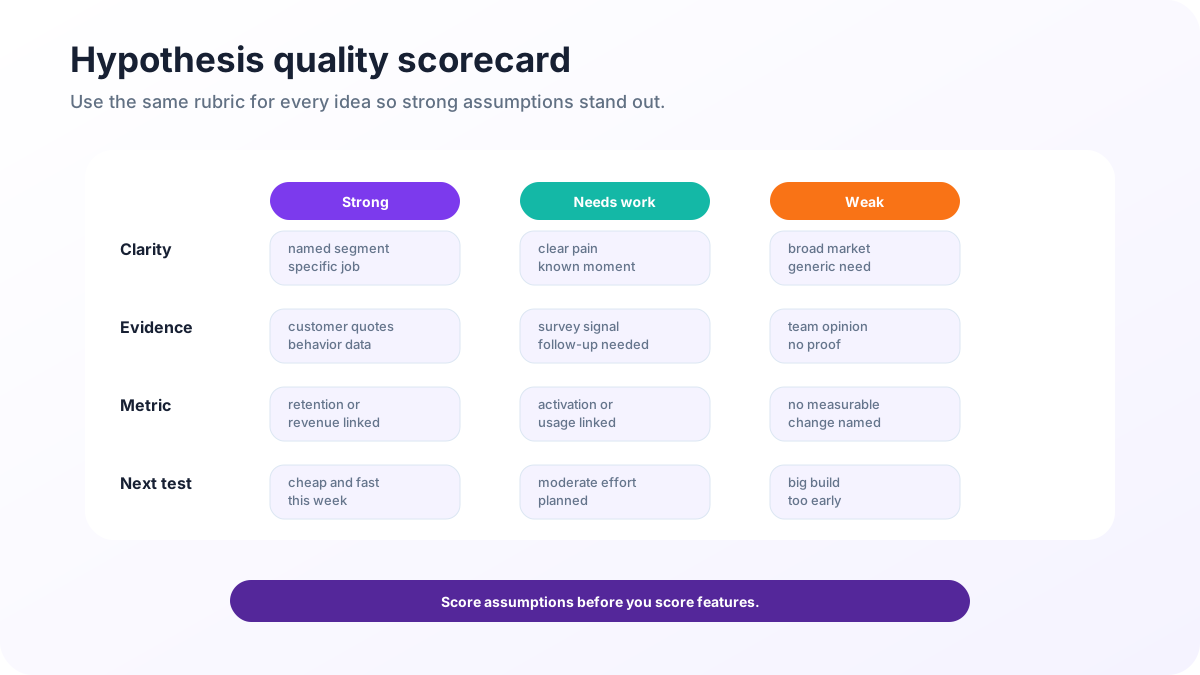
A value hypothesis should feed prioritization, not sit in a discovery document nobody reads. When a team scores roadmap ideas, the hypothesis explains what value is being pursued and what evidence supports it. A RICE score, opportunity score, or impact-effort matrix is much more useful when each candidate has a clear customer, problem, promise, and outcome.
For example, two features may both look high impact. One has a vague hypothesis and enthusiastic internal support. The other has a specific hypothesis, repeated customer evidence, and early behavior from a target segment. The second should usually win, even if the first sounds more exciting. Prioritization is not only about estimating impact; it is about comparing confidence in the value claim.
Use the hypothesis to decide what to do next. If confidence is low but potential impact is high, run another experiment. If confidence is high and effort is low, build. If confidence is high but effort is high, look for a smaller version. If confidence is low and effort is high, pause. This prevents teams from treating discovery and delivery as separate worlds.
Document learning so it compounds
The most underrated output of value-hypothesis work is organizational memory. A failed test can save months if future teams can find it. Record the original belief, the experiment, the evidence, the decision, and the next question. Keep the customer's words attached to the result. Six months later, the reasoning will matter more than the raw metric.
Learning compounds when teams compare related hypotheses. Maybe three failed experiments show that the target customer cares about visibility but not collaboration. Maybe two successful pilots show that value appears only after importing historical data. These patterns can shape positioning, onboarding, and roadmap strategy.
A public feedback board can support this memory by preserving requests, comments, votes, and statuses over time. FeaturAsk gives small teams a lightweight place to collect that evidence while they test whether a product direction deserves more investment.
A value hypothesis is finished only when it changes the next customer conversation. The team should be able to say who the product helps, what measurable progress they expect, what signal would disprove the belief, and where users can add evidence. If the hypothesis cannot survive that level of clarity, it is still a slogan. If it can, the team has a practical guide for what to build, measure, and communicate next.
FAQ
What is a value hypothesis?
A value hypothesis is a testable claim about why a specific customer segment will receive meaningful value from a product, feature, or workflow.
What makes a value hypothesis testable?
It names the customer, problem, promise, and observable outcome. The team can then design an experiment and define success criteria before running it.
How much evidence is enough?
It depends on risk. A small UX improvement may need a few strong qualitative signals. A major product bet should require repeated behavior from the target segment, willingness to act, and clear business fit.
How can FeaturAsk help?
FeaturAsk helps test whether customers will submit, vote on, and follow feature requests. It costs $29.95/year and offers a one month free, no-credit-card trial.