Roadmap Planning for SaaS Founders and Product Managers
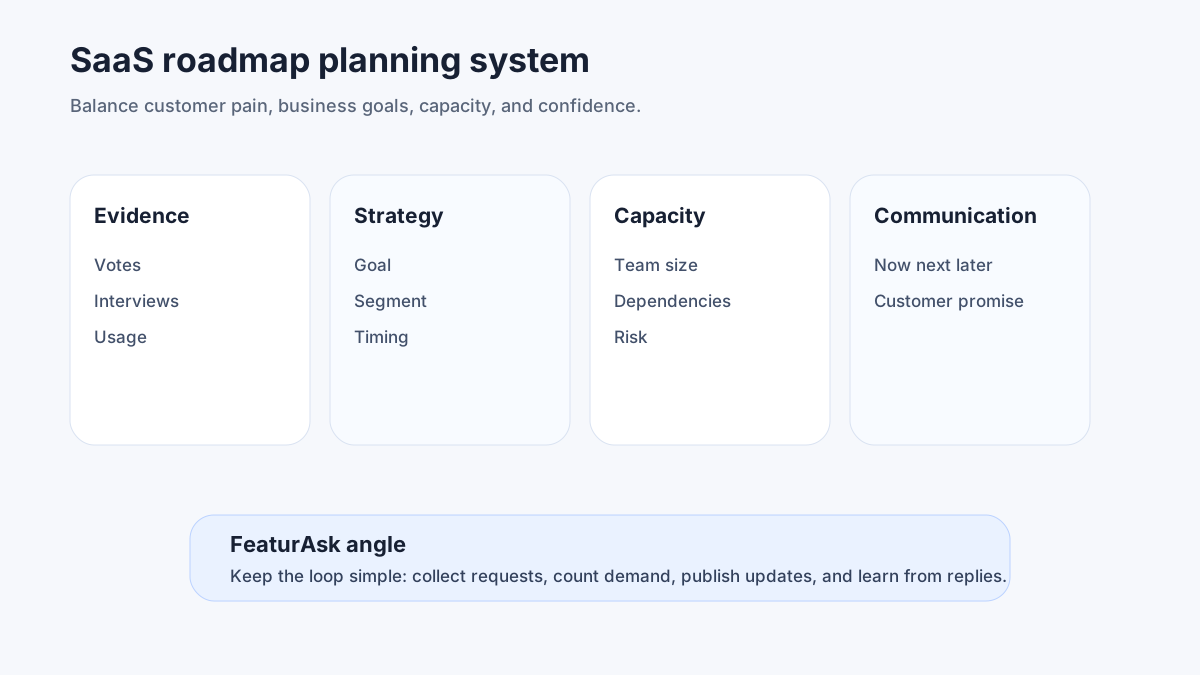
Roadmap planning is where product judgment becomes visible. For SaaS founders and product managers, the roadmap is not a wish list, a sales promise, or a backlog in prettier clothing. It is a decision system: what you believe matters next, why it matters, what you will not do yet, and how customers will know progress is real.
The hard part is that SaaS teams plan in motion. Customer feedback keeps arriving, competitors ship, enterprise prospects ask for exceptions, revenue targets move, and engineering uncovers work that no user will ever request but every user will feel if it is ignored. A useful roadmap has to absorb all of that without turning into chaos.
This guide gives you a practical process for planning a roadmap that supports growth without overpromising. It covers the inputs to collect, the decisions to make, the prioritization methods that work for small teams, the pitfalls to avoid, and the communication habits that keep customers aligned. If you want the shortest version: collect evidence, choose themes, score opportunities, publish only what you can discuss honestly, and keep a steady feedback loop open.
For a lightweight way to collect feedback, prioritize requests, and show customers what is coming, try FeaturAsk with a 1 month free trial and no credit card required. It is built for SaaS teams that want the essentials without enterprise complexity, and paid plans are just $29.95/year.
Why roadmap planning matters beyond feature releases
A roadmap is often treated as a shipping calendar, but the best roadmaps answer a broader question: how will the product get more valuable for the market you serve? That question includes features, but it also includes reliability, onboarding, integrations, pricing experiments, internal tooling, compliance, and sometimes removing things that distract from the core use case.
For founders, roadmap planning creates focus. It forces you to decide whether the next quarter is about activation, retention, expansion, infrastructure, or a new market segment. Without that theme, every customer request can sound urgent and every competitor announcement can look like a threat.
For product managers, roadmap planning creates alignment. It turns scattered inputs into a shared view that design, engineering, marketing, sales, support, and leadership can discuss. A roadmap does not eliminate disagreement; it gives disagreement a structured place to happen before work starts.
For customers, roadmap planning creates trust. A public roadmap lets users see that their feedback is being heard, but it also shows that your team is making choices. Atlassian’s guide to product roadmaps frames a roadmap as a shared source of truth for product direction, priorities, and progress rather than a fixed commitment list.
The key elements of a useful SaaS roadmap
A strong roadmap is not complicated, but it is explicit. It should include the following elements.
First, it needs a product vision. This is the long-term direction that keeps the roadmap from becoming a collection of unrelated tickets. A vision does not have to be poetic. “Help self-serve SaaS teams collect, rank, and communicate customer feedback without a dedicated product ops function” is more useful than a vague statement about innovation.
Second, it needs measurable goals. Roadmap items should connect to outcomes such as activation, retention, time-to-value, expansion revenue, support ticket reduction, or product reliability. The Atlassian team explains the value of using roadmaps to connect priorities and execution in its product roadmap guide.
Third, it needs evidence. Evidence includes user interviews, feature votes, support conversations, churn reasons, win/loss notes, analytics, sales calls, and competitive research. Evidence does not make decisions for you, but it reduces the odds that the loudest voice wins.
Fourth, it needs prioritization criteria. Use criteria your team can explain: customer impact, business impact, confidence, effort, strategic fit, risk, and urgency. A scoring system is not a robot. It is a conversation aid.
Fifth, it needs time horizons. Many SaaS teams use Now, Next, Later because it communicates direction without pretending every item has a fixed date. If you need calendar planning internally, keep it separate from the public promise.
Finally, it needs ownership and review cadence. Someone must maintain the roadmap, update statuses, close the loop with requesters, and remove stale ideas.
Eight steps for roadmap planning
1. Collect feedback from users
Start with the people who already experience the problem. Product feedback should come from multiple channels: in-app widgets, support tickets, customer success calls, sales notes, cancellation surveys, community posts, and structured interviews. The mistake is not collecting too little feedback; it is collecting feedback in too many disconnected places.
Create a single intake path where every request can be tagged by account type, use case, revenue relevance, product area, and frequency. A small team does not need a complex taxonomy. You need enough structure to answer: who asked, what pain is underneath the request, how many similar users feel it, and what outcome would improve if you solved it.
If you need a deeper feedback workflow, see our guide to collecting product feedback and our breakdown of feature request management.
2. Conduct market and competitor research
Competitor research should inform your roadmap, not hijack it. Track how competitors position their product, which integrations they emphasize, which customer segments they pursue, and which gaps users complain about in public reviews. Do not copy a feature simply because a rival shipped it. Ask whether the feature advances your strategy or merely reduces sales anxiety.
A simple research habit is to review competitor changelogs monthly, collect customer review themes quarterly, and maintain a list of “table stakes,” “differentiators,” and “not for us.” That last category matters. Roadmap clarity improves when the team knows which directions you are intentionally avoiding.
3. Look into product analytics
User behavior shows whether requests match reality. If customers ask for advanced reporting but only a small percentage completes setup, the roadmap might need onboarding improvements first. If churned accounts never reached a key activation event, the highest-impact roadmap item may not be glamorous.
Use analytics to find drop-offs, underused workflows, cohort differences, expansion signals, and friction points. Pair quantitative data with qualitative feedback. Analytics tells you where something is happening; conversations explain why.
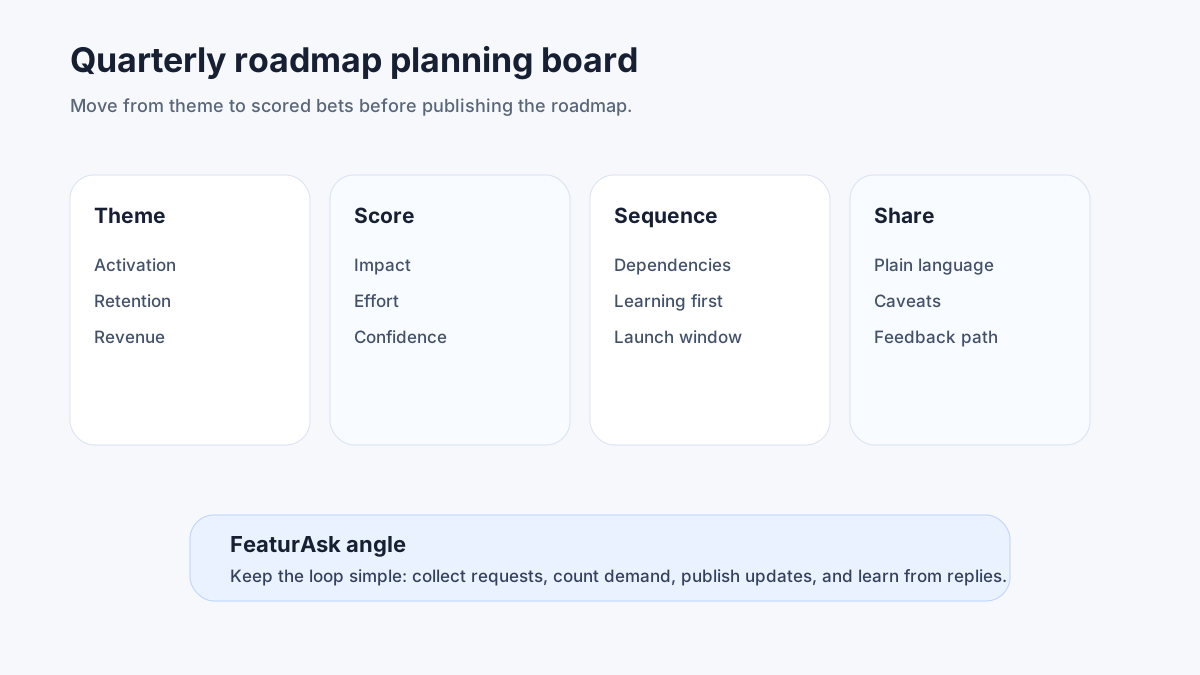
4. Set a theme for the quarter
A quarterly theme protects the roadmap from scattering effort across too many product areas. Examples include “reduce time-to-value for new teams,” “make enterprise administration credible,” “improve feedback-to-release transparency,” or “strengthen mobile collaboration.”
The theme does not mean every item must be identical. It means the majority of roadmap decisions should ladder up to one story. When a stakeholder proposes work that does not fit the theme, you can still consider it, but the exception is visible.
5. Consider impact, effort, confidence, and risk
Prioritization frameworks help only if the team uses them consistently. RICE, ICE, value-versus-effort, opportunity scoring, and MoSCoW can all work. For a SaaS roadmap, a practical scoring model usually includes impact, reach, confidence, effort, and strategic fit.
Do not hide risk. A feature with high revenue potential and low confidence might deserve discovery before it deserves a build slot. A small infrastructure project might score low on customer excitement but high on retention risk prevention. The roadmap should make those tradeoffs clear.
6. Add chosen items to a public roadmap
A public roadmap is most useful when it is honest. Avoid exact dates unless the team is ready to stand behind them. Group items by status such as Under Consideration, Planned, In Progress, and Shipped. Let customers vote, comment, and subscribe for updates.
The public roadmap is also a research channel. When users react to roadmap items, you learn which phrasing resonates, which use cases matter, and which assumptions need validation before engineering starts.
7. Groom the backlog without worshiping it
The backlog is not the roadmap. It is a reservoir of possible work. During planning, archive duplicates, merge similar requests, clarify vague tickets, add evidence links, and remove stale ideas that no longer support strategy.
A healthy backlog is searchable and calm. An unhealthy backlog becomes a guilt pile that makes every roadmap conversation harder.
8. Be ready to change the roadmap quickly
Changing the roadmap is not a failure if the reason is clear. SaaS teams learn. A launch can underperform, a security requirement can become urgent, a partner API can break, or a market window can open. The key is to change direction transparently.
When priorities move, explain what changed, what the team learned, and what happens to affected items. Customers can handle change better than silence.
Best practices for roadmap planning
Align the roadmap with company vision
Every roadmap item should connect to the product strategy or a deliberate maintenance need. If it does not, ask why it is on the roadmap. This discipline is especially important for founder-led teams where large customers or investor conversations can create sudden priority swings.
Balance customer wants with business needs
Customer votes matter, but they are not the whole strategy. A feature requested by five ideal customers may matter more than a feature requested by twenty users outside your target segment. Conversely, internal revenue goals cannot justify building work that makes the product harder for core users.
Good roadmap planning makes segment context visible. Label requests by customer type, plan level, lifecycle stage, and use case so the team sees which voices are aligned with the company’s direction.
Use multiple prioritization lenses
A single framework can flatten nuance. Combine a quantitative score with a strategic discussion. For example, use RICE to compare similar opportunities, then run a leadership review for sequencing, risk, and narrative. The score helps the conversation start; it should not end it.
Involve stakeholders early
Roadmap planning fails when stakeholders see the roadmap only after decisions are made. Invite sales, support, marketing, success, engineering, and leadership into the input and review stages. Give each group a clear role: share evidence, challenge assumptions, clarify dependencies, and prepare communication.
Stakeholder involvement does not mean stakeholder veto power. The roadmap needs a decision owner.
Separate public and internal detail
Your internal roadmap can include dependencies, delivery risks, tentative dates, staffing assumptions, and technical constraints. Your public roadmap should be simpler: what problem is being considered, what status it is in, and how customers can follow progress.
This separation prevents accidental overpromising while still giving users visibility.
Communicate often
Roadmaps go stale when teams publish them and disappear. Update statuses, reply to comments, share release notes, and close the loop when shipped work comes from customer feedback. If you need release communication ideas, read our guide to release notes best practices.
FeaturAsk helps small SaaS teams turn feedback into a public roadmap with a 1 month free trial, no credit card, and plans at $29.95/year. Use it when you want customers to see progress without paying for a heavy product management suite.
Four roadmap planning pitfalls to avoid
1. Overpromising
The fastest way to damage roadmap trust is to publish dates or commitments that the team cannot control. This often happens when sales pressure turns roadmap items into deal promises. If a prospect needs a feature, treat it as a commercial decision with explicit risk, not as a casual roadmap edit.
2. Under-communicating
Customers do not expect every requested feature to ship, but they do expect clarity. If an item is declined, explain the reason briefly. If an item is delayed, update the status. If an item ships, notify the people who asked for it.
3. Ignoring technical debt
Technical debt rarely wins a customer vote, but it can decide whether the product remains reliable. Reserve roadmap capacity for platform health, security, performance, and developer productivity. Explain these items in customer-impact language: faster load times, fewer errors, safer data, quicker future releases.
4. Overreacting to loud voices
One enterprise account, one angry thread, or one competitor launch can distort planning. Before changing the roadmap, compare the signal against your chosen market, revenue impact, support volume, product data, and strategic theme.
Tools for roadmap planning
You do not need a huge stack. Most teams need four capabilities.
User feedback software captures requests, tags feedback, supports voting, and keeps customer context attached to ideas. Public roadmap software displays planned work and collects reactions. Product analytics shows how users actually behave. Competitor tracking keeps market signals visible without making them the strategy.
Spreadsheets can work at the start, but they break when feedback volume grows or when customers need visibility. A dedicated feedback and roadmap tool becomes useful once you need traceability from request to decision to shipped update.
A simple roadmap planning cadence
Use a monthly triage, a quarterly planning cycle, and a weekly communication habit.
Monthly, review new feedback, merge duplicates, tag requests, and identify emerging themes. Quarterly, choose the theme, score candidates, review engineering capacity, decide Now/Next/Later, and update the public roadmap. Weekly, move item statuses, reply to comments, and send updates to subscribers when something changes.
This cadence keeps planning lightweight but alive. It also reduces the emotional pressure of one giant planning meeting where every unresolved decision appears at once.
What to publish on your public roadmap
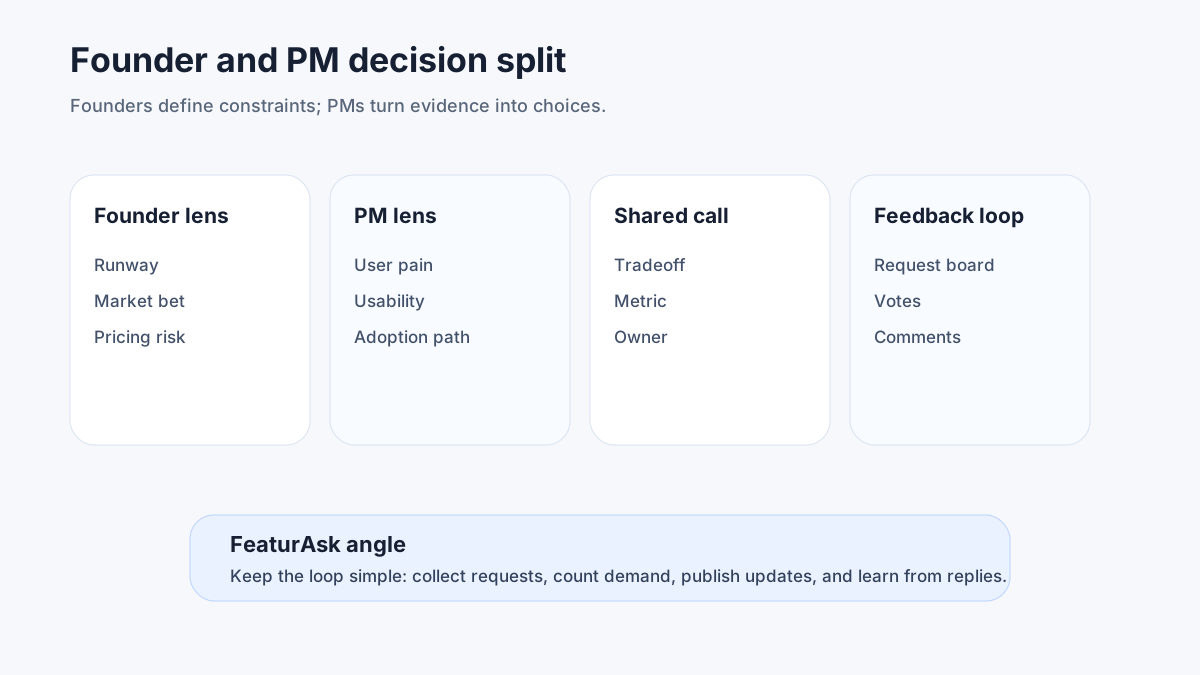
Publish problems and outcomes more than internal tickets. “Improve invoice exports for finance teams” is clearer than “CSV export v2.” Include enough context for customers to recognize the value, but avoid implementation detail that may change.
For each public item, include a short problem statement, status, target user segment, voting or commenting option, and update history. When the item ships, link to release notes or a short announcement. This closes the trust loop and proves that feedback can influence the product.
Final takeaway
Roadmap planning is not about predicting the future perfectly. It is about making better decisions with imperfect information, communicating those decisions clearly, and adjusting when evidence changes. The SaaS teams that do this well are not the teams with the longest roadmaps. They are the teams with the clearest themes, the strongest feedback loops, and the discipline to say no.
If you want to centralize requests, prioritize what matters, and publish a roadmap customers can follow, start with FeaturAsk's 1 month free trial, no credit card required, then continue for only $29.95/year.