Product Delivery: The Key to Successful Products
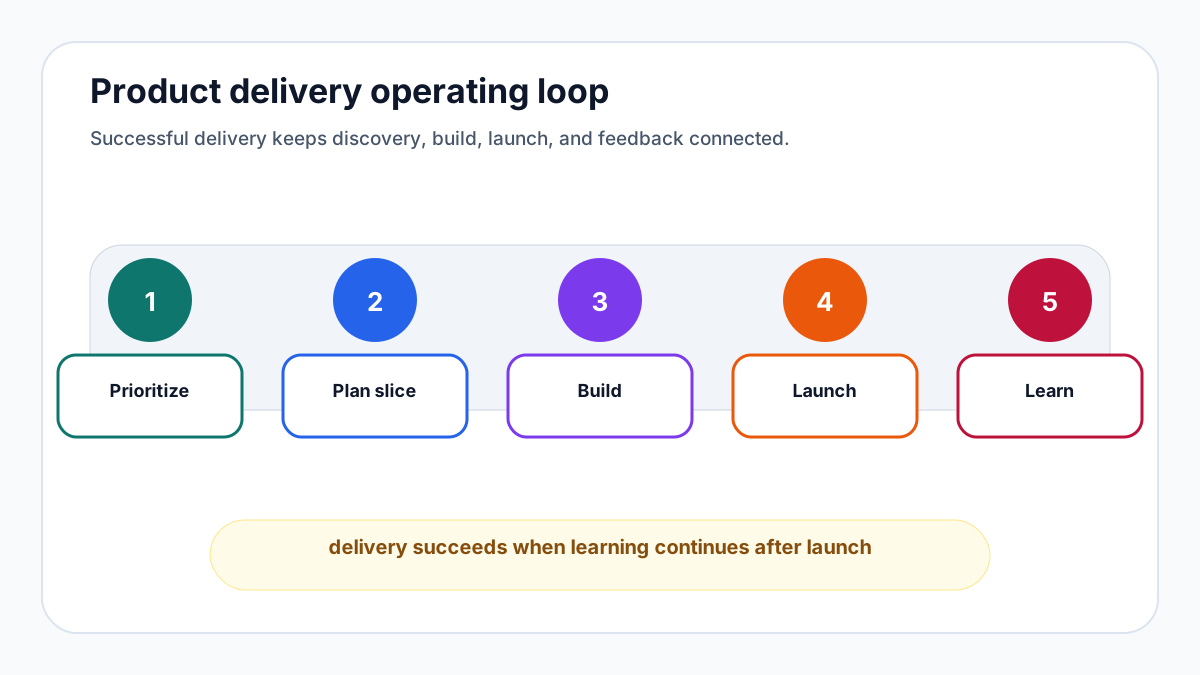
Customer feedback, support conversations, and product data now move too quickly for teams to rely on guesswork. This guide gives you a practical FeaturAsk-style approach to product delivery the key to successful products: clear enough for small teams, current enough for modern product work, and focused on actions rather than bloated process.
Relevant sources for the current landscape include Scrum Guide, Lean Enterprise Institute principles, DORA research program.
What product delivery means
Product delivery is the system that turns a product decision into a working customer outcome. It includes planning, discovery, design, engineering, release, measurement, support readiness, and the feedback loop after launch. Delivery is not just shipping code. A feature is not delivered until the intended users can adopt it safely and the team can learn whether it created value.
Successful delivery balances three questions: Are we building the right thing? Can we build it well? Did it create the intended result? Teams that answer only the second question may hit deadlines while missing customer value. Teams that answer all three build trust.
Why delivery breaks down
Delivery fails when strategy, scope, and feedback are disconnected. A team may have a roadmap with attractive themes but no clear definition of success. Engineering may receive requirements without customer context. Marketing may learn about the launch too late. Support may discover the edge cases only after customers complain.
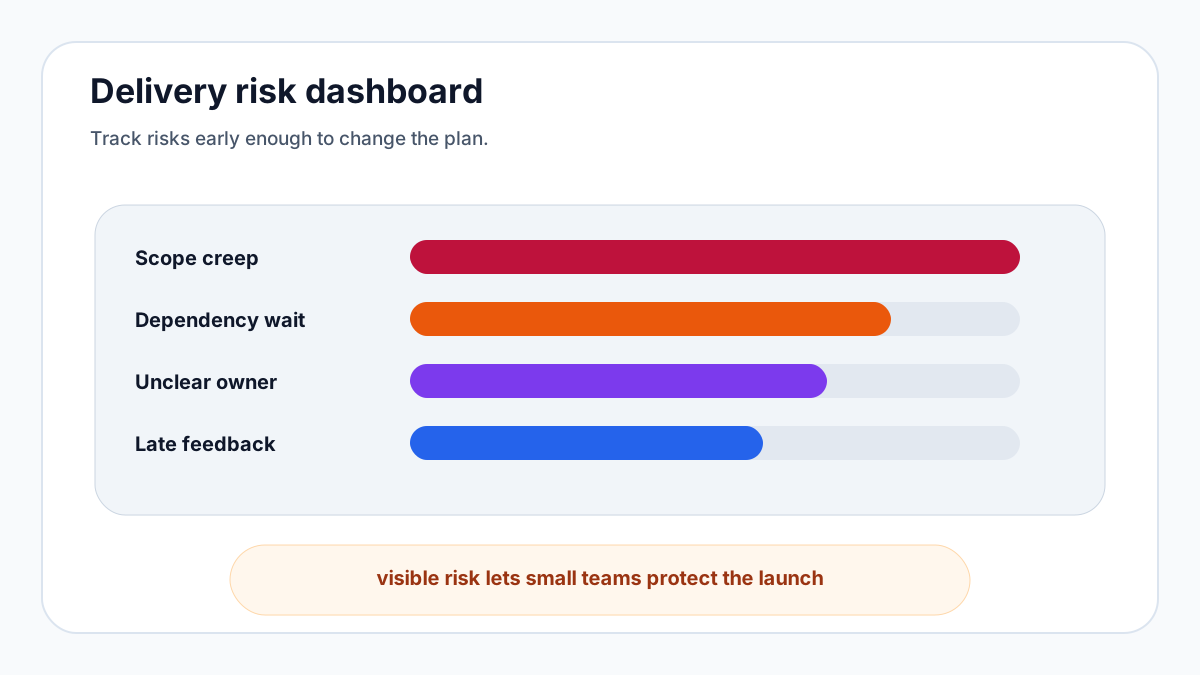
Missed deadlines are usually symptoms, not root causes. Common causes include unclear priorities, hidden dependencies, overloaded teams, weak discovery, untested assumptions, and changes introduced after implementation begins. A better delivery system makes these tensions visible early.
The role of product delivery teams
Product managers clarify the problem, trade-offs, and success measures. Designers shape the experience and test comprehension. Engineers evaluate feasibility, build, and protect quality. Customer-facing teams bring evidence from sales, support, and success. Leadership sets constraints and makes priority calls when the team cannot do everything.
Some companies add a delivery manager or program manager to coordinate schedules, dependencies, and risk. That role can be valuable, but it should not become a substitute for product thinking. Delivery management keeps the system moving; product management keeps the work connected to customer value.
Delivery methods: waterfall, lean, agile, and hybrid
Waterfall can work when requirements are stable, regulation is high, and late changes are expensive. It struggles when customer needs are uncertain. Lean emphasizes reducing waste, learning quickly, and improving the whole system. The Lean Enterprise Institute’s overview is useful for understanding the focus on customer value and continuous improvement.
Agile methods, including Scrum, are designed for iterative delivery in complex environments. The Scrum Guide defines a lightweight framework built around transparency, inspection, and adaptation. In practice, many teams use a hybrid: enough planning to coordinate, enough iteration to learn, and enough discipline to release safely.
Creating a product delivery strategy
Start with vision. What customer outcome are you trying to create, and why now? Then define the roadmap theme, not just a list of features. A theme such as “reduce onboarding time for new admins” gives the team room to find the best solution.
Next, run discovery. Use interviews, analytics, support themes, prototype tests, and feature votes. Convert what you learn into a small set of delivery bets. For each bet, define scope, non-goals, dependencies, release plan, success metric, and rollback criteria. The strategy should also say how customer feedback will be collected after launch.
FeaturAsk helps with that feedback loop by letting customers submit and vote on requests in a widget while your team reviews demand in a dashboard. You can try FeaturAsk for one month free with no credit card, then keep it for $29.95/year if it becomes part of your delivery rhythm.
Measuring delivery success
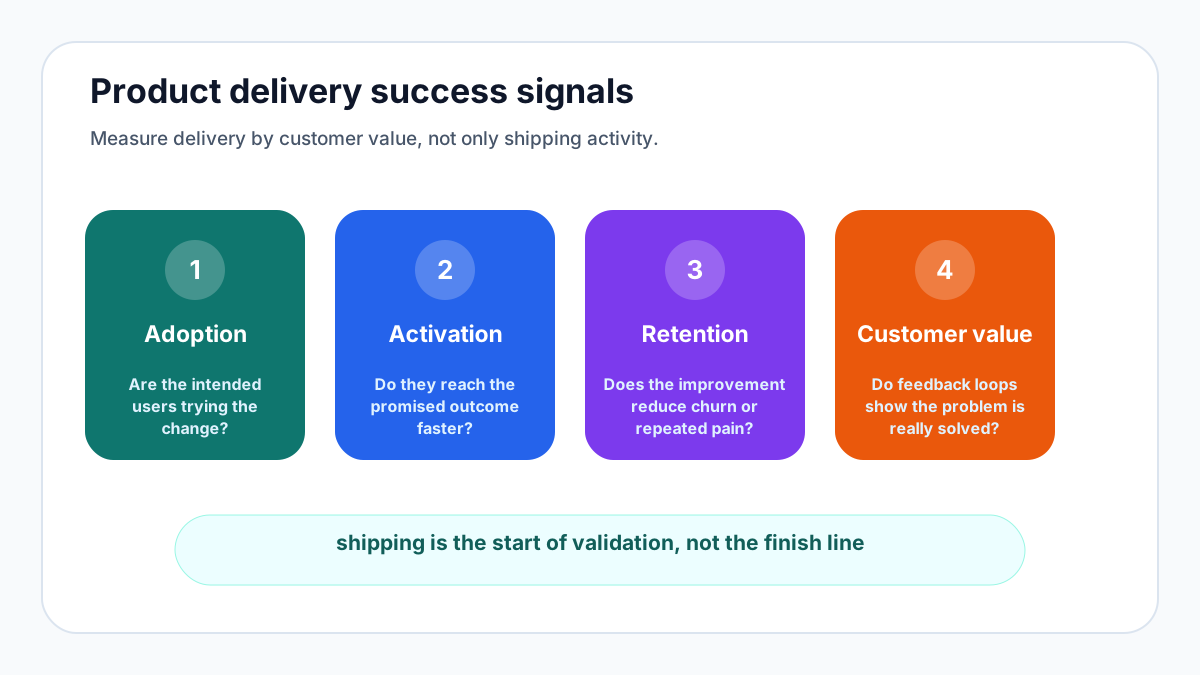
Do not measure only output. Count releases, but also measure lead time, change failure rate, adoption, retention, support impact, revenue effect, and customer sentiment. DORA research is widely used for software delivery performance because it connects delivery speed with stability and operational outcomes.
Pair quantitative metrics with qualitative learning. If adoption is low, interview users. If support tickets rise after launch, inspect the onboarding path. If customers vote for adjacent improvements, decide whether the next iteration belongs on the roadmap.
Common challenges and how to reduce them
Scope creep is managed by a clear problem statement, non-goals, and a decision process for late requests. Dependency risk is managed by early technical discovery and visible ownership. Quality risk is managed by testing, staged rollout, monitoring, and support preparation. Adoption risk is managed by launch communication, education, and feedback collection.
The simplest improvement is to close the loop every time. Tell customers what changed, why it changed, and what you are still considering. The FeaturAsk blog has related guides on release notes, product roadmaps, and SaaS growth strategy. If you need a low-cost way to keep post-launch requests organized, start FeaturAsk with no credit card. The first month is free and the plan is $29.95/year.
Practical next steps
Delivery also depends on communication. A team can build the right thing and still create confusion if customers, support, and sales are not prepared. Release notes, help content, and internal enablement are part of delivery, not afterthoughts.
The best delivery teams keep a narrow definition of done. Done means released, observable, supported, communicated, and reviewed. Anything less is work in progress with a nicer name.
If you want the feedback side of this workflow to stay simple, launch FeaturAsk with a one-month free trial and no credit card. It is built for feature requests, voting, and lightweight prioritization at $29.95/year, so you can learn from customers without buying an enterprise platform.
A delivery operating rhythm
Use a weekly rhythm that makes progress, risk, and learning visible. On Monday, review the goal, current scope, blockers, and any decision needed from leadership. Keep this meeting short and focused on changes since the last review. If nothing changed, do not perform status theater.
Midweek, inspect the work itself. Designers review flows with engineers. Engineers surface technical unknowns. Product reviews customer evidence and checks whether the solution still fits the problem. This is where teams catch misalignment before it becomes rework.
Before release, run a readiness check. Confirm analytics events, support notes, help content, rollback steps, customer communication, and monitoring. A feature that cannot be measured or supported is not ready, even if the code is complete.
After release, review adoption and feedback quickly. Look at usage, errors, support tickets, cancellation notes, and direct comments. Decide whether the next action is iteration, documentation, sales enablement, or moving on. Teams that skip this step often keep shipping without learning.
Once a month, review the delivery system itself. Which projects waited on decisions? Which dependencies surprised the team? Which releases created support load? Which customer insights changed priorities? Improving delivery is an ongoing product in its own right.
Building a feedback loop into delivery
The delivery plan should include feedback before the team ships. Decide who will see the first version, how they will be invited, what questions you need answered, and what evidence will trigger another iteration. If feedback is treated as something that happens after the project is over, the team loses the chance to learn while change is still cheap.
Use multiple feedback sources. Analytics show what people do. Support tickets show where they struggle. Interviews explain motivations. Feature votes show demand patterns. Sales conversations reveal objections. No single source is complete, but together they reduce guesswork.
Plan for negative feedback. A launch can be strategically correct and still create confusion. Decide how the team will respond to bug reports, missing edge cases, and disappointed customers. A calm response process protects trust and prevents one surprise from derailing the roadmap.
Make release communication part of the delivery definition. Customers should know what changed, who it helps, and where to send comments. Internal teams should know the same information before customers ask. This is especially important for small teams where support, sales, and product may be the same people wearing different hats.
Finally, connect feedback to the next planning cycle. A shipped feature should create evidence for the roadmap, not disappear into the archive. Review what customers adopted, what they ignored, what they requested next, and which assumptions were wrong. That learning is the compounding advantage of disciplined product delivery.
Decision checklist before you commit
Before committing to a delivery plan, check whether the team can explain the desired customer outcome in one sentence. If the answer is only a feature name, the plan is not ready. Delivery should be anchored in a change you expect customers to experience.
Check whether risks are visible early enough. Technical unknowns, data migrations, compliance concerns, launch dependencies, and support readiness should be discussed before the deadline is under pressure. Hidden risk is one of the most common reasons teams appear on track until they suddenly are not.
Check whether the release can be observed. Analytics events, logs, error monitoring, customer comments, and support tags should be ready before launch. If the team cannot tell whether the feature is being adopted or causing problems, it cannot responsibly learn from delivery.
Finally, check whether the next decision is clear. After launch, will you iterate, expand rollout, improve education, fix quality issues, or move to another priority? Delivery is successful when the next decision is better informed than the last one.
Delivery maturity grows through repetition. Teams get better when they compare planned scope with actual scope, planned risk with actual risk, and expected customer behavior with observed behavior. Keep those comparisons visible and blameless. The goal is not to prove that a plan was perfect; the goal is to make the next plan less fragile.
Protect focus during delivery. New ideas should be captured, not automatically inserted. If an idea is urgent, make the trade-off explicit: what will move out, what risk changes, and who approves the shift? This keeps flexibility from becoming chaos.
Celebrate learning as well as launches. A release that disproves an assumption early can save months of wasted effort. A feature that ships smoothly because support, documentation, and analytics were ready deserves recognition. Culture shapes delivery quality more than any single framework.
Keep the roadmap honest while delivery is underway. If a project expands, slows down, or creates new risk, update stakeholders quickly instead of waiting for the next formal review. Early transparency gives the business more options and reduces deadline surprises.
Delivery quality compounds when teams protect recovery time. After a difficult launch, reserve space to fix follow-up issues, clean documentation, review metrics, and pay down urgent technical debt. Moving immediately to the next project can make every later delivery harder.
Strong delivery is therefore a management habit as much as a development practice: visible priorities, honest risk, steady communication, and fast learning.
When those habits are present, teams can move quickly without pretending uncertainty has disappeared. They ship, observe, adapt, and earn customer trust over repeated releases.
That trust is the durable output of product delivery, beyond any single launch.
FAQs
How often should this process be reviewed?
Review the operating metrics monthly and review strategic assumptions quarterly. Fast-moving teams can review high-signal feedback weekly, but the cadence should be predictable enough that customers and teammates see follow-through.
What is the biggest mistake to avoid?
The biggest mistake is collecting feedback without assigning ownership for the next action. Every survey, request board, support trend, or product brief should have a person responsible for interpreting the signal and deciding what happens next.
Can a small team use this without extra process?
Yes. Keep the workflow lightweight: capture the signal, group similar items, choose the next best action, ship or explain the decision, and close the loop. The habit matters more than complex tooling.