Top 22 Idea Management Software by Category
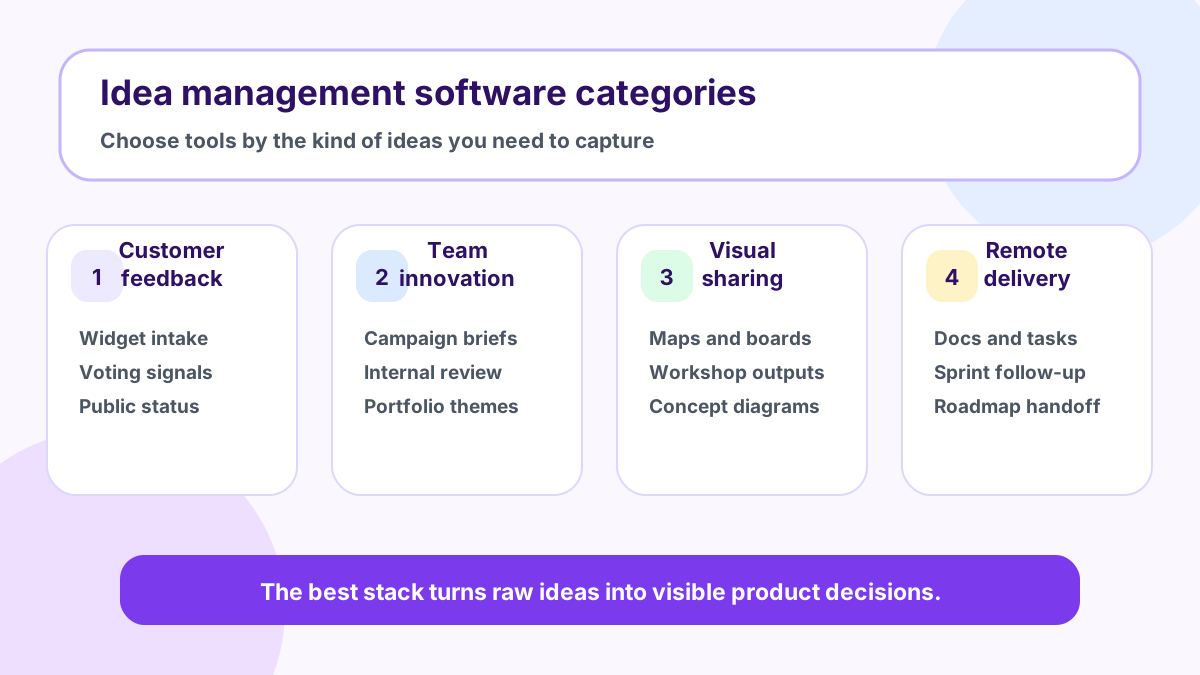
Idea management software helps teams capture suggestions, organize them, evaluate demand, and turn the best ideas into visible decisions. The category is broad. A startup collecting feature requests from users does not need the same system as a global company running internal innovation challenges. A product manager preparing a roadmap needs different evidence than a marketing team clustering campaign concepts on a whiteboard.
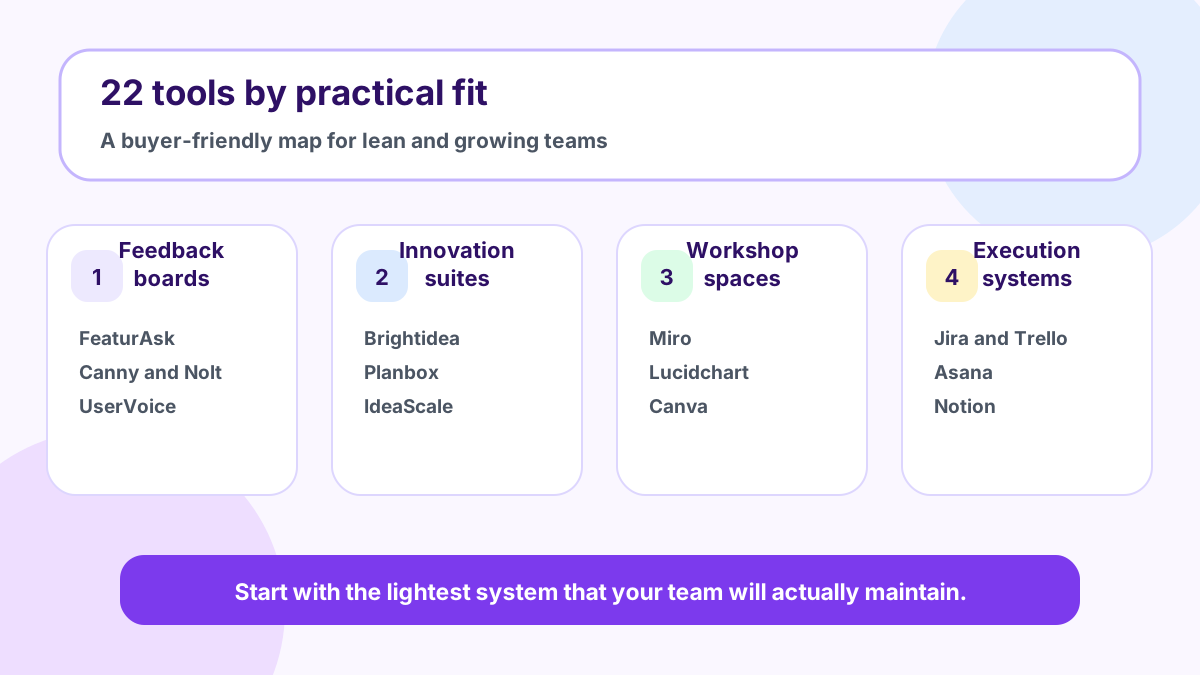
This guide keeps the buying decision practical. It groups 22 tools by job: customer idea management, company and team innovation, visualization and sharing, and remote collaboration. Use the categories first, then compare individual tools. If your biggest problem is scattered customer feature requests, start with a feedback board. If your problem is executive portfolio governance, evaluate innovation suites. If your problem is workshop synthesis, look at visual collaboration. If your problem is delivery follow-through, connect ideas to project systems.
For a lean product team, the simplest useful stack is often a public idea board, voting, comments, moderation, and status updates. That is the space FeaturAsk is built for: a lightweight feature request widget with voting, analytics, custom branding, and moderation. You can start FeaturAsk with a one month free trial, no credit card required, then keep it for $29.95/year if it fits.
Quick answer: what is idea management software?
Idea management software is a shared system for collecting, organizing, evaluating, and communicating ideas. The ideas may come from customers, employees, prospects, partners, sales calls, support tickets, workshops, surveys, or market research. Good software preserves the context around each idea: who asked, why it matters, how many people support it, which customer segment cares, what it would cost, and what decision the team made.
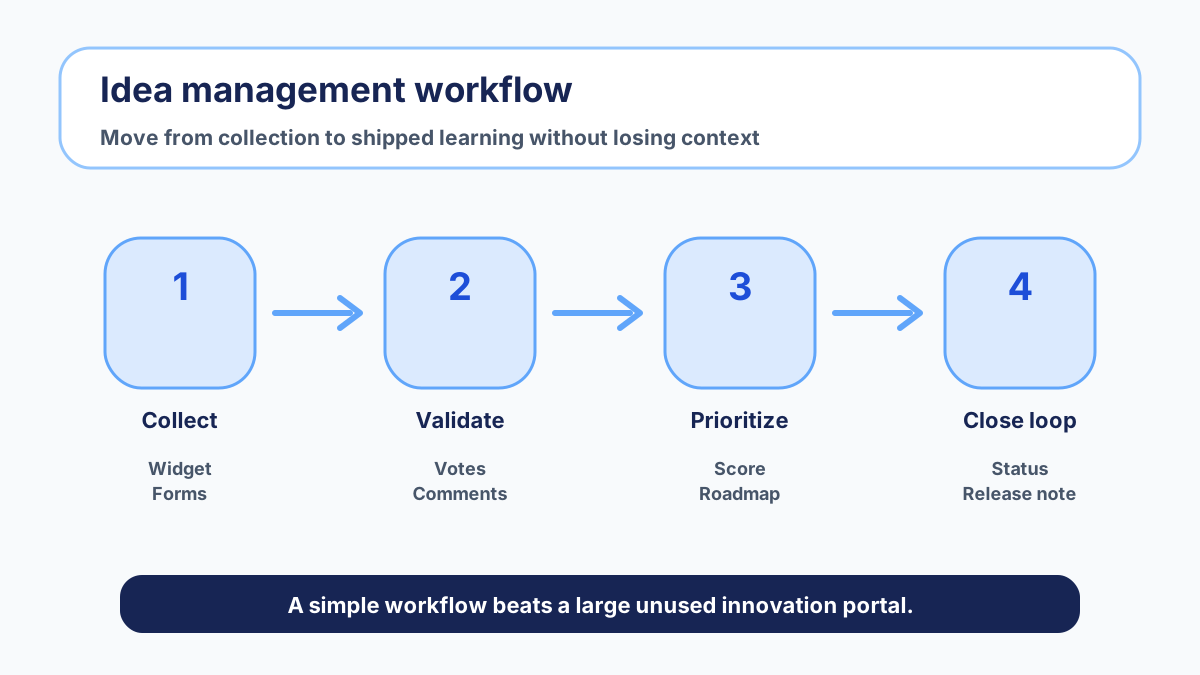
The key difference from a normal task manager is that ideas are not automatically work. They are evidence. A task manager asks, “Who will do this by Friday?” An idea management system asks, “Is this worth doing, for whom, and why?” Eventually a validated idea may become a roadmap item, epic, project, or release note, but the early workflow should leave room for discovery and prioritization.
If you are still designing your intake process, FeaturAsk's guides to how to prioritize feature requests, how to use a website feedback tool, and feedback board software pair well with this comparison.
How to choose the right category
Start by naming the decision you need to improve. If you want users to submit and vote on product improvements, choose customer idea management software. If you want employees to submit innovation proposals, run challenges, and review portfolios, choose company idea management software. If you want to brainstorm, map, or explain ideas visually, choose visualization tools. If you want ideas to become assigned work across distributed teams, choose collaboration and project tools.
Do not begin with the longest feature list. Heavy tools create impressive demos and abandoned processes. The right tool should match the volume of ideas, the number of stakeholders, the sensitivity of the information, and the cadence of decisions. A bootstrapped SaaS may only need a branded feedback board and a monthly review. An enterprise innovation office may need permissions, campaign templates, scoring workflows, reporting, and governance.
ProductPlan's roadmap guidance, accessed May 22, 2026, emphasizes that roadmaps communicate strategic intent rather than every task; that matters because ideas should become roadmap candidates only after evaluation. Atlassian's product management material, accessed the same day, likewise separates prioritization decisions from execution tracking. Those distinctions help prevent an idea inbox from turning into an unfiltered build queue.
Customer idea management software
Customer idea management tools are best when the core input is external feedback. They collect requests from users, help other users vote or comment, and let the product team update statuses such as under review, planned, in progress, shipped, or not now. The strongest tools in this group reduce duplicate requests and make communication visible.
1. FeaturAsk
FeaturAsk is a focused choice for startups, SaaS companies, agencies, and small teams that want customer feedback without buying a full product management suite. It gives you a feature request widget, voting, comments, analytics, moderation, and custom branding. The appeal is the ratio of usefulness to cost: you can collect real product demand and close the loop without a complicated rollout.
Use FeaturAsk when you want a public or embedded place for users to suggest improvements, support other ideas, and see progress. It is especially useful when feedback currently arrives through email, chat, social posts, and founder notes. Instead of losing those signals, you can turn them into a visible board and review them with context.
2. Canny
Canny is a popular customer feedback and roadmap platform for SaaS teams. It supports feedback boards, voting, segmentation, roadmaps, and changelog-style communication. It can be a strong fit for teams that want a more mature feedback operation and are ready for higher platform complexity and cost than a tiny team may need.
3. Nolt
Nolt focuses on simple feedback boards with voting and status updates. It is often considered by teams that want a clean public board and do not need a large product suite. Compare its moderation, customization, and reporting against the level of feedback volume you expect.
4. Upvoty
Upvoty combines feedback boards, roadmaps, and changelog features. It can suit teams that want to manage requests and communicate releases in one place. As with any bundled tool, make sure each module is strong enough for your actual workflow rather than attractive in a demo.
5. Usersnap
Usersnap is useful when visual feedback, screenshots, bug reports, and user context matter. Product and QA teams may choose it when the problem is not only “what should we build?” but also “what exactly did the user see?” It can complement an idea board when visual reproduction is important.
6. Qualaroo
Qualaroo is closer to survey and research software than a public idea board. Use it when you need targeted prompts, intercept surveys, or qualitative answers from specific website visitors. It is valuable for discovering why users behave a certain way, but less ideal as the main public voting system.
Company and team idea management software
Internal innovation tools help employees submit ideas, collaborate on concepts, evaluate proposals, and track programs. They are usually heavier than customer feedback boards because they support governance, campaigns, scoring, and executive reporting.
7. Brightidea
Brightidea is designed for enterprise innovation management. It can support idea campaigns, evaluation workflows, program analytics, and collaboration across business units. Consider it when innovation is a formal program with budget, sponsors, and many participants, not just a product backlog.
8. HelloIgnite
HelloIgnite focuses on employee idea collection and collaborative innovation. It is a fit for organizations that want staff to contribute process improvements, product ideas, or internal initiatives. Evaluate whether its workflow matches your review culture; internal idea programs fail when employees never see decisions.
9. Planbox
Planbox supports innovation management, challenges, and portfolio views. It can suit larger organizations that need a structured pipeline from idea submission to business case and implementation. The trade-off is setup effort: define criteria and ownership before inviting everyone to submit ideas.
10. IdeaScale
IdeaScale offers crowdsourcing and innovation management capabilities. It is often used for open innovation, employee engagement, and large-scale idea campaigns. Use it when you need broad participation and structured review rather than a small product feature board.
11. Typeform
Typeform is not a full idea management platform, but it is excellent for structured intake. Use it to collect detailed proposals, research responses, or internal suggestions when a conversational form will produce better context than an open text box. Pair it with a review board or database if you need ongoing status tracking.
Idea visualization and sharing tools
Visualization tools are strongest during discovery, workshops, and explanation. They help teams map relationships, cluster themes, and make concepts understandable. They are not always the system of record for demand, but they are valuable between raw intake and final prioritization.
12. Miro
Miro is a flexible online whiteboard for workshops, journey maps, affinity clustering, and brainstorming. It is useful when cross-functional teams need to see patterns together. Miro's product materials, accessed May 22, 2026, emphasize collaborative boards and templates, which makes it strong for facilitation but not a replacement for customer voting history.
13. Lucidchart
Lucidchart is strong for diagrams, flows, and architecture explanations. Choose it when ideas need to become process maps, system diagrams, or decision trees. It helps teams understand implications before work enters delivery.
14. Canva
Canva is useful when ideas need to become polished visuals, campaign concepts, or stakeholder-friendly one-pagers. It is not an idea pipeline, but it can help communicate selected concepts clearly to executives, customers, or internal teams.
Remote collaboration and execution tools
Remote collaboration tools keep ideas moving after selection. They help teams assign work, document decisions, and connect product discovery to delivery. The risk is using them too early. If every user suggestion becomes a task, your team loses the evaluation step.
15. Confluence
Confluence is useful for documenting product decisions, research summaries, meeting notes, and requirements. Atlassian's Confluence documentation, accessed May 22, 2026, positions pages as collaborative knowledge spaces. Use it to preserve why an idea was accepted or declined.
16. Notion
Notion works well for lightweight databases, idea libraries, product briefs, and team wikis. Notion's help center, accessed May 22, 2026, describes databases and templates that make it flexible for small teams. It can track ideas internally, but public voting and moderation usually require another layer.
17. ClickUp
ClickUp combines tasks, docs, whiteboards, dashboards, and forms. It can centralize internal work after prioritization. It is a good fit when your team already uses ClickUp for delivery and wants a connected intake process, but avoid over-customizing the workflow before the team has simple habits.
18. Asana
Asana is strong for cross-functional project tracking, ownership, due dates, dependencies, and status reporting. Asana's product documentation, accessed May 22, 2026, highlights goals, portfolios, and project views. Use it once an idea has become a committed initiative.
19. Monday.com
Monday.com provides configurable work management boards, automations, and dashboards. It can track idea pipelines internally, especially for operations or marketing teams. The best use case is a team that wants visual work management and is comfortable maintaining board structure.
20. Trello
Trello is simple and visual. Trello's guide to boards and cards, accessed May 22, 2026, still makes it useful for lightweight idea triage, editorial concepts, or small product experiments. It becomes weaker when you need segmentation, voting, or deep analytics.
21. Jira
Jira is built for software delivery and issue tracking. Jira documentation, accessed May 22, 2026, covers projects, issues, workflows, and agile boards. Use Jira after a validated idea becomes work for engineering. Do not make customers submit raw ideas into Jira unless your users are technical and the workflow is carefully moderated.
22. Airtable
Airtable is a flexible database-spreadsheet hybrid for teams that want custom fields, views, and lightweight automation. It can be a practical idea repository for marketing, operations, or product teams. Its weakness is that you must design your own governance, voting, and communication loop.
A simple evaluation checklist
Before you choose a tool, answer seven questions. Where do ideas come from? Who needs to submit them? Who reviews them? What context must be captured? How will duplicate ideas be merged? What statuses will contributors see? Where does a validated idea go next?
Then score each tool against your actual bottleneck. If your bottleneck is participation, choose the easiest intake. If your bottleneck is noise, choose moderation and duplicate management. If your bottleneck is stakeholder trust, choose transparent statuses and reporting. If your bottleneck is delivery, integrate with project management.
ISO 56002 guidance on innovation management systems, reviewed through accessible ISO summaries on May 22, 2026, is a useful reminder that innovation is a management system, not just a suggestion box. Even small teams need defined responsibilities, evaluation criteria, and feedback loops.
Common mistakes when buying idea management software
The first mistake is buying for future complexity instead of current behavior. A tool with advanced scoring does not help if nobody cleans incoming ideas. The second mistake is hiding decisions. Contributors quickly stop participating when every idea remains “under review” forever. The third mistake is mixing bugs, support tickets, feature requests, and strategic initiatives without clear labels.
Another common mistake is treating votes as a roadmap. Votes are valuable evidence, but they do not know your architecture, margins, strategy, or capacity. Combine votes with customer segment, revenue relevance, effort, confidence, and strategic fit.
Recommended lightweight stack
For most small SaaS teams, start with FeaturAsk for customer-facing idea intake, a short monthly prioritization meeting, and your existing project system for delivery. Keep the public board clean, merge duplicates, tag the strongest themes, and update statuses after planning. When an idea is accepted, create the implementation work in Jira, Linear, Asana, ClickUp, or your current tool. When it ships, close the loop in the feedback board.
This setup avoids two extremes: a private spreadsheet that users never see and an enterprise innovation suite that takes months to administer. If you want to test the workflow without a procurement cycle, launch a FeaturAsk board free for one month. There is no credit card required, and the plan is $29.95/year after the trial.
Final takeaways
Idea management software should make decisions easier, not merely collect more suggestions. Pick a category based on the job: customer feedback, internal innovation, visual exploration, or remote execution. Choose the lightest tool that captures enough context, helps you prioritize, and lets contributors see what happened.
If customer feature requests are your main source of ideas, a focused board with voting, analytics, custom branding, and moderation is often the highest-leverage starting point. You can try FeaturAsk for one month free with no credit card and keep your idea management process affordable at $29.95/year.
Sources checked in May 2026
- ProductPlan, <a href="https://www.productplan.com/learn/product-roadmap/" rel="nofollow">product roadmap guidance</a>, accessed May 22, 2026.
- Atlassian, <a href="https://www.atlassian.com/agile/product-management" rel="nofollow">product management and agile guides</a>, accessed May 22, 2026.
- Trello, <a href="https://trello.com/guide/trello-101" rel="nofollow">Trello 101 guide</a>, accessed May 22, 2026.
- Notion, <a href="https://www.notion.com/help/guides" rel="nofollow">help guides and databases</a>, accessed May 22, 2026.
- Asana, <a href="https://help.asana.com/s/" rel="nofollow">help center</a>, accessed May 22, 2026.
- ISO, <a href="https://www.iso.org/standard/68221.html" rel="nofollow">ISO 56002 innovation management overview</a>, accessed May 22, 2026.