Best Product Management Books for Startups in 2026: 6 Practical Picks
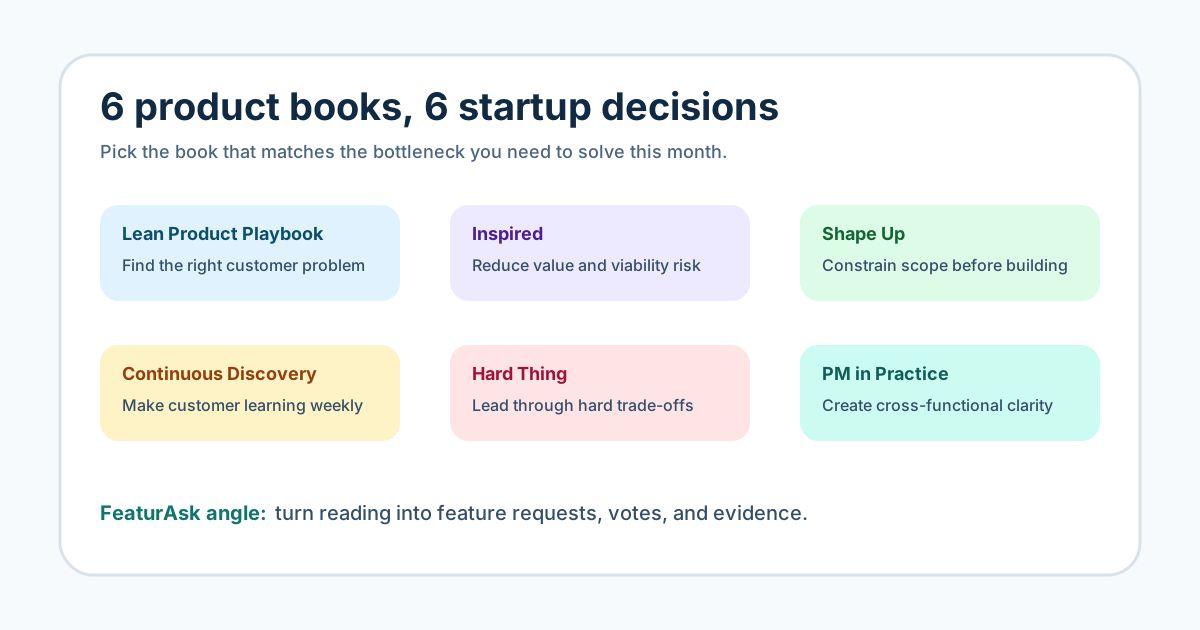
The best product management books for startups in 2026 are not just books about roadmaps, specs, or agile rituals. Startup product work now combines customer discovery, AI-assisted research, positioning, pricing, onboarding, prioritization, launch communication, and the discipline to avoid building every request that sounds reasonable.
This guide focuses on six books that still help small teams make better decisions. The goal is practical: read one book, change one operating habit, and connect that lesson to real customer evidence. If a product book does not help you decide what to build, what to ignore, or what to validate next, it is probably not the right book for your current stage.
For FeaturAsk readers, the theme is simple: reading is useful when it improves the feedback loop. A founder or PM should be able to turn a chapter into a better question, a clearer feature request, a sharper roadmap conversation, or a better update for users who asked for a change.
How to choose product management books as a startup team
A startup does not need a massive product library. It needs a shared operating language. If one founder thinks product management means “write specs,” another thinks it means “talk to customers,” and engineering thinks it means “change priorities every week,” the team will waste more time aligning than building.
Choose books that match your current bottleneck. If you are still proving demand, read about product-market fit and discovery. If your team has demand but keeps overbuilding, read about shaping work and setting appetite. If your backlog is full of disconnected requests, read about prioritization, communication, and leadership judgment.
The most useful reading habit is extraction. After each chapter, write down one customer question, one assumption to test, and one product decision you would handle differently. That turns reading into operating behavior instead of passive inspiration.
If your team already collects feature requests through email, support tickets, sales calls, and DMs, centralize those signals before they disappear. FeaturAsk lets you collect feature requests for $29.95/year, with a 30-day free trial and no credit card required, so a small team can turn book lessons into real user evidence without buying an enterprise product suite.
1. The Lean Product Playbook
Dan Olsen’s <a href="https://leanproductplaybook.com/" rel="nofollow">The Lean Product Playbook</a> remains one of the most useful startup product books because it connects product-market fit to a concrete process. Instead of treating product-market fit as a vague milestone, it breaks the work into target customers, underserved needs, value proposition, feature set, user experience, and testing.
The 2026 startup lesson is sequencing. AI tools can generate landing pages, product ideas, surveys, and mockups faster than ever, but they cannot prove that the customer problem is real. Many teams now overbuild faster because execution feels cheap. Olsen’s model pushes you back to the core question: which customer, which problem, which promise, and which minimum product will test the promise honestly?
Use this book when your roadmap feels like a pile of plausible ideas. Translate each major request into a hypothesis: who wants it, what problem it solves, what alternative they use today, and what evidence would prove the need is meaningful. Then collect votes and comments before committing engineering time. FeaturAsk’s guide to feature request templates can help turn those hypotheses into structured intake questions.
2. Inspired
Marty Cagan’s <a href="https://www.svpg.com/books/inspired-how-to-create-tech-products-customers-love/" rel="nofollow">Inspired</a> is a product culture book disguised as a product management book. Its core message is that strong teams do not simply gather requirements and ship tickets. They solve customer and business problems with empowered product, design, and engineering collaboration.
For startups, the most useful idea is risk. Before building, teams should understand value risk, usability risk, feasibility risk, and business viability risk. A feature can be technically possible and still fail because customers do not care, the workflow is confusing, or the business model cannot support it.
This is where small teams can outperform larger competitors. You may not have a research department, but you can talk to customers quickly, review feature votes weekly, and test prototypes before committing months of work. If you already maintain a public or private board, connect each high-vote request to the risk it reduces. Is it proving demand? Clarifying usability? Revealing willingness to pay? Reducing churn?
3. Shape Up
Basecamp’s <a href="https://basecamp.com/shapeup" rel="nofollow">Shape Up</a> is freely available online and remains one of the clearest books on turning fuzzy product ideas into shippable work. Its language of shaping, betting, appetite, boundaries, and hill charts gives teams a practical alternative to endless backlog grooming.
The startup lesson is appetite. Instead of estimating how long a feature might take and watching scope expand, decide how much time the problem is worth. A two-week appetite produces a different solution than a six-week appetite. That constraint forces sharper product thinking.
Shape Up also helps with feedback requests. Users often describe solutions: “Add a dashboard,” “Build an export,” “Create an integration.” Shaping asks you to uncover the underlying problem, define boundaries, and leave enough room for builders to find a good implementation. That pairs naturally with a feedback board: collect raw requests, group duplicates, then shape the problem before the team bets on it.
If you need a lightweight way to gather raw input before shaping, try FeaturAsk free for 30 days with no credit card required. You can collect requests, let users vote, and review demand before deciding which shaped projects deserve a cycle.
4. Continuous Discovery Habits
Teresa Torres’s <a href="https://www.producttalk.org/continuous-discovery-habits/" rel="nofollow">Continuous Discovery Habits</a> is the best book in this list for teams that know they should talk to customers but do not have a repeatable habit. The book argues for weekly customer touchpoints, opportunity solution trees, assumption testing, and discovery as a continuous team practice rather than a one-off research phase.
The 2026 value is cadence. Customer discovery often fails because it becomes a special project: a survey once a year, a few interviews before launch, or a research sprint when churn spikes. Torres makes discovery operational. Product teams should keep learning as the product evolves.
For a small SaaS or ecommerce software team, continuous discovery can be simple. Review new feature requests every Friday. Pick one confusing request and ask follow-up questions. Tag requests by customer segment. Compare votes with revenue, churn risk, and support volume. Run one small test before building a large solution.
This book also explains how to avoid treating feedback as a popularity contest. Votes are useful, but they are not the whole decision. The best discovery practice combines what users request, why they request it, how often the problem appears, and whether solving it supports the business.
5. The Hard Thing About Hard Things
Ben Horowitz’s <a href="https://www.harpercollins.com/products/the-hard-thing-about-hard-things-ben-horowitz" rel="nofollow">The Hard Thing About Hard Things</a> is not a tactical PM manual. It is a leadership book about making decisions when every option has consequences. That makes it valuable for startup product leaders, because early product management is full of uncomfortable trade-offs.
You will disappoint some customers when you focus. You will cut features that took real effort. You will ship imperfectly. You will decide whether to serve a loud enterprise prospect or protect the product’s simplicity for the broader market. Product frameworks help, but leadership judgment still matters.
Read this book when the team is growing, customer demands are diverging, or the roadmap is becoming political. Its product lesson is emotional discipline: be honest about constraints, communicate clearly, and make decisions with the information you have. A transparent feedback process helps here. If users can see requests, votes, and statuses, you can explain why some ideas move forward and others wait.
For more on making customer demand visible, read FeaturAsk’s guide to feedback board software. A shared board will not remove hard decisions, but it gives the team better evidence and reduces hidden lobbying.
6. Product Management in Practice
Matt LeMay’s <a href="https://www.oreilly.com/library/view/product-management-in/9781491982268/" rel="nofollow">Product Management in Practice</a> is a grounded book for people doing product work inside real organizations. It emphasizes communication, alignment, decision-making, and the messy human side of product management.
That makes it useful for startup teams where job titles are fluid. The founder is also the PM. The designer handles research. The engineer talks to customers. The marketer owns launch messaging. In that environment, product management is less about authority and more about creating clarity.
The book is especially helpful for learning how to work across functions. A feature request may touch support, engineering, design, sales, onboarding, and pricing. If the PM only writes a ticket, context disappears. If the team documents the user problem, evidence, expected impact, and launch communication, execution improves.
Pair this book with FeaturAsk’s product launch communication plan when you are preparing to ship. The best product teams do not stop at prioritization. They close the loop with users who asked for the improvement, explain what changed, and keep collecting feedback after launch.
How to turn book lessons into better product decisions
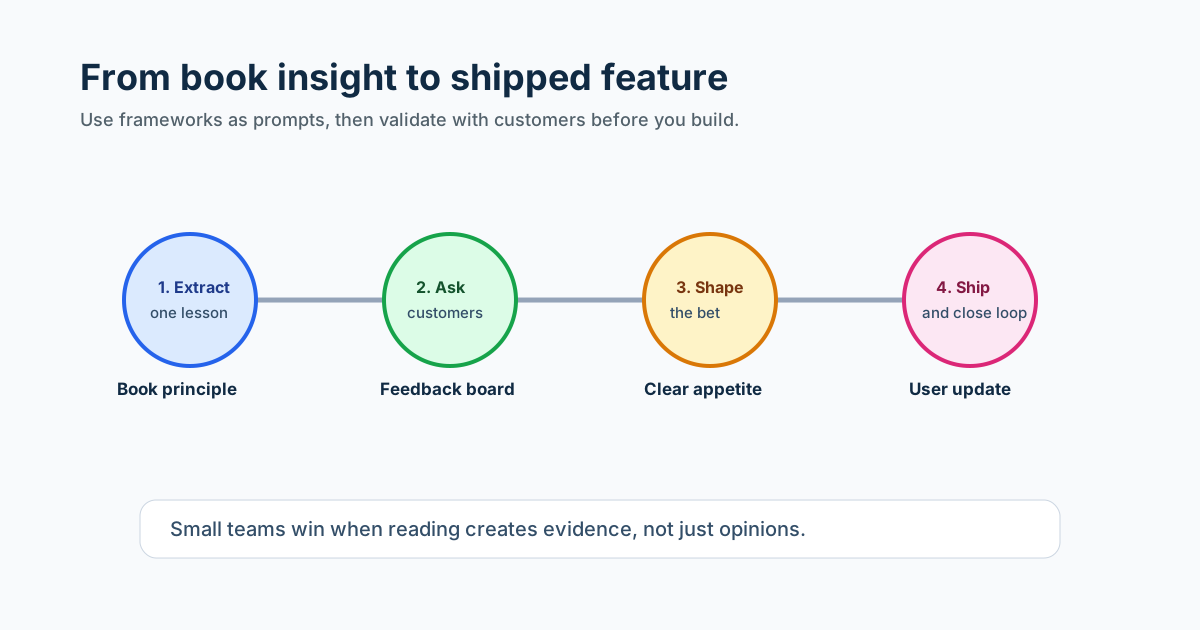
Reading is only valuable if it changes decisions. Use a simple four-step operating loop.
First, collect raw customer input. That includes feature requests, bug reports, sales objections, churn reasons, onboarding friction, support tickets, and comments from existing customers. Do not hide these signals in private notebooks.
Second, clarify the problem behind each request. A request for “custom fields” might really mean better reporting. A request for “Slack integration” might mean faster team visibility. A request for “mobile app” might mean users need notifications, not a full native product.
Third, prioritize with evidence. Combine votes, customer segment, revenue impact, strategic fit, implementation effort, and urgency. Avoid letting the loudest user or newest idea dominate every planning conversation.
Fourth, close the loop. Tell users when their request is planned, shipped, declined, or merged into a different solution. This builds trust even when you say no. It also turns product development into an ongoing relationship rather than a black box.
Which product management book should you read first?
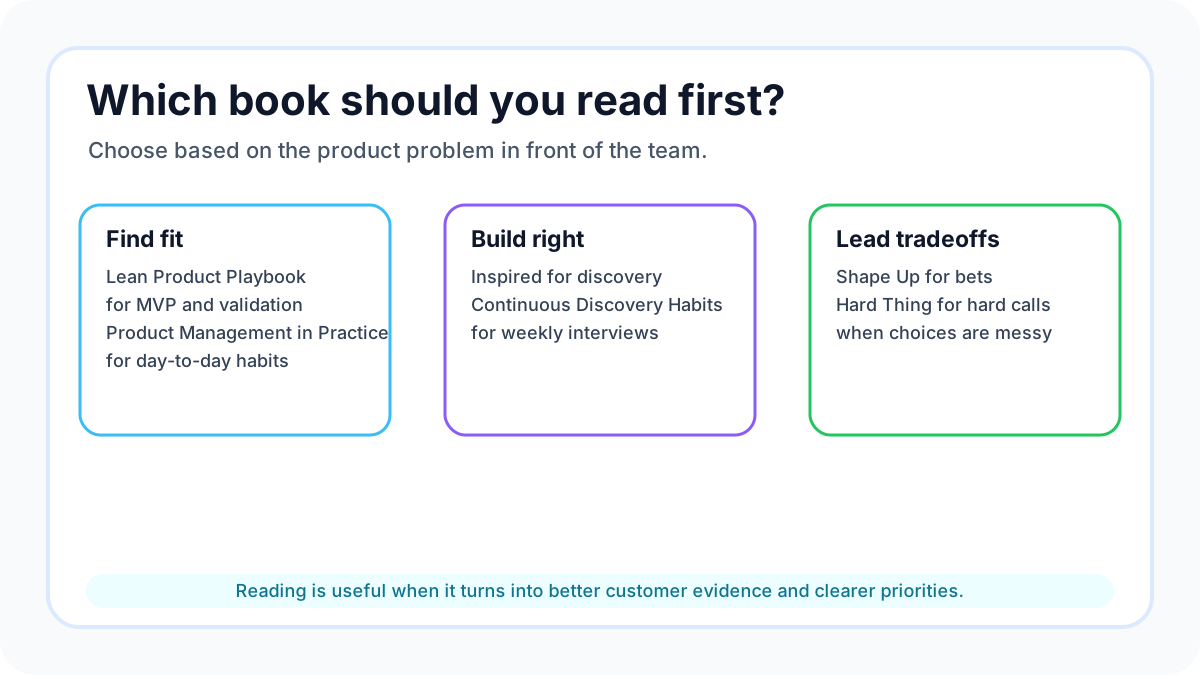
If you are pre-product-market fit, start with The Lean Product Playbook. It will help you define the customer, problem, and value proposition before you overbuild.
If your team is shipping but feels like a feature factory, read Inspired. Use it to reframe product work around outcomes and risks instead of requirements.
If projects keep growing beyond their original scope, read Shape Up. Its appetite-based planning is especially useful for small teams with limited engineering capacity.
If you need a repeatable customer learning habit, read Continuous Discovery Habits. It is the most directly useful book for improving weekly discovery behavior.
If leadership decisions are getting harder, read The Hard Thing About Hard Things. It will not give you a roadmap template, but it will make you more honest about trade-offs.
If communication is the bottleneck, read Product Management in Practice. It is practical, human, and relevant to teams where influence matters more than job titles.
The best overall sequence for a startup is: The Lean Product Playbook, Continuous Discovery Habits, Shape Up, Inspired, Product Management in Practice, then The Hard Thing About Hard Things. That path moves from finding demand to discovering opportunities, shaping work, improving team culture, communicating clearly, and leading through ambiguity.
Final takeaway
Product management books can sharpen your judgment, but users decide whether your product matters. The strongest startup teams combine good product principles with a lightweight system for capturing customer demand, validating ideas, and closing the loop.
If you want a practical next step after reading, sign up for FeaturAsk and start collecting feature requests for $29.95/year, with a 30-day free trial and no credit card required. It gives small teams a simple way to turn product lessons into a living feedback loop.