9 Effective Tips for Scaling a Product Team for Business Success
Last updated January 22, 2026
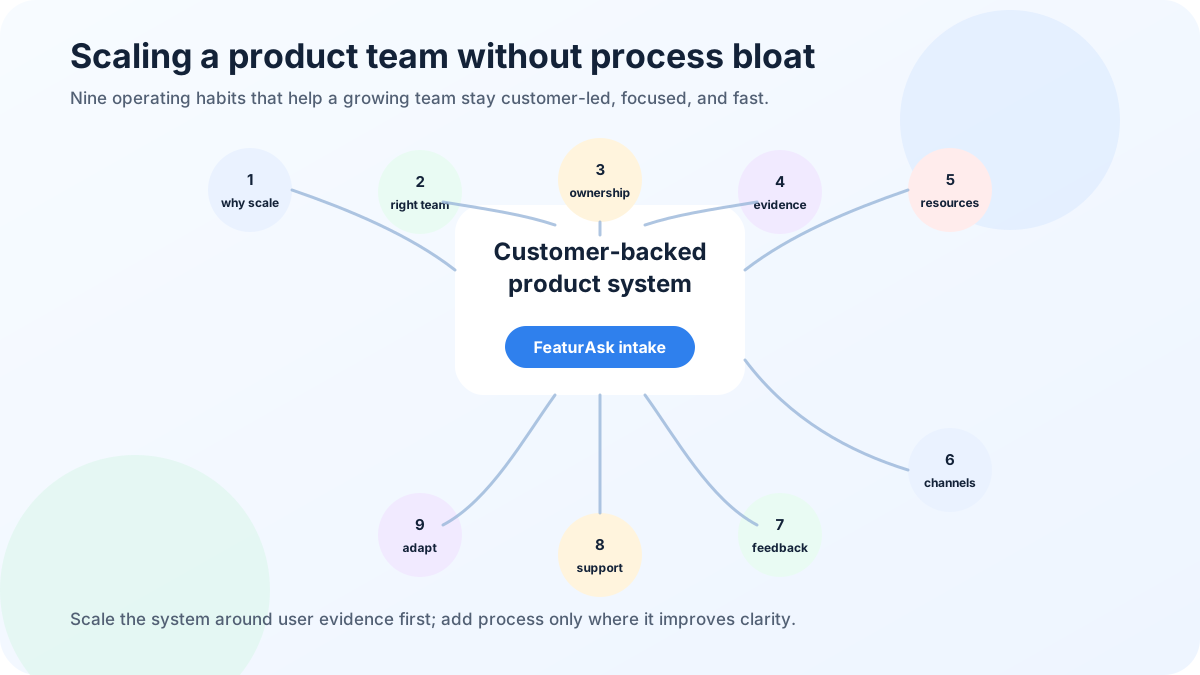
Quick answer: the 9 effective tips for scaling a product team for business success are to define why you are scaling, assemble the right team, create clear responsibilities, keep diverse ideas decision-ready, optimize resources, improve communication channels, build customer feedback intake before process bloat, scale customer support with product operations, and adapt to change with a learning cadence.
Scaling a product team is exciting because it usually means the business is working. More customers, feature requests, bugs, integrations, onboarding questions, and market opportunities are visible than one founder or small team can handle alone.
The danger is that growth can make the product slower instead of stronger. A team of three can solve problems through direct conversation. A team of ten needs clearer ownership. A team of twenty needs decision rules, feedback intake, support alignment, and lightweight rituals.
Teams need enough structure to keep customer learning, product decisions, engineering work, and communication connected. Before you add heavy roadmapping, scoring, and reporting layers, create a simple place where customers can ask, vote, explain, and see progress.
If scattered requests are already slowing your roadmap, start a FeaturAsk feedback board to collect ideas, prioritize with votes, and close the loop. It includes a 30-day free trial, no credit card required, and simple pricing at $29.95/year.
Challenges of Scaling a Team
Scaling a product team introduces challenges that are not obvious when the company is small. Early communication is informal. As the team grows, the same habits create gaps.
<a href="https://www.highalpha.com/saas-benchmarks" rel="nofollow">High Alpha's 2025 SaaS benchmarks</a> show why growing software companies need disciplined operating metrics, not just more headcount. <a href="https://cloud.google.com/resources/content/2025-dora-ai-assisted-software-development-report" rel="nofollow">Google Cloud's 2025 DORA research</a> also emphasizes fast feedback, user focus, and organizational capabilities. For growing product teams, headcount alone does not create speed. Systems do.
Selecting the Best Team
Hiring is the most visible scaling challenge, but it is easy to oversimplify. The right hire is not just the most impressive resume. You need people who fit the product stage, customer problem, working style, and constraints of the business.
A scaling product team may need product managers, designers, engineers, data analysts, customer success partners, QA support, technical writers, marketers, or operations help. The mistake is hiring for a future org chart before the current bottleneck is understood. If discovery is weak, add user research capacity. If shipping is slow because scope keeps changing, fix product decisions before adding developers.
Diverse Ideas and Expertise
A larger team brings more ideas, backgrounds, and specialties. That diversity is an advantage when disagreement improves decisions. It becomes a drag when every discussion resets strategy.
Design may optimize for usability, engineering for maintainability, sales for objections, support for confusion patterns, and product for retention. All of those views matter, but without a decision process they create slow meetings.
Effective Resource Management
Scaling creates competition for time, budget, tools, infrastructure, and attention. More people can produce more output, but only if resources are allocated to the highest-value work.
Resource problems appear as half-finished projects, context switching, design work waiting on decisions, customer interviews that never reach the roadmap, or support questions product could have prevented.
Operational Complexity
Processes that work for five people rarely work for fifty. But the answer is not to bury the team in ceremonies. Operational complexity should be handled with simple defaults: where requests go, who reviews them, how priorities are chosen, what status labels mean, how decisions are documented, and when customers are updated.
The more your team grows, the more expensive ambiguity becomes.
Team Scalability
Team scalability is the ability to add people without making everyone less effective. It depends on onboarding, standards, decision rights, documentation, and rituals that preserve context.
A scalable team does not require every person to know every detail. It requires each person to know where to find the current truth.
Customer Support
When the product grows, customer support grows with it. New customers bring new use cases. Larger accounts ask for integrations, permissions, reporting, security, and workflow changes. If support and product are disconnected, support becomes a pressure valve instead of a source of product intelligence.
The best scaling teams treat support input as product evidence, not closed-ticket history.
Effective Tips for Scaling a Product Team
Use these 9 tips as a practical operating system. They are written for small SaaS teams, bootstrapped founders, creators, agencies, and lean product groups that need business success without enterprise process bloat.
1. Define why you are scaling before you hire
Do not scale because the company looks busy. Scale because a specific constraint is blocking the business. Ask whether customers are waiting too long for fixes, discovery is weak, engineers lack clear requirements, support is repeating product gaps, the roadmap is overloaded, or one person is the decision bottleneck.
The answers tell you whether to hire, change process, improve tooling, narrow scope, or clarify ownership. Hiring is powerful, but it multiplies the system you already have.
Before opening a role, write the outcome you expect in the next six months, such as “reduce onboarding confusion,” “clarify product specs,” or “turn customer feedback into a weekly prioritization input.” Outcome-based hiring keeps the team focused on business success.
2. Assemble the right team for the product stage
The right product team changes by stage. Early teams need generalists who can talk to users, prototype, ship, and learn quickly. Growing teams need clearer specialization: product management, design, engineering leadership, customer success, analytics, and support operations.
Look for people who can work with uncertainty. Scaling teams face changing priorities, imperfect data, and tradeoffs. A strong hire can ask good questions, document assumptions, collaborate across functions, and avoid turning every idea into a large project.
Hire for complementary strengths. If the founder is technical but weak in discovery, add product or research capability. If the team ships quickly but creates support burden, add design, QA, or customer education strength.
For roles that touch customer needs, ask candidates to review five customer requests, identify patterns, and recommend the next step. This reveals how they think about evidence.
3. Create clear responsibilities and decision rights
As the product team grows, role confusion becomes one of the fastest ways to lose momentum. Two people may work on the same problem. Nobody may own a decision. Engineering may wait for product while product waits for leadership.
Clear responsibilities answer three questions: who owns the outcome, who contributes evidence, and who makes the final decision.
For each meaningful product area, define the accountable owner, engineering lead, design contributor, support contact, decision approver, and customer communication owner. This does not need to become a complex RACI matrix; a short ownership note can prevent weeks of confusion.
Clear ownership also helps users. If a feature request is under review, someone should know who is responsible for reading comments, merging duplicates, updating status, and responding when a decision is made. The guide to feature request templates can help you collect the right information before ownership decisions are made.
4. Turn diverse ideas into decision-ready evidence
Diverse ideas are valuable only when the team can compare them. Otherwise, the loudest opinion, largest customer, or latest Slack message wins.
Create a standard way to prepare ideas for discussion. A decision-ready idea should include the user problem, requester context, demand signal, customer quotes, expected business impact, smallest useful version, risks, dependencies, and open questions.
This structure helps product, design, engineering, support, and leadership discuss the same thing. It also separates problems from solutions. A customer may request a full analytics dashboard, but the underlying need might be a weekly export. A sales team may request advanced permissions, but the immediate blocker might be one role toggle.
When ideas are captured consistently, the team can debate tradeoffs instead of definitions. That is the difference between healthy diversity and endless opinion loops.
5. Optimize resources around constraints, not politics
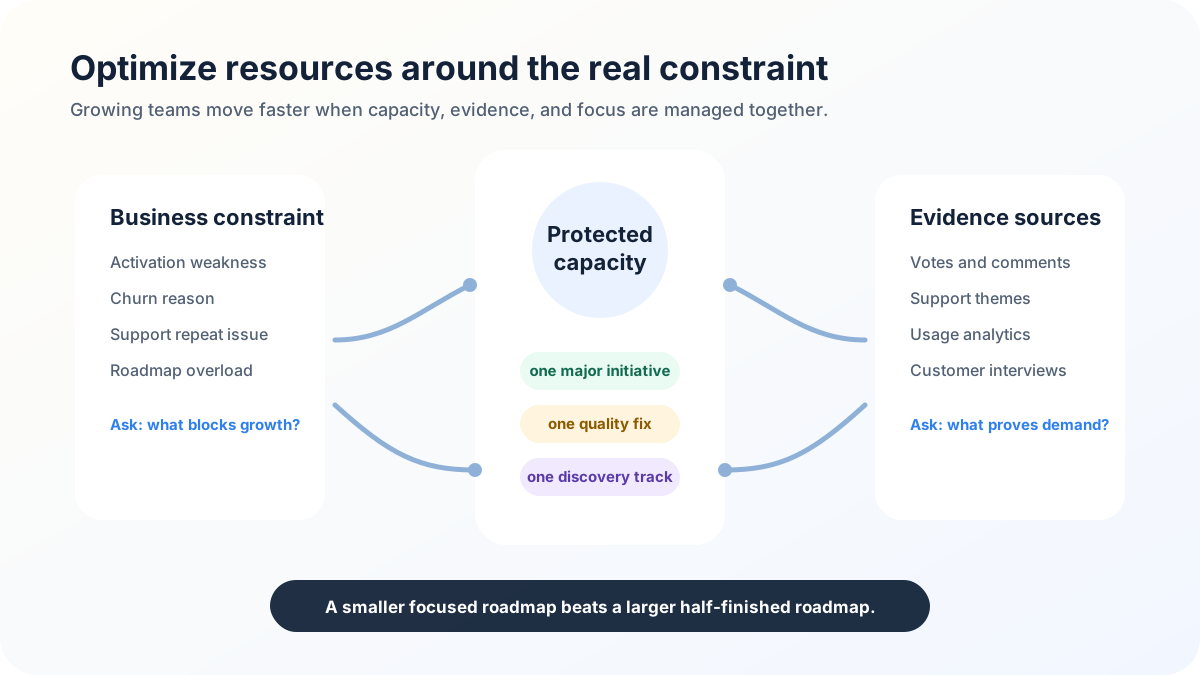
Resource allocation gets harder as the product team grows. Every function can make a reasonable case for more time, budget, or tooling. The scaling leader’s job is to allocate around the business constraint.
If activation is weak, invest in onboarding, UX fixes, documentation, and customer learning. If churn is tied to missing workflow features, prioritize discovery and delivery around those workflows. If engineering is slowed by quality issues, allocate time to test coverage, observability, and technical debt. If the roadmap is overloaded, reduce work in progress before adding more initiatives.
Use capacity limits to protect focus. A small product team might commit to one major initiative, one quality improvement, and one discovery track per cycle. Resource optimization also means retiring rituals, requests, and experiments that no longer fit strategy.
6. Improve communication channels before meetings multiply
Growing teams often respond to confusion by adding meetings. Some meetings are useful, but meetings alone do not create alignment. They can even hide the fact that decisions are not documented.
Build communication around channels and purposes: a feedback board for requests, a roadmap for priorities, an issue tracker for delivery, documentation for decisions, chat for quick coordination, and recurring review for triage. Each channel should have a job.
A practical rule: after every important product decision, write one short note explaining what changed, why, and who owns the next step. That note saves future meetings.
For communication patterns between product and engineering, the related guide on improving dev team communication gives lightweight habits that work well for scaling teams.
7. Build simple user feedback intake before process bloat
This is the tip many scaling teams miss. They add product managers, project tools, planning meetings, and prioritization frameworks before they fix the intake problem. As a result, the roadmap still depends on scattered signals from email, chat, sales calls, support tickets, founder memory, and random screenshots.
A simple feedback intake system gives users and teammates one place to submit ideas, vote, comment, and follow status. It helps the team see patterns before investing in heavier process.
The system should show what users are asking for, which requests are duplicates, who cares, what comments explain urgency, what status each request has, and who should hear back when the status changes.
This is especially important for small teams because they cannot afford a large research operation for every decision. A feedback board is not a replacement for strategy, interviews, analytics, or judgment. It is a clean intake layer that prevents customer knowledge from fragmenting.
Try FeaturAsk if you want that intake layer without heavy setup. It helps small teams collect requests, manage votes, and update customers for $29.95/year after a one-month free trial, with no credit card required.
8. Scale customer support with product operations
Customer support should not scale separately from product. If support volume rises but product never sees the patterns, the company will keep paying people to explain avoidable problems.
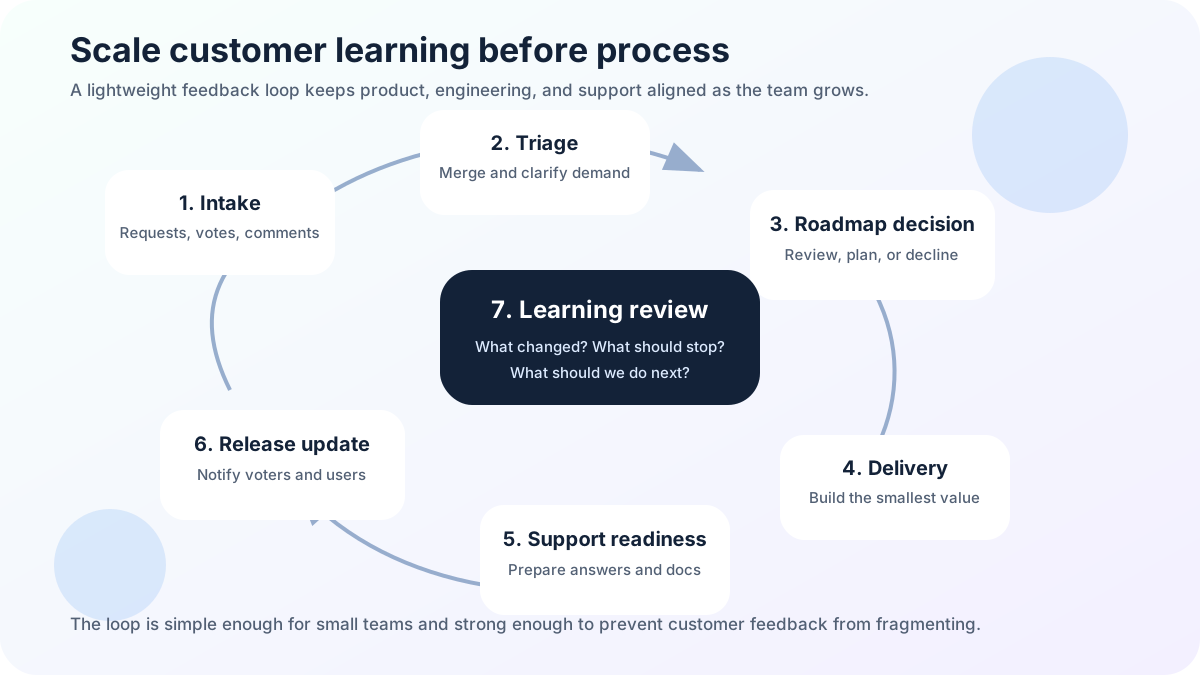
Create a support-to-product loop: tag recurring issues, add product gaps to the feedback board, merge duplicates, review top patterns, decide whether to fix or document, notify support when a decision changes, and close the loop with customers after release.
This loop improves both support and product quality. Support gets clearer answers. Product gets real user evidence. Engineering sees why work matters. Customers feel heard because their feedback does not vanish.
For launches, connect support readiness to release communication. The guide to a product launch communication plan shows how to prepare internal teams and customers before a change goes live.
9. Adapt to change with a learning cadence
Scaling does not remove uncertainty. It increases the cost of ignoring it. Markets change, competitors move, users mature, pricing changes, AI shifts workflows, and the team discovers new constraints.
Adaptability works best when it is scheduled. Create a learning cadence that gives the team regular opportunities to adjust without thrashing.
A lightweight cadence might include weekly feedback triage, biweekly delivery review, monthly roadmap review, quarterly strategy check, and post-launch review for meaningful releases.
At each review, ask: what did we learn, what changed, what should stop, what should continue, and what decision needs updating?
This protects the team from two extremes. One extreme is constant pivoting, where every new request disrupts the roadmap. The other is rigid planning, where the team keeps building yesterday’s assumptions. A good scaling rhythm lets evidence enter the system without making every signal urgent.
How to know your product team is scaling well
A scaling product team is healthy when growth creates more clarity, not confusion. Look for signs such as new teammates understanding priorities quickly, customer requests staying visible, support explaining product decisions, engineers knowing the problem behind the work, meetings producing written decisions, roadmap items having owners, shipped features closing the loop, and the team saying no without losing context.
Metrics can help, but avoid measuring only output. Track cycle time, activation, retention, support themes, roadmap aging, customer-request volume, and post-release feedback. <a href="https://www.pendo.io/product-benchmarks/" rel="nofollow">Pendo's product benchmarks</a> are a useful reminder that usage, engagement, and retention signals matter when product teams prove impact and align stakeholders.
The most important signal is whether the team is learning faster as it grows. If more people create slower learning, the system needs attention.
Final thoughts
Scaling a product team for business success is not just hiring people. It is building a system where talented people can make better decisions together.
Start with the 9 tips: define why you are scaling, assemble the right team, clarify responsibilities, turn diverse ideas into evidence, optimize resources, improve communication channels, build simple feedback intake, connect support with product operations, and adapt through a learning cadence.
Small teams do not need bloated process to scale well. They need visible customer input, honest priorities, clear ownership, and a repeatable way to close the loop. Add structure where confusion appears, but keep it light enough that the team can maintain it every week.
If you want to scale product decisions around real customer input, use FeaturAsk to collect requests, prioritize ideas, and update users when you ship. You can start with a 30-day free trial, no credit card required.