Guide to Customer Feedback Management for SaaS
Customer feedback management for SaaS is the process of collecting, organizing, prioritizing, and acting on user input across the full customer lifecycle. Done well, it turns scattered comments into roadmap clarity. Done poorly, it becomes a noisy backlog that frustrates both customers and teams.
This guide presents SaaS feedback management as a small operating system: intake rules, taxonomy, scoring, communication, metrics, and governance that a lean team can actually maintain.
Define the feedback management system before tools
SaaS feedback arrives everywhere: sales calls, onboarding sessions, support tickets, review sites, Slack communities, email, cancellation forms, product analytics, and in-app widgets. Each channel has a different owner and a different level of detail. Without a shared system, teams either ignore valuable signals or overreact to the most recent complaint.
The second challenge is bias. Enterprise accounts may have a loud voice. New users may complain about setup while long-term users ask for advanced workflows. Sales may highlight deal blockers. Support may highlight confusing edge cases. Product teams need to respect every source without letting any single channel control the roadmap.
The third challenge is closing the loop. Customers stop giving feedback when they never hear what happened. Management is not complete until a team communicates decisions and shipped improvements.
If you want this loop without a heavy rollout, FeaturAsk gives you a clean feedback widget, organized request dashboard, and public updates in one place. Start with one month free, no credit card required, then keep it for just $29.95/year when it fits your workflow.
Create one repository with account context
Centralization does not mean flattening every comment into a generic ticket. Keep the original customer wording, account segment, plan, lifecycle stage, date, source, and related evidence. Then summarize the underlying problem in a consistent format.
A simple feedback portal can become the shared layer between support, product, customer success, and leadership. Support can attach tickets to existing ideas. Product can merge duplicates. Customer success can add revenue or renewal context. Leadership can see themes without reading every conversation.
If you are building the system from scratch, start with our posts on feedback management strategy, feature request tracking, and product roadmap prioritization.
Capture SaaS feedback at lifecycle moments
Timing shapes quality. Ask during onboarding when users understand whether setup is clear. Ask after repeated feature use when they can describe friction. Ask after a support resolution when the pain is still fresh. Ask at cancellation when the missing outcome is explicit.
Use short prompts, not long surveys by default. A one-field idea widget can capture more honest context than a formal form. For deeper discovery, follow up with a small set of users who described a high-value problem.
Do not ask every user every time. Use throttling, segmentation, and event triggers. A well-timed prompt feels like service. A random pop-up feels like interruption.
Small teams do not need enterprise software to listen well. FeaturAsk helps you collect ideas, prioritize requests, and close the loop with users. Try the first month free, no credit card required; ongoing access is only $29.95/year.
Prioritize with taxonomy, evidence, and business context
Prioritization should combine demand, impact, effort, confidence, strategy, and customer segment. Votes are useful, but they are not the whole story. A request with fewer votes may matter more if it unlocks a target market, reduces churn, or removes a major activation barrier.
Use a lightweight scoring approach. RICE can help compare reach, impact, confidence, and effort. MoSCoW can help communicate must-have, should-have, could-have, and will-not-do decisions. The point is not to make scoring perfect; it is to make tradeoffs visible.
For reference, see the <a href="https://www.productplan.com/glossary/moscow-prioritization/" rel="nofollow">MoSCoW prioritization overview</a> and the <a href="https://www.productplan.com/glossary/rice-scoring-model/" rel="nofollow">RICE scoring overview</a>.
Close the loop with customer-visible communication
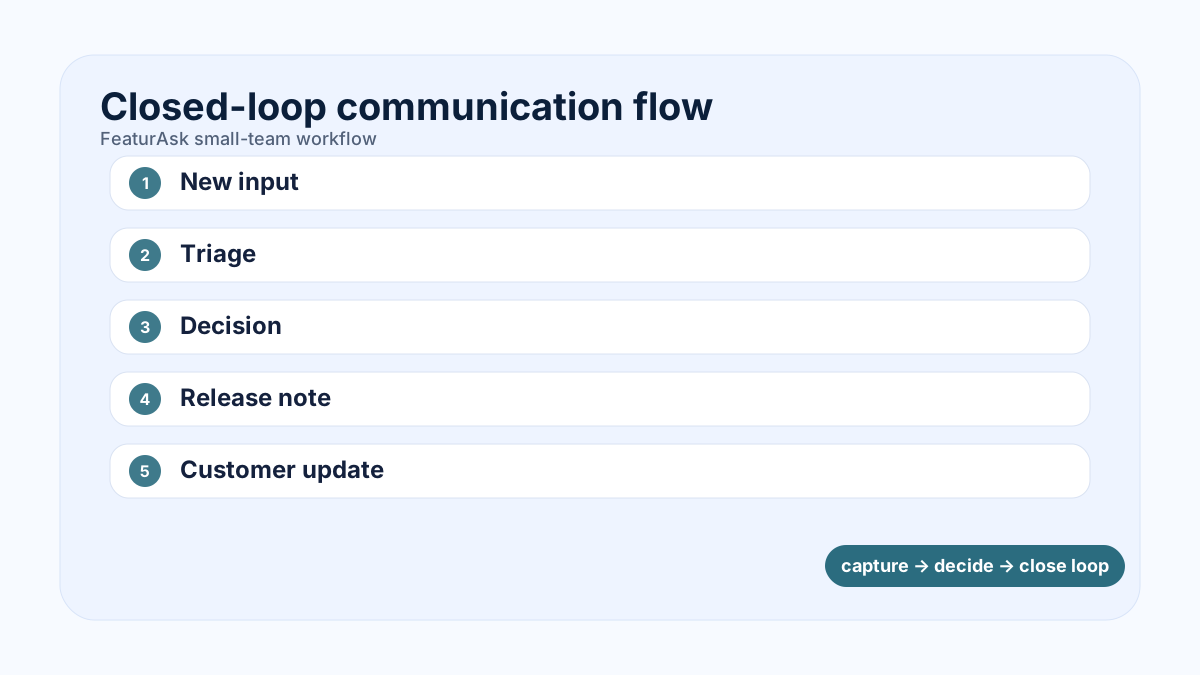
A SaaS feedback system earns trust when customers see outcomes. Use statuses to show what is under review, planned, in progress, shipped, or not planned. Add short explanations when a popular request is not aligned with strategy. Customers can handle a no better than silence.
When something ships, connect the update to the original request. Publish a changelog entry, notify voters, and explain the benefit in customer language. This turns feedback management into retention work because customers see that the product evolves with them.
Internal communication matters too. Sales needs to know when deal blockers change. Support needs to know what to suggest. Customer success needs to know which accounts asked for the improvement.
Govern the workflow so it survives growth
The best SaaS teams make feedback management boring in the best way: clear channels, predictable review, visible prioritization, and consistent updates. The system does not need to be heavy. It needs to be trusted.
Start with one central place, a weekly triage habit, a simple status model, and a monthly changelog. As your product grows, add segmentation, integrations, and scoring depth. The foundation remains the same: capture what customers mean, decide deliberately, and close the loop.
Implementation checklist for SaaS feedback management
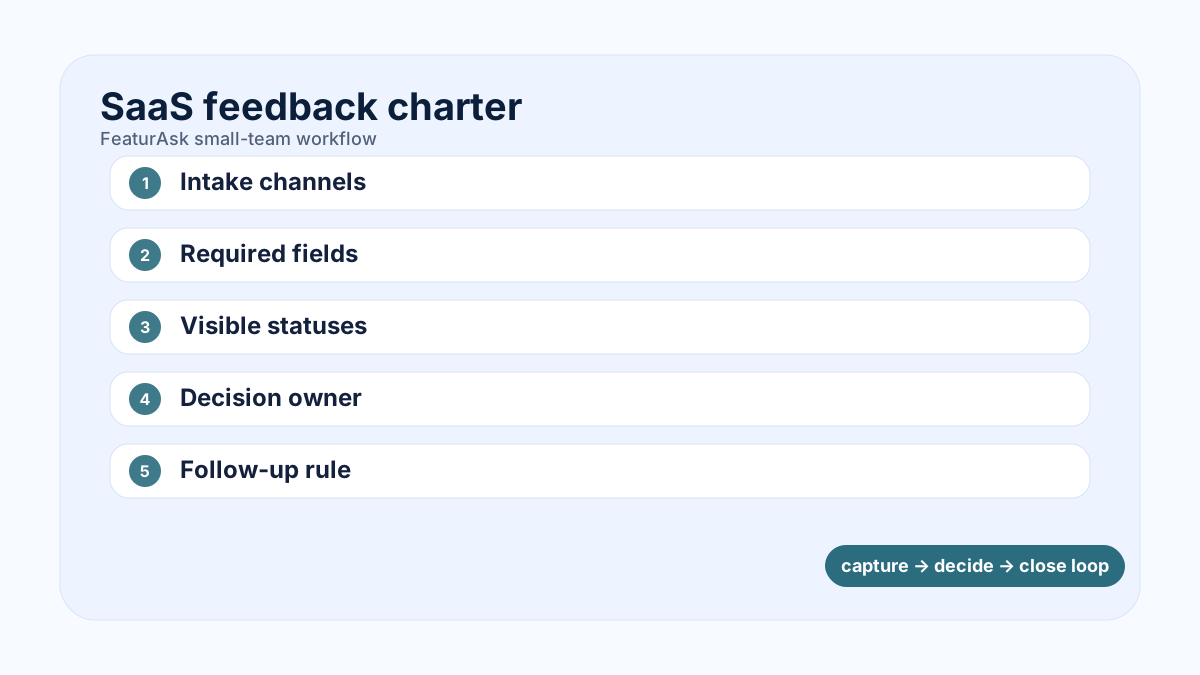
Begin with a feedback charter. It should define which channels feed the system, who triages new items, how duplicates are merged, which tags are required, how prioritization happens, and how decisions are communicated. The charter can be one page. Its value is not bureaucracy; its value is preventing every team from inventing a different process.
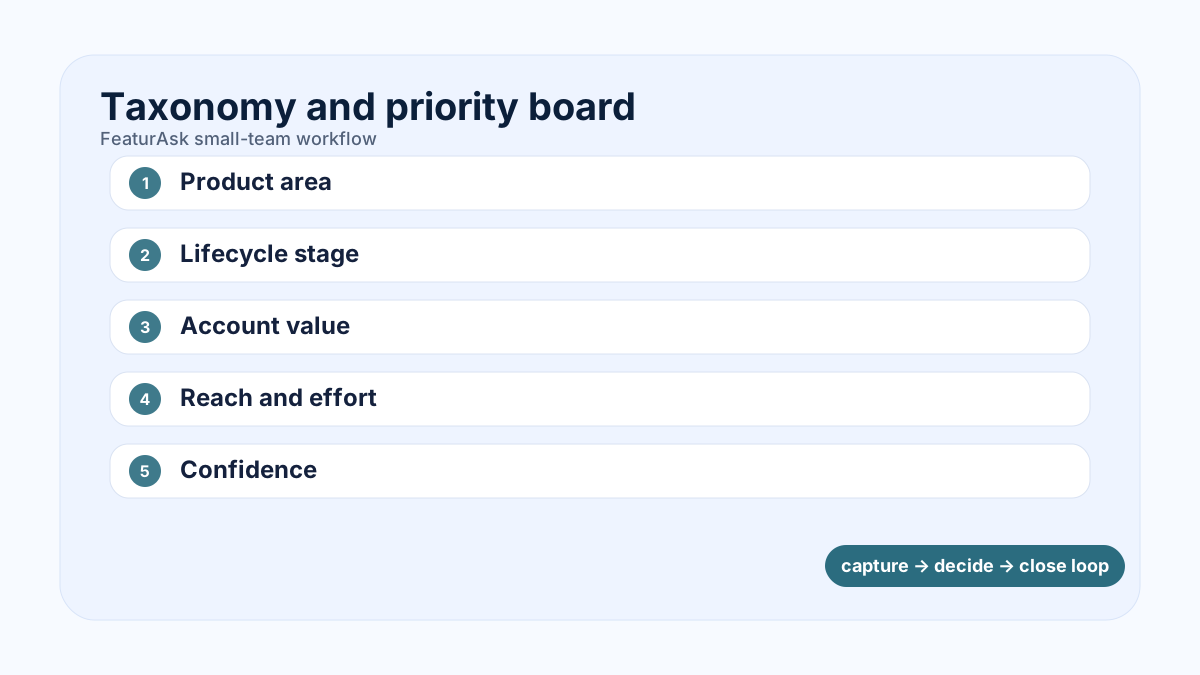
Create a taxonomy that supports decisions. Product area is useful, but not enough. Add customer segment, plan, lifecycle stage, severity, revenue relevance, and confidence. A feature idea from an evaluating enterprise account is different from the same idea submitted by a free user experimenting with the product. Context does not mean one customer always wins. It means the team can make tradeoffs consciously.
Separate problems from proposed solutions. Customers may ask for a button, report, integration, or setting. The product team should record the request, then identify the underlying job. Several different feature ideas may point to one deeper issue. Solving the deeper issue can produce a simpler roadmap than building every requested option.
Use a review cadence that matches volume. Early SaaS teams can review feedback weekly and synthesize themes monthly. Larger teams may need daily triage and quarterly strategic reviews. Whatever cadence you choose, make it visible. Teams trust the system when they know when feedback will be reviewed.
Measure outcomes after acting. If a request ships, watch adoption, support volume, customer comments, retention, expansion, and related usage behavior. Feedback management does not end at release. The team should learn whether the decision solved the problem and whether communication reached the affected users.
Common SaaS feedback management mistakes
The most common mistake is confusing a backlog with a strategy. A long list of requests can make a team feel informed while hiding the fact that no tradeoffs have been made. Another mistake is treating enterprise feedback as automatically correct. High-value accounts deserve attention, but the roadmap still needs product coherence and market focus.
Do not let old requests remain in limbo. Stale items reduce trust inside and outside the company. Close, merge, or update them. Do not overcomplicate scoring either. If a scoring model requires a meeting to understand, teams will stop using it. Finally, do not communicate only when the answer is yes. A thoughtful no with context can preserve trust and clarify strategy.
A SaaS feedback management 90-day governance plan
Days 1 to 30 should define the intake charter. Decide which channels feed the system, who owns triage, which fields are required, and which statuses customers can see. Each input should include customer segment, account context, product area, source, exact wording, and the decision it might inform. Route bugs, support tasks, and feature requests differently so the repository stays clean.
Days 31 to 60 should build the taxonomy and prioritization habit. Use product areas customers recognize, tags for lifecycle stage and plan type, and a light scoring model for reach, value, effort, and confidence. Review new items weekly, merge duplicates, and attach evidence from interviews, support tickets, analytics, and revenue context.
Days 61 to 90 should close the communication loop. Update request statuses, publish shipped improvements, notify relevant customers, and summarize top themes for leadership. Make declined decisions visible internally so the same debate does not restart next quarter.
The governance retrospective should ask which fields changed decisions, which tags were confusing, which stakeholders ignored the process, and which customers received no follow-up. Keep the smallest workflow that supports prioritization, communication, and learning.
Field design and governance examples
A SaaS feedback record should be detailed enough to support a decision months later, but not so heavy that teammates avoid logging it. Use required fields for customer segment, account type, lifecycle stage, product area, original wording, source channel, date, and desired outcome. Add optional fields for revenue context, severity, workaround, competitor mention, and related analytics. Keep the customer's phrasing intact in one field and the team's interpretation in another so assumptions are visible.
Governance starts with routing rules. Bugs go to the defect workflow with a link back to the customer. Support questions become documentation or onboarding improvements unless multiple customers reveal a product gap. Feature requests enter the feedback repository only when the problem is clear enough to compare. Strategic account requests should be labeled, not hidden in private spreadsheets, because leadership needs to see when one account is influencing roadmap discussion.
A taxonomy should help people find patterns. Product area tags such as Reporting, Billing, Integrations, Permissions, Mobile, and Notifications are easier to review than team names. Lifecycle tags such as Trial, Onboarding, Active Use, Renewal, Expansion, and Churn Risk explain when the pain appears. Decision tags such as Discover, Consider, Planned, Shipped, Declined, and Needs Evidence show what happens next. If a tag does not change triage, prioritization, or communication, remove it.
Measure the system with operational metrics rather than vanity counts. Track time to first triage, duplicate rate, percentage of requests with segment context, percentage of shipped items with customer notification, and number of stale open items. Review a sample of declined requests each month to make sure the team is explaining tradeoffs respectfully. A healthy system makes roadmap debates clearer and customer follow-up easier; it does not simply accumulate more inputs.
A simple governance meeting can replace dozens of ad hoc roadmap arguments. Review new high-signal items, stale public requests, requests tied to renewal risk, and recently shipped items that need follow-up. The meeting should end with status changes, discovery questions, or explicit declines. If it ends only with discussion, the system will feel performative.
Customer communication should be part of governance, not an afterthought. Draft standard explanations for Under review, Planned, Shipped, and Not planned so teammates can update customers consistently. A respectful decline often builds more trust than silence because it shows the team considered the request and understands the tradeoff. For SaaS companies with long customer relationships, that trust matters as much as the individual feature decision.
Also keep an audit trail for decisions that affect pricing, permissions, or enterprise commitments. Those records help future teammates understand why a request was accepted, delayed, or declined without reopening the same conversation. Review the trail before quarterly planning so stale promises, strategic bets, repeated objections, and ownership gaps are visible together across teams before commitments renew.
When you are ready to replace scattered notes with a simple customer feedback system, FeaturAsk is built for that job. You get one month free with no credit card required, and the paid plan is a predictable $29.95/year.